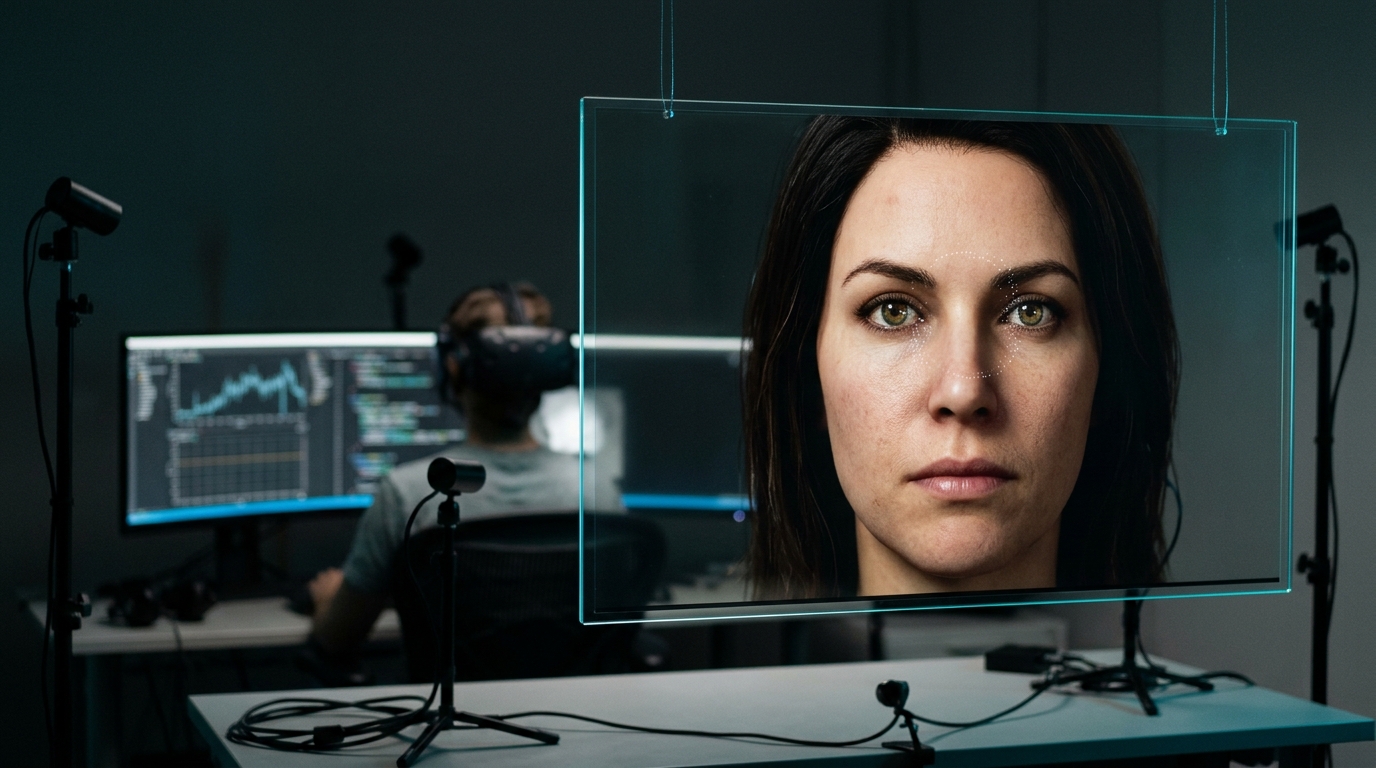
Eye gaze is one of the most powerful channels of nonverbal communication, but in virtual reality it is surprisingly easy to misread. A new study from Keio University, published in Frontiers in Virtual Reality, shows that changing only the way an avatar’s eyes are rendered can dramatically alter how well people decode where a virtual agent is looking, how natural the agent appears, and which design users ultimately prefer. The findings reveal a clear trade-off: making gaze targets explicit within the eye region improves communication but can push a photorealistic avatar toward the uncanny valley.
The research team, led by Daichi Godo with Hiroo Yamamura, Alexander Plopski, Jean-Marie Normand and Maki Sugimoto, conducted a within-subject virtual reality study with 24 participants using a Varjo XR-3 head-mounted display. Each participant experienced three versions of a photorealistic embodied virtual agent, identical in every respect except for the rendering of the eyes. The Pupil condition retained a standard anatomical eye with iris and pupil and displayed no gaze-target information. The Blend condition preserved the pupil and iris as an anatomical scaffold while projecting the current gaze target onto the eye region in a reflection-like manner. The Projection condition removed the iris and pupil textures entirely and displayed only the projected gaze target on the eye surface.
The study addressed three research questions. The first concerned gaze explicitness, asking whether richer information in the eye region makes an avatar’s fixation target easier to estimate. The second concerned impressions of the agent, including naturalness and perceived similarity to human eyes, which the authors treated as adjacent indicators of uncanny-valley-related responses. The third concerned social presence during interaction, decomposed into co-presence, psychological involvement and behavioural interaction. Because a single metric cannot capture these processes, the researchers triangulated across behavioural measures, item-level questionnaires and retrospective comparative choices.
In the first task, participants identified which object the virtual agent was gazing at. Five everyday objects with distinct silhouettes and textures, an apple, a lemon, a cup, a clock and a camera, were placed in five different spatial layouts, with direct gaze at the participant, called Face, always a possible target. Across five layouts, all layout-target combinations occurred exactly once per eye condition, giving 25 trials per condition and 75 trials in total. Each trial began with the agent fixating the participant before shifting gaze toward a target over a 0.8-second animation. Participants pressed a key when confident of their judgement, and decision time was measured from the end of the gaze shift. Accuracy was recorded from verbal reports.
The results on accuracy were striking. Projection yielded significantly higher accuracy than both Pupil and Blend, and this advantage persisted even after the researchers controlled for a learning effect across the session. When the same five layouts were reused across the three conditions, participants became faster over successive conditions, a spatial-familiarity effect that was clearly confirmed for decision time. Yet the accuracy benefit of gaze-explicit rendering held in a statistical model that already included ordinal position, indicating that the behavioural effect was not attributable to familiarity alone. Decision time itself showed no significant overall difference between eye conditions, although local effects appeared: responses to the clock were slower under Blend and Projection, and Projection was slower in the isolated position, where gaze direction alone was presumably sufficient.
Subjective ratings reinforced the objective pattern. All seven Task 1 questionnaire items showed significant differences across conditions. Relative to Pupil, both Blend and Projection were rated higher for perceived decoding speed, perceived accuracy, interpretability and confidence. Projection additionally exceeded Blend on perceived accuracy and interpretability. The impression items moved in the opposite direction: naturalness decreased monotonically from Pupil through Blend to Projection, with all pairwise differences significant, and perceived closeness to real human eyes was markedly lower for Projection. Ratings of lack of human-likeness increased with explicitness. In the post-experiment comparative questionnaire, 22 of 24 participants selected Projection as the condition in which it was easiest to understand what the agent was looking at, but 23 of 24 also chose it as the most uncanny, while 16 of 24 selected Pupil as the most natural.
The second task examined joint attention. The agent contingently followed the participant’s gaze: when a participant’s gaze remained on a designated object for 1.5 seconds, the agent shifted its gaze toward the same object, and when the participant looked back at the agent’s eye region, the agent held direct gaze for three seconds. Twelve questionnaire items assessed responsiveness, attentional alignment, shared attention, perceived understanding, contingency and related social-presence constructs. None of the nine social-presence items showed a significant effect of eye condition. The three impression items, however, replicated the Task 1 pattern, with Projection rated significantly less natural and less human-like than the other designs. The authors suggest that because gaze behaviour was held constant and contingent gaze following was already in place, what mattered for social presence was whether gaze was conveyed at all, rather than how the eye region was rendered.
Overall preference told a nuanced story. Blend was the most frequently preferred condition, chosen by 16 of 24 participants, suggesting that users often favour a compromise between readability and perceptual comfort. Free-response explanations included comments such as realistic with pupils in addition to reflections, less discomfort while still being able to somewhat tell what the agent was looking at, and intuitively the least unnatural. Participants also noted that objects appearing too sharply defined felt unnatural, while no reflection at all felt inhuman. The authors caution that in both Blend and Projection the target object was scaled to fill the pupil region rather than reproduced at the size a physically accurate corneal reflection would have, a departure from physical plausibility that they treat as a continuous cost parameter trading legibility against perceptual plausibility.
The study has limitations the authors themselves enumerate. The sample of 24 participants was drawn predominantly from young-adult science and engineering students at a single institution, and 19 of the 24 had prior experience with head-mounted VR. The findings were obtained on a single high-resolution device, the Varjo XR-3, whose display is particularly well suited to resolving fine detail in the eye region, so legibility on lower-fidelity consumer headsets remains unverified. The manipulation was restricted to gaze-related visual cues without speech or facial expression, and the augmented eye display appeared only when the agent fixated a task-relevant object. The questionnaire items were authored in Japanese and translated into English without back-translation validation, and the interpretation of task-dependent impression differences in terms of the chameleon effect remains speculative because no direct measure of imitation or gaze synchronisation was collected.
Despite these constraints, the study offers practical guidance for designing social VR agents. A single eye expression is not universally optimal; the appearance of the eyes should be treated as a design parameter adjusted to application goals. Stronger visual augmentation may suit situations requiring rapid and unambiguous gaze interpretation, while designs preserving perceptual plausibility may be better for everyday or prolonged interaction. The Blend design exemplifies a balanced strategy that enhances interpretability compared with no explicit representation while mitigating the uncanny-valley-related ratings observed with fully explicit projection. The authors also propose a promising future direction: gaze-contingent rendering, in which the HMD’s integrated eye tracker triggers the augmentation only when the participant actually fixates the agent’s eyes, preserving communicative utility at the moment it is needed while minimising exposure to unnatural appearance during the rest of the interaction. The work demonstrates that rendering the eye region plays a crucial role in social VR, changing how users interpret attention and how comfortable they feel, without altering eye movement dynamics or any other facial feature.
Subject of Research: How avatar eye rendering affects gaze decoding, uncanny-valley impressions and social presence in virtual reality
Article Title: Avatar eyes in social VR: balancing gaze communication and uncanny-valley effects
Article References: Godo, D., Yamamura, H., Plopski, A., Normand, J.-M., & Sugimoto, M. (2026). Avatar eyes in social VR: balancing gaze communication and uncanny-valley effects. Frontiers in Virtual Reality, 7, Article 1804637. https://doi.org/10.3389/frvir.2026.1804637
Image Credits: AI Generated
DOI: 10.3389/frvir.2026.1804637
Keywords: virtual reality, embodied virtual agent, eye gaze, gaze decoding, uncanny valley, social presence, avatar design, joint attention, corneal reflection, nonverbal communication, Avatar, eyes
News Source: Denise Maddox. (November 6, 2026). Virtual avatar eyes that reveal gaze targets improve decoding but risk uncanny discomfort in VR. Scienmag.