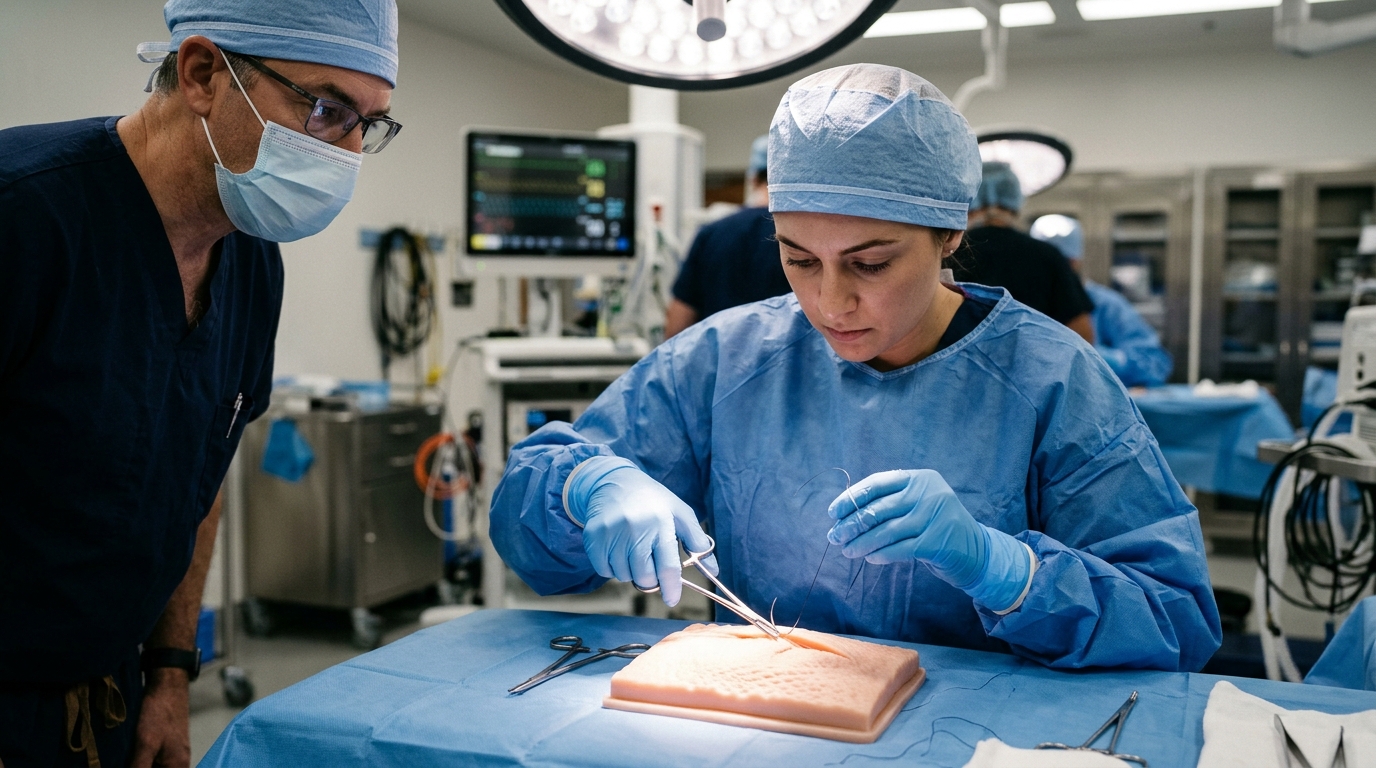
Medical students who finished a longitudinal integrated clerkship in surgery reported the greatest comfort with the most basic operating room skills and the least comfort with the more demanding ones, according to a cross-sectional survey conducted at a single institution. Gowning and gloving topped the list, with 98.3 percent of respondents reporting comfort, followed by forceps handling and instrument tying at 83.3 percent each, needle driver handling at 80.0 percent, and simple interrupted suturing at 75.0 percent. Comfort dropped for two-handed tying at 62.5 percent, one-handed tying at 50.8 percent, and mattress suturing at 37.5 percent. The study, published in Global Surgical Education, examined factors associated with these self-reported comfort levels among students completing the 2024–2025 second-year surgical LIC.
The survey was carried out in August 2025 among 123 medical students who had completed the second-year surgical longitudinal integrated clerkship and were entering their third year. Of the 123 eligible students, 120 responded, a response rate of 98 percent. Within that group, 118 completed the post-clerkship career interest items and 119 completed the surgical skill comfort and disease exposure items. The instrument assessed three things: career interest after the clerkship, self-reported comfort in eight foundational surgical skills, and the settings in which students had encountered ten selected core surgical disease topics.
Two measures anchored the analysis. Clinical exposure breadth was calculated as the number of selected disease topics each student had encountered through direct clinical exposure, giving a count of how widely a student had engaged with surgical conditions during the clerkship. Fisher’s exact tests examined associations between post-LIC career interest and comfort in each skill, and separate unadjusted logistic regression models examined the association between clinical exposure breadth and comfort for each of the eight skills individually.
The career interest findings clustered among the more technically demanding skills. Students who reported post-clerkship surgical career interest were more likely to report comfort in needle driver handling, with a p value of 0.024, two-handed tying at p = 0.011, one-handed tying at p < 0.001, simple interrupted suturing at p = 0.004, and mattress suturing at p = 0.020. The skills showing these associations were largely the ones with the lowest overall comfort levels.
Clinical exposure breadth told a parallel story. Greater breadth of direct clinical exposure to the selected surgical disease topics was associated with higher odds of comfort in six of the eight assessed skills. Because the logistic regression models were unadjusted and examined each skill separately, the results describe associations rather than causal effects. Still, the pattern held across most of the skill set, indicating that students who had encountered a wider range of surgical disease topics in clinical settings tended to report greater comfort with foundational technical skills.
The authors note that the relationship between the breadth of that exposure, career interest, and self-reported surgical skill comfort had not been well described before this study. Surgical skill comfort matters as a learner-centered outcome because students are entering operative and procedural environments.
The eight skills surveyed span a practical range of operating room competence. At the foundation sit gowning and gloving, forceps handling, and needle driver handling, which most respondents reported feeling comfortable with. Instrument tying and simple interrupted suturing occupy a middle tier, each reported as comfortable by roughly three quarters or more of the cohort. Two-handed and one-handed tying, along with mattress suturing, fell well below that level.
The authors are careful about what the data can and cannot show. Because the survey was cross-sectional and self-reported, comfort is a subjective measure, and the associations with career interest and exposure breadth do not establish that either factor causes greater skill comfort.
What the study does establish is that both learner orientation and the breadth of direct clinical exposure are associated with how comfortable students feel with foundational surgical skills after an LIC. The authors conclude that surgical skill comfort after this type of clerkship may reflect both career orientation and the breadth of direct clinical exposure during the clerkship itself. They call for future work to pair self-reported comfort and exposure tracking with objective technical performance assessments, which would replace subjective comfort ratings with measured skill and allow a clearer test of whether wider clinical exposure builds technical competence or simply coincides with it.
Subject of Research: Factors associated with self-reported surgical skill comfort among medical students completing a surgical longitudinal integrated clerkship
Article Title: Factors associated with self-reported surgical skill comfort in a longitudinal integrated clerkship
Article References: Hegeholz, D., Sun, T., Moore, G., Weaver, M. L., Brownson, K. E., Selim, M., Glasgow, K., & Jaiswal, K. (2026). Factors associated with self-reported surgical skill comfort in a longitudinal integrated clerkship. Global Surgical Education – Journal of the Association for Surgical Education, 5(1), Article 210. https://doi.org/10.1007/s44186-026-00618-z
Image Credits: AI Generated
DOI: 10.1007/s44186-026-00618-z
Keywords: longitudinal integrated clerkship, surgical education, skill comfort, medical students, clinical exposure, career interest, suturing, logistic regression, cross-sectional survey, undergraduate surgical education, Factors, associated
News Source: Courtney Benton. (November 6, 2026). Career Interest and Clinical Exposure Shape Surgical Skill Comfort After Integrated Clerkship. Scienmag.