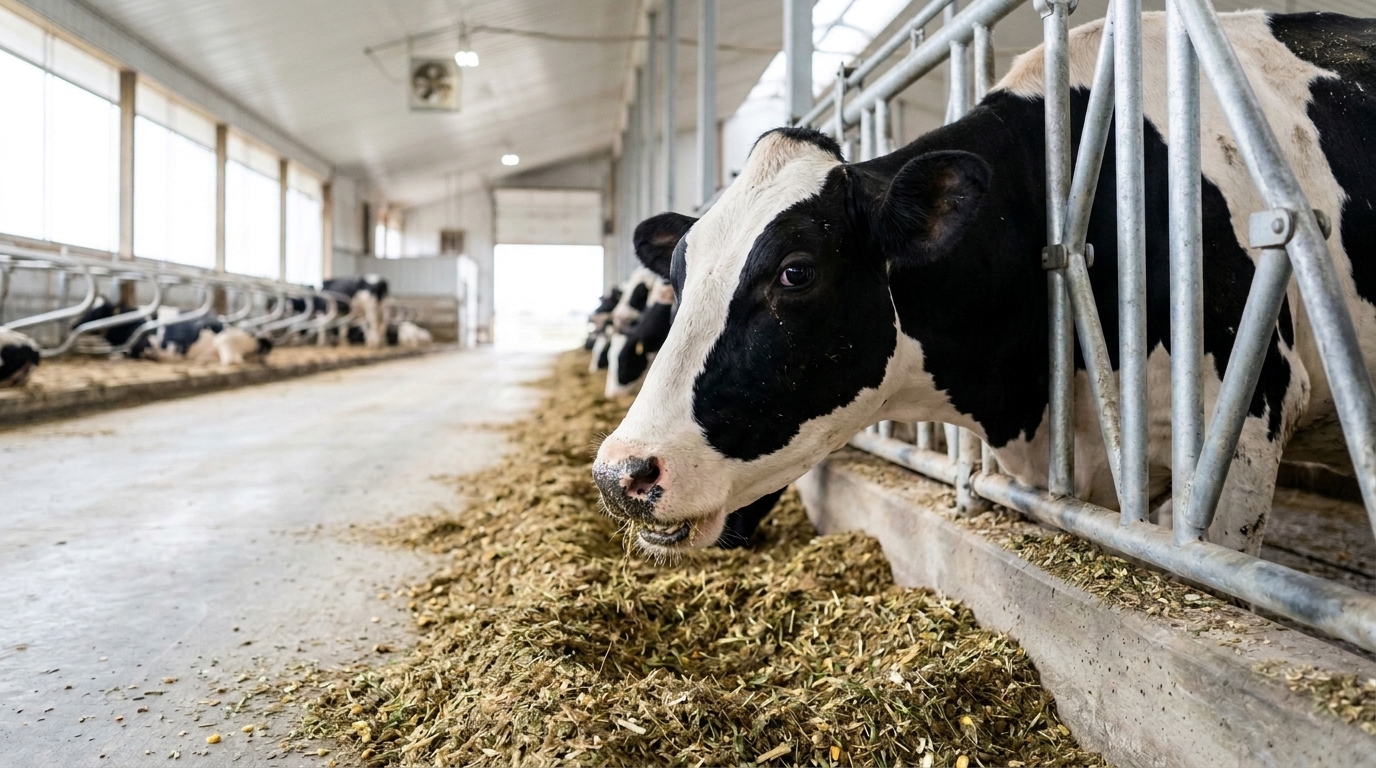
Lactating dairy cows rearrange their diets with surprising precision, and a new study shows that the balance between two common forages can tip that behavior in measurable ways. When researchers shifted the ratio of alfalfa hay to corn silage from 70:30 to 30:70 in high-concentrate rations, cows began sorting against the longest feed particles and in favor of finer ones. The fat source added to the diet, by contrast, left feeding and rumination patterns largely untouched. The findings, published in Dairy Science and Management, offer a detailed look at how ration composition shapes the daily eating habits of multiparous Holstein cows.
The experiment was designed to fill a specific gap. Previous work by the same team had already documented how alfalfa hay-to-corn silage ratios combined with fat supplementation affected feed intake, rumen fermentation, milk production, and milk fat secretion. What remained unexamined was the behavioral layer: how these same dietary factors influence feed sorting, meal patterns, and chewing activity. To address this, the researchers combined two forage ratios with two fat sources in a 4 × 4 Latin square design involving eight lactating multiparous Holstein cows. Each cow experienced all four dietary treatments across successive periods, with 14 days of adaptation followed by 7 days of data collection in each period.
The four experimental diets all maintained a forage-to-concentrate ratio of 40:60, meaning these were high-concentrate rations typical of modern commercial dairy feeding. The forage component consisted of corn silage with a mean particle size of 13.5 mm and chopped alfalfa hay with a mean particle size of 5.5 mm. Fat was supplied either as calcium salts of fatty acids at 3.5% of dry matter or as C16:0-enriched palm fat at 3.0% of dry matter. Both fat types are designed to remain inert within the rumen, minimizing disruption to rumen function and feed intake, but they differ in fatty acid profile and physical form.
Feed sorting was assessed by comparing the particle size distribution of the total mixed ration offered against that of the refusals collected during the 7-day collection phase. Researchers used the Penn State Particle Separator fitted with 19-, 8-, and 1.18-mm sieves to determine how much of each fraction the cows actually consumed versus what they would have eaten if they had consumed the ration indiscriminately. A sorting index was calculated for each fraction, where values below 100 indicated sorting against that particle size and values above 100 indicated preferential consumption. One-sample t-tests determined whether the index differed significantly from 100, the value representing no sorting.
The results revealed a clear behavioral shift tied to forage composition. Cows fed the 70:30 alfalfa hay-to-corn silage diet sorted more in favor of long particles retained on the 19-mm sieve and against fine particles on the 1.18-mm sieve and in the pan, compared to those on the 30:70 diet. Conversely, cows receiving the 30:70 diet consumed a higher proportion of particles retained on the 8-mm sieve. The abstract summarized this as increased sorting against long particles exceeding 19 mm but in favor of fine-length particles when the ratio shifted from 70:30 to 30:70. The researchers suggested that the lower NDF content and higher non-fiber carbohydrate content of the 70:30 diet may explain the enhanced effective fiber consumption observed with higher alfalfa inclusion.
Meal patterns also responded to the forage shift. Feeding the 70:30 ratio increased both meal length and meal size compared to the 30:70 ratio. The researchers connected this to greater dry matter intake previously reported in the companion study, proposing that larger meals and longer eating bouts, combined with reduced intake of 8-mm particles and greater selective consumption of 1.18-mm particles, may result in less filling in the rumen. However, the shift to 30:70 did not affect rumination patterns, indicating that the behavioral response was concentrated in eating rather than in post-meal chewing activity.
Chewing behavior, expressed relative to nutrient intake, showed nuanced responses. Eating time per kilogram of physically effective neutral detergent fiber greater than 8 mm was longer in cows fed the 70:30 diet than in those fed the 30:70 diet. Ruminating time per kilogram of dry matter intake or NDF intake was lower in cows fed the 70:30 ratio, but higher when expressed per kilogram of peNDF greater than 8 mm. Total chewing time per kilogram of dry matter intake followed the same pattern: lower with 70:30 but higher when expressed per kilogram of peNDF greater than 8 mm. The researchers attributed the absence of differences in daily chewing time across forage ratios to the comparable proportion of particles retained on the 19-mm sieve in both diets, noting that these long particles are known to effectively stimulate chewing.
The fat source told a different story. Calcium salts of fatty acids and palm fat had no effect on feeding or rumination patterns, and no significant interactions between forage ratio and fat source emerged for sorting index values or particle intake. However, cows fed palm fat spent more time ruminating than those fed calcium salts, with the palm fat diet increasing rumination time by up to 47.5 minutes per day. Total chewing time was greater when expressed as minutes per day or per kilogram of peNDF greater than 8 mm, and tended to be greater per kilogram of dry matter intake, in cows fed palm fat. Resting time was correspondingly greater in cows consuming calcium salts, at 666 versus 615 minutes per day. Cows fed calcium salts also tended to sort more against particles retained on the 1.18-mm sieve and consumed less of the fine fraction in the pan compared to those fed palm fat, which the researchers suggested may reflect reduced palatability or altered feed texture from the calcium salts.
The researchers were careful to note limitations. Chewing activities were assessed during a single 24-hour observation period on day 3 of each collection period, with activities recorded at 5-minute intervals. This limited duration may not have fully captured day-to-day variation in chewing behavior. They recommended that future studies use longer observation periods or automated tracking systems to provide more accurate and representative estimates of eating and ruminating patterns. They also acknowledged that while increased sorting against longer particles in low-alfalfa diets may reduce intake of physically effective fiber, differences in total dry matter intake, non-fiber carbohydrate, and starch content across diets would likely have a greater influence on ruminal propionate concentration than physically effective fiber intake alone. Notably, ruminal pH was not different between the 70:30 and 30:70 diets in the companion study, suggesting that fermentation stability was maintained despite the behavioral differences.
The broader significance lies in what these results reveal about ration design. Forage composition, rather than fat supplementation, emerged as the primary driver of feed sorting and chewing behavior in these high-concentrate diets. The interaction effects between forage ratio and fat source on feeding behavior patterns were not evident in this experiment, simplifying the interpretation for nutritionists formulating rations. The findings underscore that the physical characteristics of forage, including particle size distribution and fiber content, play a central role in shaping how cows consume their feed, with implications for rumen health, salivation, and nutrient digestion in commercial dairy systems where corn silage and alfalfa hay serve as the primary fiber sources.
Subject of Research: Effects of alfalfa hay-to-corn silage ratio and fat source on feed sorting and chewing behavior in lactating dairy cows
Article Title: Effects of varying alfalfa hay-to-corn silage ratio and fat source on feed sorting behavior and chewing activities of lactating dairy cows
Article References: Sadeghi, M., Ghorbani, G. R., Ghasemi, E., Kargar, S., Ghaffari, M. H., & Ahmadi, F. (2025). Effects of varying alfalfa hay-to-corn silage ratio and fat source on feed sorting behavior and chewing activities of lactating dairy cows. Dairy Science and Management, 2(1), Article 3. https://doi.org/10.1186/s44363-025-00004-y
Image Credits: AI Generated
DOI: 10.1186/s44363-025-00004-y
Keywords: dairy cows, feed sorting, alfalfa hay, corn silage, chewing behavior, rumination, fat supplements, calcium salts of fatty acids, palm fat, high-concentrate diets, particle size, Holstein
News Source: Alan Morgan. (November 6, 2026). Forage Ratio, Not Fat Source, Drives Feed Sorting and Chewing in Lactating Holstein Cows. Scienmag.