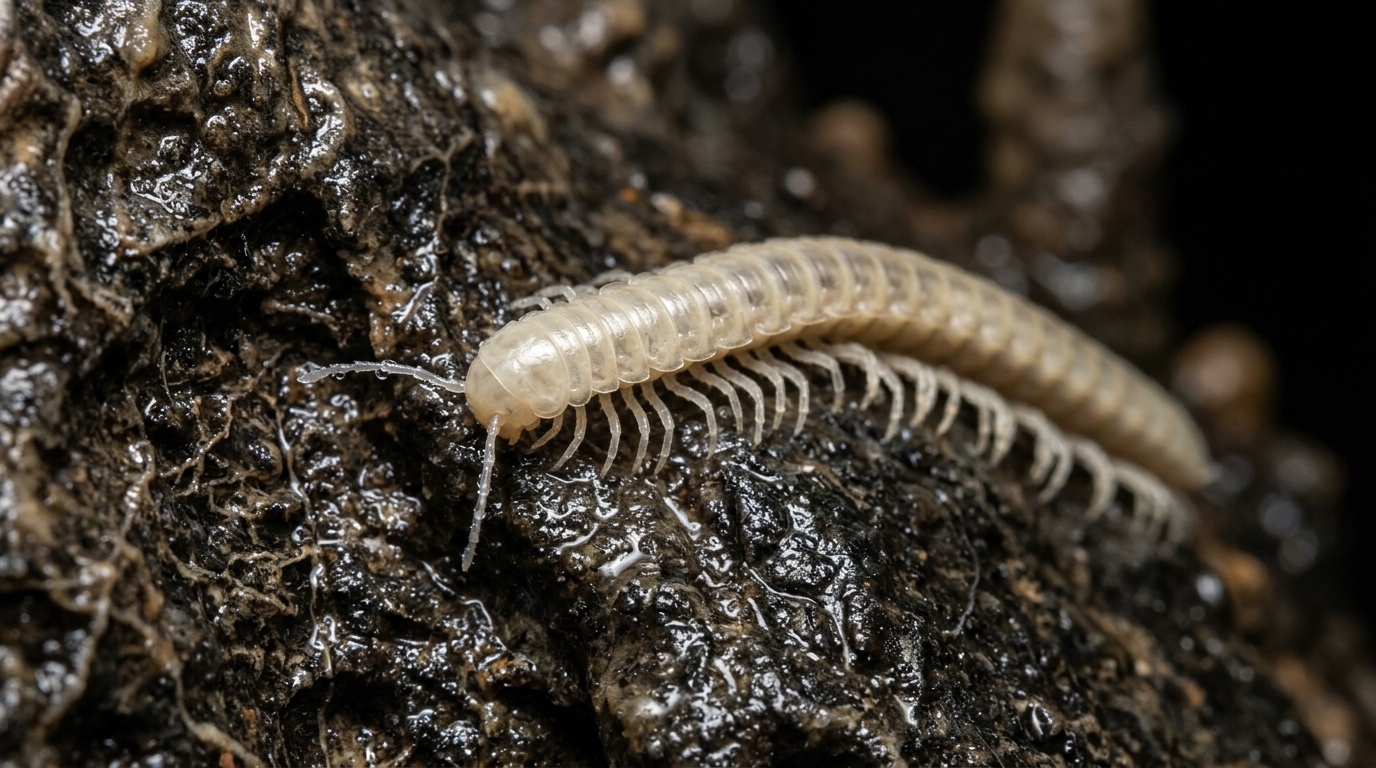
The researchers used two mitochondrial markers, 16S rDNA and COI, and one nuclear marker, 28S rDNA, to reconstruct the population genetics and phylogeny of the species. Their results showed that populations from the Slovak and Aggtelek Karst were genetically separated from those in the Bükk Mountains with significant statistical support in both a concatenated phylogenetic tree and a COI-based tree, despite the absence of any observed morphological differences between the two groups.
For the COI marker, the genetic distance between individuals from the two regions reached 12.068 percent using p-distance and 13.426 percent using the K2p model, while no genetic variability at all was detected within populations in the Bükk Mountains and only 0.032 percent within populations of the Slovak and Aggtelek Karst. In other words, the difference between regions was more than tenfold greater than the variation within them. Drawing on published thresholds for species differentiation in millipedes, including a range of 11 to 15 percent p-distance derived from COI sequences of the spirobolid millipede Anadenobolus excisus, and noting that the shape of the male gonopods, the standard diagnostic structures in julid taxonomy, does not differ between the regions, the authors conclude that the two regional populations likely represent two cryptic lineages, or molecular taxonomic units, within a single species complex.
The two karst areas are separated by a roughly 30-kilometer-wide plain along the Slaná, or Sajó, River, a barrier the authors say has prevented gene flow between the regions. Their geological histories also differ: according to recent plate-tectonic research on the Pannonian region, the Aggtelek Karst and Slovak Karst developed independently from the Bükk Mountains and only moved close to one another secondarily during the Early Miocene, with the former Pannonian Sea and sediment-laden rivers later separating the terrestrial environments of the two regions. The phylogenetic tree reflects this isolation, showing a clear separation of the regional populations and an absence of shared haplotypes, which the researchers treat as additional evidence for the cryptic lineage hypothesis.
Based on its external morphology, Typhloiulus polypodus had been assigned to the genus Typhloiulus, the largest and most widespread genus of blind julid millipedes, currently comprising 27 species and three subspecies concentrated around the Mediterranean and Black Seas. But the phylogenetic analyses placed the Carpathian populations not among Typhloiulus species or the tribe Typhloiulini, to which the genus belongs, but closer to species from the tribes Julini and Leptoiulini, particularly the genus Xestoiulus. The concatenated tree pointed to a relationship with Xestoiulus imbecillus, while the COI analysis pointed to Xestoiulus laeticollis. This placement is consistent with earlier molecular work suggesting that both the tribe Typhloiulini and the genus Typhloiulus are poly- or paraphyletic as currently defined. The authors suggest that Typhloiulus polypodus could even represent a separate genus and a candidate for assignment to Xestoiulus, which would make it the sole blind representative of that genus, though a formal redescription and taxonomic revision lies beyond the scope of the present study.
Imre Loksa described the species as Allotyphloiulus polypodus in 1960 from a male and a female collected with pitfall traps in Anna Cave, also known as Anna-barlang, in the Bükk Mountains between 1958 and 1959. Because Allotyphloiulus is actually a subgenus of Cylindroiulus, a group with completely different gonopods, the species was later transferred to the genus Typhloiulus, though its generic placement has remained undecided. For roughly four decades no new specimens turned up, and the type material is considered lost. Sporadic records eventually emerged from the Gombasecká and Domica caves in the Slovak Karst and later from the Baradla Cave in the Aggtelek Karst, but without adult males or material from the type locality, the identifications remained incomplete. The new material was gathered during long-term cooperation with the administrations of Bükk National Park, Aggtelek National Park, Slovak Karst National Park, and the Slovak Caves Administration, using hand collecting, baiting with sterilized crushed hardwood, and bait extraction in Berlese-Tullgren funnels. Notably, pitfall traps, which captured so many other invertebrates, yielded none of these millipedes; specimens turned up only individually, often at bait heaps.
The species remains extraordinarily scarce. Despite more than two decades of continuous monitoring at Domica and Gombasecká caves, the researchers encountered the blind julids only as isolated individuals. The caves it inhabits share a signature: they are extensive underground systems formed in Mesozoic limestone, mostly horizontal fragments of fluviokarst origin with permanent or temporary underground streams, moist, occasionally flooded, and relatively warm at 8.5 to 12.0 degrees Celsius, with main entrances between 290 and 535 meters above sea level. Specimens were typically found in the dark zone with a stable microclimate but relatively close to the surface, often in static zones where sinking watercourses transport organic substrates such as wood, leaves, soil, and animals. The Anna Cave type locality stands apart: it formed in travertine as a Pleistocene complex of originally isolated chambers, though it remains hydrogeologically connected to the surrounding karst caves.
Most collection sites lie in caves open to the public, with concrete-lined paths that are regularly cleaned, extensive electrical installations for artificial lighting that cause light and heat pollution and promote lamp flora, and aggressive chlorine-based sprays used to remove the vegetation. Thousands of visitors pass through each year, and the authors note that protection of the subterranean ecosystem is secondary to visitor safety and comfort. At Anna Cave, the type locality, major interventions, including artificial drainage, floor modification, disinfection during the COVID-19 pandemic, chemical removal of lamp flora, and heavy visitor traffic that introduced non-native microorganisms and altered the microclimate, most likely led to the extinction of the local population, based on a comparison of recent data with Loksa’s records. A local population also disappeared from part of Domica Cave after ill-considered concreting of the floor in areas designated for speleotherapy. The researchers argue that these distinct genetic lineages should be recognized as conservation units, and that at least two such units of blind julid millipedes occur in the Western Carpathians.
The distribution of this millipede is remarkable in its own right: it is the northernmost known among cave-dwelling julids in Europe, an endemic confined to the Bükk Mountains and the Slovak and Aggtelek Karst. Košel’s earlier hypothesis that the Bükk Mountains served as a south-north land bridge during the Tertiary, connecting the Dinaric Mountains with the Western Carpathians, fits with the southern, Mediterranean origin of much of the region’s subterranean fauna. The study’s genetic findings add a new dimension to this biogeographic picture, showing that isolation between the two karst regions has produced deep molecular divergence without any visible change in body form. Detailed microscopic studies are now needed to find morphological characters that distinguish the two lineages and clarify whether they should be treated as separate species, and work on the external morphology and alimentary tract physiology of the material is underway as the next phase of the research.
These cave-dwelling animals are sensitive to long-term human interventions in underground ecosystems, which most likely led to the permanent degradation of Anna Cave, the type locality of Typhloiulus polypodus. The authors urge that biodiversity value be assessed not only through morphologically well-defined species but also through distinct genetic lineages, and they hope the fate of the type locality will serve as a lesson for the management of show caves elsewhere.
Subject of Research: Population genetics and phylogeny of the troglobiotic millipede Typhloiulus polypodus in Western Carpathian caves
Article Title: The northernmost blind beauty rediscovered: The identity and cryptic diversity of the troglobiotic millipede Typhloiulus polypodus (Loksa, 1960) ( Diplopoda , Julidae ) from caves of the Western Carpathians
Article References: Fedičová, M., Rendošová, A., Žurovcová, M., Mock, A., & Kováč, Ľ. (2026). The northernmost blind beauty rediscovered: The identity and cryptic diversity of the troglobiotic millipede Typhloiulus polypodus (Loksa, 1960) (Diplopoda, Julidae) from caves of the Western Carpathians. Subterranean Biology, 58, 137-158. https://doi.org/10.3897/subtbiol.58.207993
Image Credits: AI Generated
DOI: 10.3897/subtbiol.58.207993
Keywords: Typhloiulus polypodus, Diplopoda, Julidae, troglobiotic millipede, Western Carpathians, cryptic lineages, DNA barcoding, COI, Slovak Karst, Aggtelek Karst, Bükk Mountains, show cave conservation
News Source: Drew Townsend. (November 5, 2026). Blind cave millipede in the Western Carpathians reveals two cryptic lineages. Scienmag.