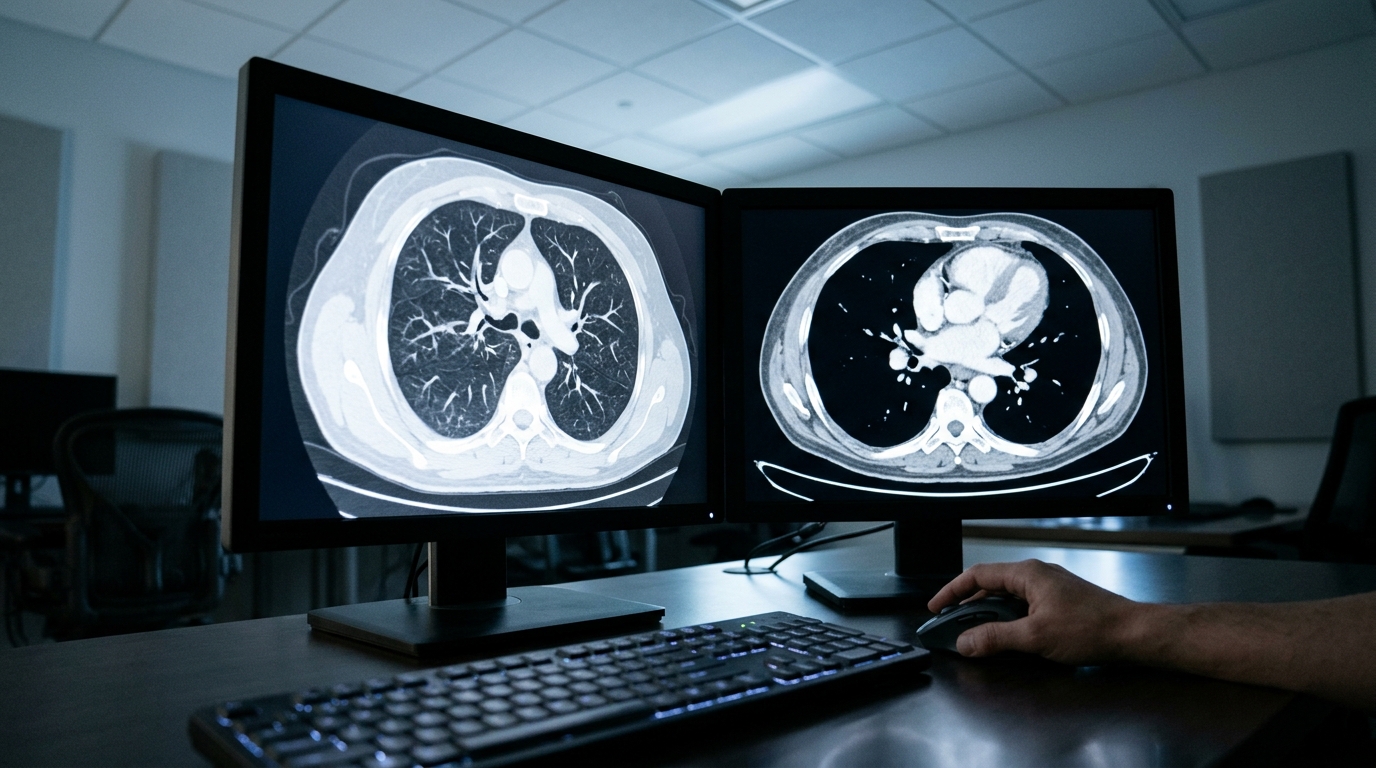
A routine staging scan may reveal calcium deposits in the heart’s arteries, but for patients battling advanced stomach or gastroesophageal junction cancer, those deposits carry no meaningful signal about how long they will live. That is the central finding of a secondary analysis of baseline CT images from the phase III EXPAND trial, published in the Journal of Cancer Research and Clinical Oncology. The study examined 785 patients with unresectable locally advanced or metastatic disease and found that coronary artery calcification, scored on pretreatment CT scans, showed no significant association with overall survival.
Computed tomography is the clinical standard for staging gastrointestinal cancers, and previous research had highlighted the prognostic significance of coronary artery calcification detected by CT in various cancer types. However, the prognostic role of calcification scoring in gastrointestinal cancers remained unclear, prompting the research team to investigate its impact on overall survival in this patient population. The trial participants had originally been randomly assigned to first-line treatment with cisplatin and capecitabine, either with or without cetuximab, in the parent study.
To measure the calcium burden, the researchers applied the visual Weston method, a semiquantitative scoring approach, to the baseline CT scans of all 785 patients. The median coronary artery calcification score in the cohort was 1, with an interquartile range of 0 to 3. A total of 337 patients, representing 42.9 percent of the cohort, had no visible calcification at all, scoring zero on the scale.
One clear pattern did emerge from the imaging data. Male patients had statistically significantly higher calcification scores than female patients, with a median score of 1 compared with 0, a difference that reached a p-value below 0.0001.
The statistical analysis tested the calcification score against mortality in multiple ways. In univariable Cox regression, when the score was analyzed as a continuous value, the hazard ratio was 0.99 with a 95 percent confidence interval of 0.96 to 1.02 and a p-value of 0.74, indicating essentially no effect. When the score was dichotomized into absence versus presence of calcification, the hazard ratio was 1.08 with a 95 percent confidence interval of 0.92 to 1.26 and a p-value of 0.34, again showing no significant association. Group differences elsewhere in the analysis were calculated using the Mann-Whitney U test and ANOVA, while Kaplan-Meier curves and multivariable Cox regression models were used to test the effect of calcification on mortality.
Further subgroup analyses produced similar results, reinforcing the conclusion that the calcification score lacks prognostic power in this setting.
The authors conclude that CT-defined coronary artery calcification scoring has no relevant prognostic impact in advanced gastric and gastroesophageal junction cancer patients undergoing first-line chemotherapy. Importantly, the present study cannot confirm the promising results previously reported for calcification scoring in lung cancer patients.
Subject of Research: Prognostic value of CT-detected coronary artery calcification for survival in advanced gastric and gastroesophageal junction cancer
Article Title: Coronary artery calcification is not associated with survival in advanced gastric and gastroesophageal junction cancer: a secondary analysis of the EXPAND trial
Article References: Meyer, H.-J., Dermendzhiev, T., Jacobs, P.-P., Romeo, D., Stocker, G., Denecke, T., Lordick, F., & Hacker, U. T. (2026). Coronary artery calcification is not associated with survival in advanced gastric and gastroesophageal junction cancer: a secondary analysis of the EXPAND trial. Journal of Cancer Research and Clinical Oncology, 152(11), Article 213. https://doi.org/10.1007/s00432-026-06654-y
Image Credits: AI Generated
DOI: 10.1007/s00432-026-06654-y
Keywords: coronary artery calcification, gastric cancer, gastroesophageal junction cancer, EXPAND trial, computed tomography, overall survival, prognostic marker, Weston score, first-line chemotherapy, secondary analysis, Cox regression, oncology imaging
News Source: Nathaniel Bowman. (November 5, 2026). CT-Scanned Heart Calcification Fails to Predict Survival in Advanced Stomach and Esophageal Cancer Patients. Scienmag.