A pair of researchers, Mahadev M. Channakote and O. Anwar Bég, has formulated a unified mathematical framework to investigate the coupled thermal, solutal, and hydrodynamic transport dynamics of a viscoplastic Casson biofluid moving through a ciliated cylindrical microtube under the combined influence of electro-osmosis and convective boundary conditions. Published in the journal Discover Fluid Mechanics, the study integrates non-Newtonian rheology with electrokinetic driving forces and microscopic wall actuation to determine how electric fields, coordinated ciliary beat patterns, and rhythmic wall contractions regulate fluid displacement. Natural peristalsis drives physiological fluid propulsion across diverse biological structures, including the gastrointestinal tract, lymphatic vessels, bile ducts, ureters, and reproductive systems, through coordinated sinusoidal muscular deformations. By coupling these mechanical propulsion systems with externally applied axial electric fields, the authors constructed closed-form analytical solutions that describe the exact interactions among fluid velocity, temperature variations, chemical species concentration, axial pressure gradients, and internal bolus trapping phenomena.
The fluid under investigation is modeled as an incompressible Casson fluid, which represents a yield-stress non-Newtonian biofluid whose rheological behavior closely mirrors the physiological properties of human blood. In their theoretical formulation, the authors accounted for this non-Newtonian behavior through a constitutive yield stress equation governing the extra stress tensor. Because biological microvessels and microfluidic channels operate under laminar conditions dominated by viscous friction rather than fluid momentum, the mathematical model incorporates the classical lubrication approximation by assuming that the peristaltic wavelength is significantly larger than the microchannel radius and that the Reynolds number remains significantly below unity.
To capture non-mechanical pumping mechanisms, the authors incorporated electro-osmosis, a process where an externally imposed constant axial electric field interacts with mobile ions inside the electric double layer formed along charged microtube walls. Assuming a symmetric electrolyte solution under low zeta potentials below twenty-five millivolts, the distribution of electrostatic potential across the fluid domain is governed by the linearized Poisson-Boltzmann equation under the Debye-Hückel approximation. Solving this equation yields an exact potential profile governed by zeroth-order modified Bessel functions of the first kind and scaled by the dimensionless electro-osmotic Debye-Hückel parameter. This electro-osmotic parameter reflects the ratio of the microtube radius to the characteristic Debye screening thickness of the diffuse ionic cloud. When the applied electric field acts upon these charges, it creates a Helmholtz-Smoluchowski slip velocity that accelerates fluid layers adjacent to the channel boundary, providing a steady non-mechanical propelling force that supplements mechanical pumping.
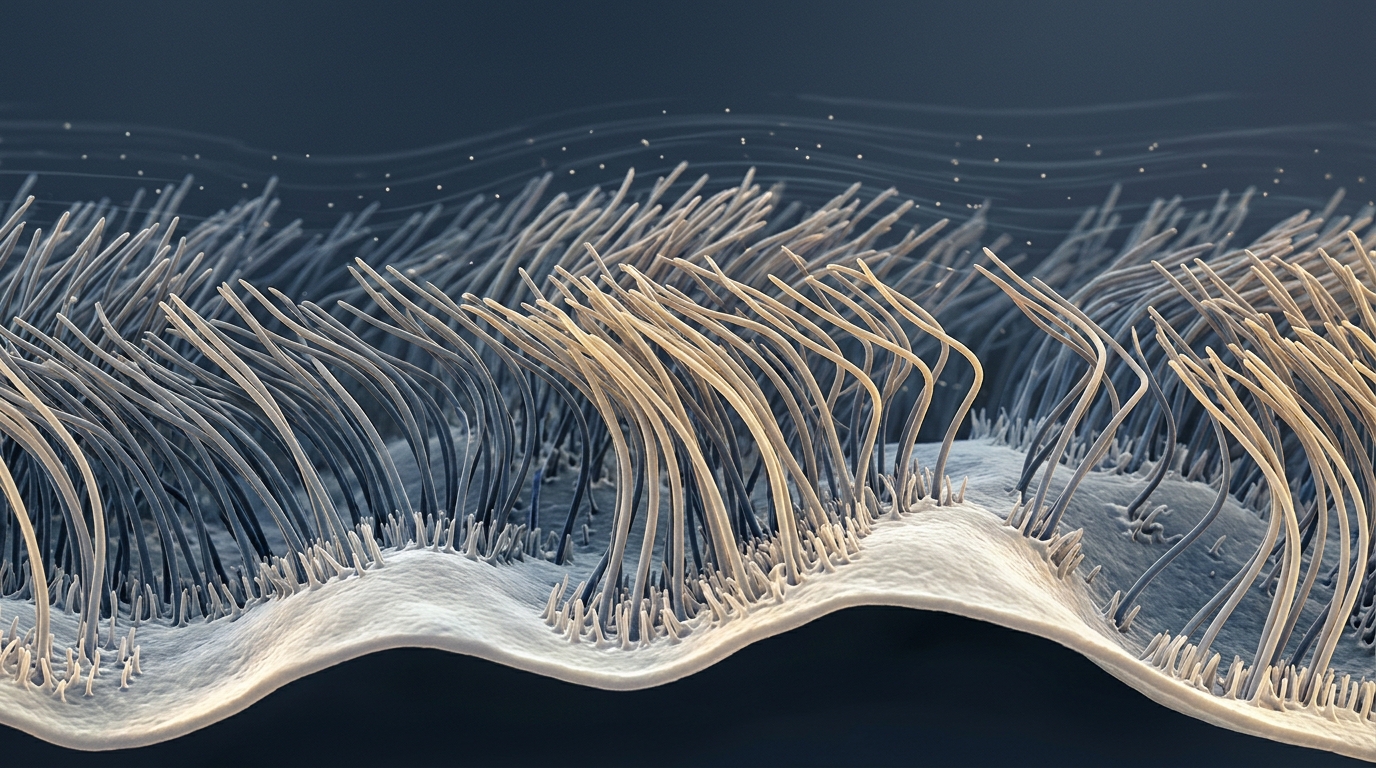
Ciliary activity along the microtube lining is modeled kinematically through elliptical tip trajectories that mimic metachronal wave propagation. Microscopic biological cilia execute an asymmetric stroke cycle featuring an effective propulsion phase followed by a slower recovery motion, generating macroscopic phase differences across adjacent ciliary rows. The model integrates this synchronized ciliary beating into the kinematic wall boundary conditions, incorporating a nondimensional cilia length parameter alongside the eccentricity of the elliptical tip motion. Heat exchange across the microtube wall is formulated using convective thermal boundary conditions governed by a thermal Biot number, replacing idealized constant-temperature assumptions with a realistic Robin boundary condition that balances conduction and convection. Radiative heat transfer within the absorbing medium is simultaneously incorporated through the Rosseland diffusion approximation, linearized by Taylor series expansion, while solutal transport accounts for species concentration gradients, convective mass transfer Biot numbers, Schmidt numbers, and Soret thermal-diffusion cross-effects.
Analytical derivations carried out in a moving wave reference frame enabled the authors to obtain exact closed-form expressions for the axial velocity, temperature field, and species concentration distributions across the cylindrical channel. Numerical evaluations executed using symbolic computation software revealed that the axial fluid velocity accelerates significantly when the electro-osmotic parameter, the Helmholtz-Smoluchowski slip velocity, the nondimensional cilia length, or the volumetric flow rate increases. Physically, elevating the electro-osmotic parameter compresses the electric double layer toward the microchannel wall, concentrating electric forces within a narrower peripheral zone and generating greater net propulsion through the fluid core. Simultaneously, longer ciliary structures transfer greater mechanical momentum to the surrounding viscoplastic fluid during their periodic beating cycle. When the investigators evaluated the Casson fluid against a baseline Newtonian fluid, the Casson biofluid consistently exhibited a lower central core velocity due to its finite yield stress, which imparts structural resistance to deformation and reduces peak flow rates.
Thermal analysis revealed distinct mechanisms controlling temperature distribution within the microfluidic channel. The mathematical solutions demonstrate that the local fluid temperature escalates across all radial positions when the volumetric heat source parameter rises, reflecting increased thermal accumulation throughout the core and peripheral fluid layers. Conversely, strengthening the thermal Biot number enhances convective heat dissipation at the outer wall, causing the interior fluid temperature to decline. Elevating the Rosseland thermal radiation parameter likewise exerts a pronounced cooling effect across the entire radial span of the microchannel. Because the Rosseland parameter reflects the comparative contribution of conduction relative to radiative transfer in optically thick absorbing media, higher values modify the effective thermal diffusion relative to momentum diffusion, suppressing thermal accumulation and lowering fluid temperatures. Species concentration distributions responded similarly to transport parameters, diminishing as the Soret cross-diffusion number and the Schmidt number increased, while rising under larger mass transfer Biot numbers.
Evaluating the axial pressure gradient revealed complex interactions between driving mechanisms, viscous resistance, and buoyancy forces. The theoretical results demonstrate that sustaining steady fluid transport requires an elevated axial pressure gradient when the electro-osmotic parameter, the Helmholtz-Smoluchowski slip velocity, or the cilia length is increased. Stronger electrokinetic propulsion and elongated cilia enhance wall-driven fluid momentum, but the accompanying viscous resistance across the microchannel requires a larger pressure gradient to maintain steady flow. Similarly, increasing the thermal Grashof number intensifies opposing thermal buoyancy forces, necessitating a greater pressure drop, whereas increasing the solutal Grashof number aids fluid motion and lowers pumping demands. Throughout these evaluations, the Casson fluid consistently required a lower axial pressure gradient than its Newtonian counterpart, demonstrating that non-Newtonian blood rheology fundamentally alters pumping expenditure and flow regulation in living tissues.
Streamline analysis illuminated the internal trapping phenomena that occur when circulating fluid forms closed recirculating boluses within the wave frame. The computed streamline contours showed that increasing the electro-osmotic parameter, the Helmholtz-Smoluchowski slip velocity, or the cilia length expands the spatial dimensions and number of trapped recirculating boluses near the channel boundaries. Longer cilia provide stronger localized momentum transfer, promoting recirculating flow structures, while stronger electro-osmotic forcing reorganizes the streamline topology. The analytical model was validated by comparing its baseline velocity solutions against earlier published literature in the absence of electric fields and thermal-solutal gradients, yielding close agreement across the channel radius.
To evaluate physiological relevance, the authors contextualized their theoretical framework using empirical biomedical data from the human ductuli efferentes, a network of ten to fifteen microscopic ciliated tubules connecting the rete testis to the epididymis. Based on established physiological measurements, each individual tubule exhibits an internal radius of approximately fifty micrometers, a ciliary beat frequency of twenty hertz, a flow rate of six thousandths of a milliliter per hour, and an estimated ciliary wave speed of two hundred micrometers per second. These physical parameters confirm the validity of using low Reynolds number and long wavelength lubrication approximations. Beyond reproductive tract physiology, the authors note that the model offers theoretical design principles for electrokinetically driven lab-on-a-chip diagnostic devices, microvascular perfusion monitoring, and targeted hyperthermia drug delivery systems where non-mechanical pumping can manipulate fluids without moving mechanical parts.
Subject of Research: Theoretical fluid dynamics of cilia-assisted electro-osmotic peristaltic transport in non-Newtonian biofluids
Article Title: Thermal and solutal transport dynamics in cilia-assisted electro-osmotic peristaltic flow of Casson fluids subject to convective thermal boundaries
Article References: Channakote, M. M., & Bég, O. A. (2026). Thermal and solutal transport dynamics in cilia-assisted electro-osmotic peristaltic flow of Casson fluids subject to convective thermal boundaries. Discover Fluid Mechanics, 2(1), Article 17. https://doi.org/10.1007/s44369-026-00024-4
Image Credits: AI Generated
DOI: 10.1007/s44369-026-00024-4
Keywords: Fluid Mechanics, Peristaltic Flow, Casson Fluid, Electro-Osmosis, Ciliary Motion, Bio-Microfluidics, Heat Transfer, Solute Transport, Mathematical Modeling, Thermal, solutal, transport
News Source: Reid Dalton. (November 5, 2026). Mathematical Model Reveals How Cilia and Electro-Osmosis Regulate Microscale Biofluid Flow. Scienmag.