• HOME
  • NEWS
  • EXPLORE
    • CAREER
      • Companies
      • Jobs
    • EVENTS
    • iGEM
      • News
      • Team
    • PHOTOS
    • VIDEO
    • WIKI
  • BLOG
  • COMMUNITY
    • FACEBOOK
    • INSTAGRAM
    • TWITTER
Friday, November 6, 2026
BIOENGINEER.ORG
No Result
View All Result
  • Login
  • HOME
  • NEWS
  • EXPLORE
    • CAREER
      • Companies
      • Jobs
        • Lecturer
        • PhD Studentship
        • Postdoc
        • Research Assistant
    • EVENTS
    • iGEM
      • News
      • Team
    • PHOTOS
    • VIDEO
    • WIKI
  • BLOG
  • COMMUNITY
    • FACEBOOK
    • INSTAGRAM
    • TWITTER
No Result
View All Result
Bioengineer.org
No Result
View All Result
Home NEWS Science News Health

Spiking Neural Networks Enhance Multimodal EEG and fMRI Brain State Decoding

by
November 5, 2026
in Health, Technology
Reading Time: 2 mins read
0
Spiking Neural Networks Enhance Multimodal EEG and fMRI Brain State Decoding

Spiking Neural Networks Enhance Multimodal EEG and fMRI Brain State Decoding

Share on FacebookShare on TwitterShare on LinkedinShare on RedditShare on Telegram

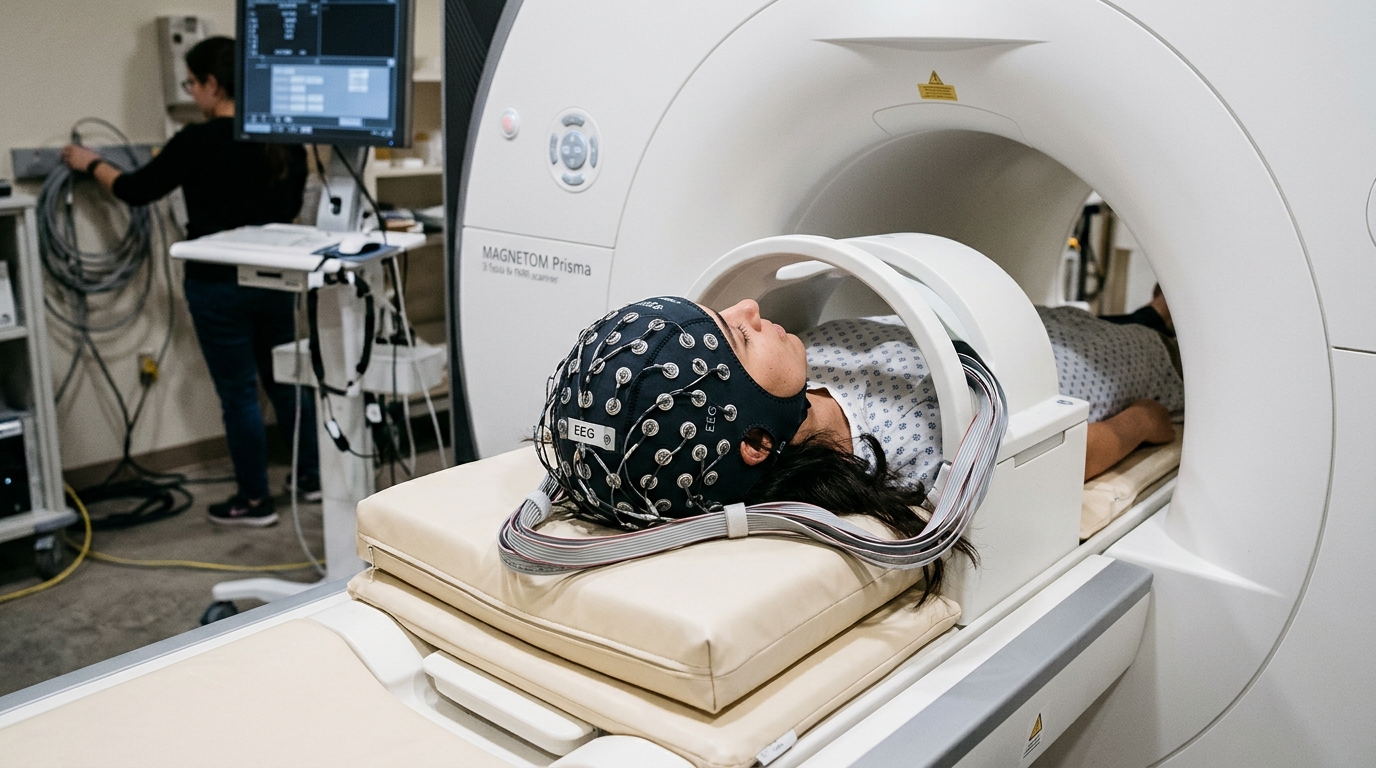
Biologically inspired spiking neural network frameworks integrating simultaneous electroencephalography and functional magnetic resonance imaging data have demonstrated superior performance over unimodal approaches in decoding resting-state brain states. In brain informatics, multimodal data integration captures complementary spatial and temporal characteristics of neural activity to generate more accurate and biologically meaningful representations of brain function. However, combining established measurement modalities such as EEG and fMRI presents significant challenges due to fundamental heterogeneity in their temporal and spatial feature representations. To address these challenges, researchers developed spiking neural network frameworks employing early, intermediate, and late fusion strategies, featuring a novel ensemble-based explainable late-fusion classifier designated as X-Meta.

Methodologically, the design extends spiking neural network reservoir architectures to support multimodal learning across separate reservoirs for EEG and fMRI, enabling the direct modelling of cross-modal interactions. The fusion frameworks were evaluated on a resting-state simultaneous EEG-fMRI dataset to decode Eyes-Closed and Eyes-Open-Eyes-Closed brain states, benchmarking results against deep learning models and conventional machine learning utilizing alpha alone and multiple frequency bands. The study also examined two distinct EEG feature representations—raw amplitude and Power Spectral Density—integrated with fMRI to assess how input representations influence multimodal fusion efficacy.

The experimental results demonstrated that all evaluated fusion strategies significantly outperformed unimodal fMRI, achieving accuracy improvements exceeding 6.6% to 18%. Performance gains relative to the EEG modality depended on the feature representation: for Power Spectral Density representations, post-reservoir fusion strategies enhanced accuracy by 2.1% to 4.21%, whereas raw amplitude representations showed smaller gains of approximately 1.3% with intermediate fusion and X-Meta, reflecting differences in the relative discriminative strength of each format. Additionally, X-Meta delivered model-level feature attribution, identifying EEG and fMRI features associated with previously documented functional brain regions while highlighting exploratory candidate markers to provide interpretable insights into the network’s classification decisions.

Subject of Research: Multimodal EEG and fMRI data integration using spiking neural networks

Article Title: Brain-inspired spiking neural network frameworks for multimodal spatiotemporal brain data integration: a case study on EEG-fMRI data

Article References: Shahab, N., Doborjeh, M., Kasabov, N., Shahab, I., & Doborjeh, Z. (2026). Brain-inspired spiking neural network frameworks for multimodal spatiotemporal brain data integration: a case study on EEG-fMRI data. Brain Informatics. https://doi.org/10.1186/s40708-026-00340-y

Image Credits: AI Generated

DOI: 10.1186/s40708-026-00340-y

Keywords: spiking neural networks, EEG-fMRI integration, multimodal neuroimaging, brain informatics, brain state decoding, machine learning, feature attribution, Brain-inspired, spiking, neural, network, frameworks

News Source: Cassandra Pierce. (November 5, 2026). Spiking Neural Networks Enhance Multimodal EEG and fMRI Brain State Decoding. Scienmag.


Tags: Brain Informaticsbrain state decodingBrain-inspiredEEG-fMRI integrationfeature attributionframeworksMachine Learningmultimodal neuroimagingnetworkneuralspikingspiking neural networks
Share12Tweet7Share2ShareShareShare1

Related Posts

Sex May Modify Obesity-Related Heart Failure Physiology but Not Treatment Eligibility

Sex May Modify Obesity-Related Heart Failure Physiology but Not Treatment Eligibility

November 6, 2026
ADHD Medication Dispensing in Norway Rose Significantly Between 2005 and 2025

ADHD Medication Dispensing in Norway Rose Significantly Between 2005 and 2025

November 6, 2026

Survey Finds Gap Between Geriatric Prescribing Knowledge and Practice in Indian Dentists

November 6, 2026

Isoflurane Anaesthesia Leaves Rabbit Gut Transit and Appetite Largely Unchanged

November 6, 2026

POPULAR NEWS

  • ECMO shows promise as rescue therapy for combat casualties, but evidence remains thin

    ECMO shows promise as rescue therapy for combat casualties, but evidence remains thin

    29 shares
    Share 12 Tweet 7
  • MRI habitat radiomics maps tumor diversity to predict lymph node spread in early-stage cervical cancer

    29 shares
    Share 12 Tweet 7
  • Japan’s Home Care Use Varies Sharply Across Municipalities Despite Universal Coverage

    29 shares
    Share 12 Tweet 7
  • Long Contact Times on AAV Affinity Resins Reshape Yield and Purity

    29 shares
    Share 12 Tweet 7

About

We bring you the latest biotechnology news from best research centers and universities around the world. Check our website.

Follow us

Recent News

Sex May Modify Obesity-Related Heart Failure Physiology but Not Treatment Eligibility

ADHD Medication Dispensing in Norway Rose Significantly Between 2005 and 2025

Survey Finds Gap Between Geriatric Prescribing Knowledge and Practice in Indian Dentists

Subscribe to Blog via Email

Enter your email address to subscribe to this blog and receive notifications of new posts by email.

Join 86 other subscribers
  • Contact Us

Bioengineer.org © Copyright 2023 All Rights Reserved.

Welcome Back!

Login to your account below

Forgotten Password?

Retrieve your password

Please enter your username or email address to reset your password.

Log In
No Result
View All Result
  • Homepages
    • Home Page 1
    • Home Page 2
  • News
  • National
  • Business
  • Health
  • Lifestyle
  • Science

Bioengineer.org © Copyright 2023 All Rights Reserved.