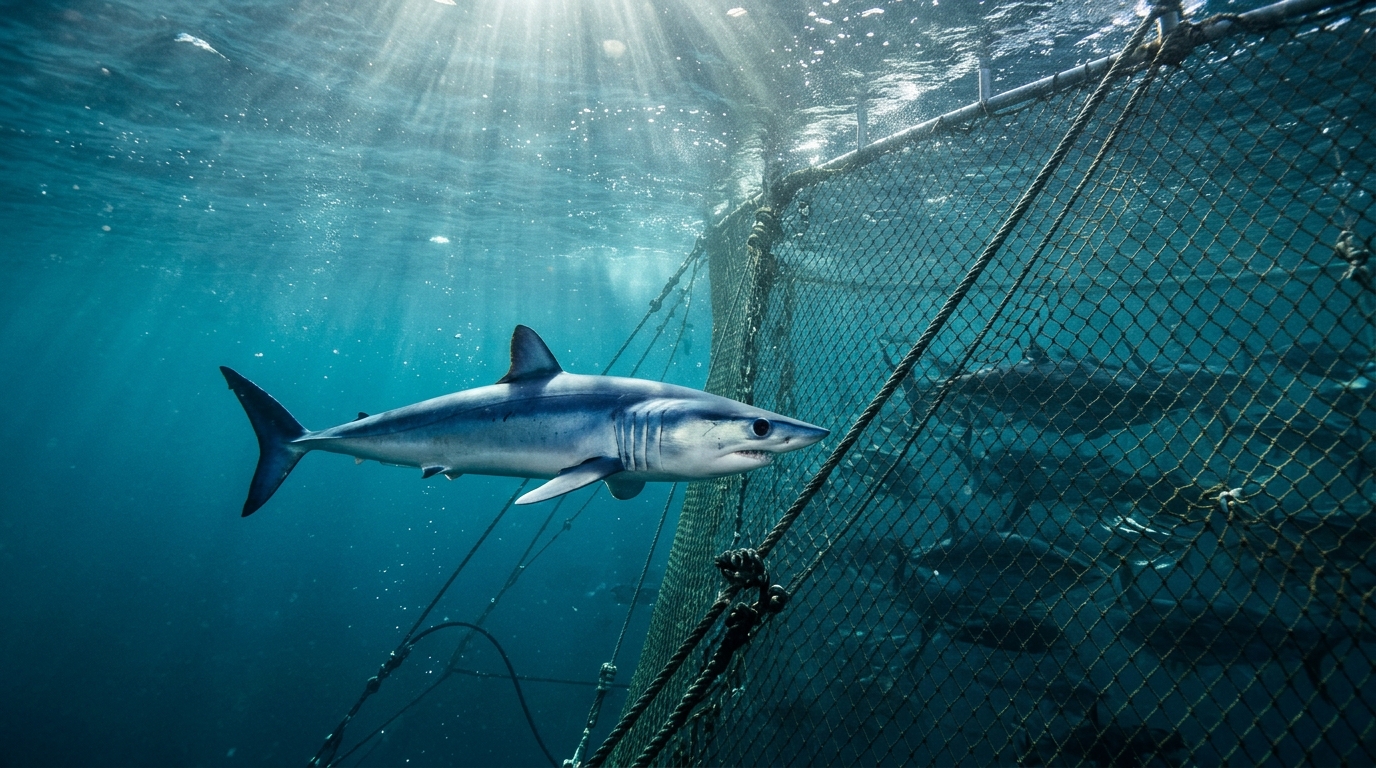
Blue sharks and shortfin makos are finding their way into Mediterranean fish farms, and not all of them are getting out alive. A study published in Acta Ichthyologica et Piscatoria documents six cage-entry events involving these two large pelagic shark species at capture-based Atlantic bluefin tuna operations and at an Atlantic salmon farm between 2018 and 2026. Four of the sharks swam in through breaches in the cage netting; the other two were caught incidentally with tuna in purse seines and then transferred, along with the catch, into transport cages. Three sharks were released alive and three died after becoming entangled in the netting. Feeding was recorded in five of the six events.
The records come from direct observations by the authors, information supplied by personnel involved in fishing, tuna transfer, cage towing, and fish farming, and original photographic and video material examined by the study team. Species were identified from diagnostic external morphological characters visible in the field or in that documentation, and sex was determined from the presence or absence of claspers where the pelvic region could be seen. Total lengths were estimated by operational personnel or by the authors, using people or objects of roughly known dimensions as size references wherever possible; estimates supplied by fishers or farm staff are flagged as reported values. Because the observations were opportunistic and effort was not standardized, the authors stress that the data cannot be used to estimate how often such interactions occur, nor to demonstrate that the farms attract sharks.
The first event unfolded on 3 June 2018 in the Jabuka Pit, a deep depression in the central Adriatic Sea. A male blue shark was captured together with tuna in a purse seine and transferred into a transport cage. While the towing vessel Trapa remained stationary, the shark consumed several juvenile Atlantic bluefin tuna intended for farming. Once towing began, it became entangled in the cage netting and died. Divers later retrieved the carcass and brought it aboard the towing vessel. One of the authors, who directly observed the specimen after retrieval, estimated its total length at 250 centimeters and its body mass at 120 kilograms.
The following day, in the same area, a blue shark entered a tuna transport cage through a breach in the bottom netting that personnel reported the shark had made during the night. Inside, it ate only the viscera of two tuna, leaving the carcasses on the cage floor. A diver cut the netting away from the floating collar, lowered the handrail, and positioned himself in the shark’s path to redirect it through the opening. The shark swam away apparently unharmed. On 20 June 2018, again in the Jabuka Pit, a third blue shark, estimated by eyewitnesses at roughly 250 centimeters in total length, was captured with tuna in a purse seine, transferred into a transport cage, and filmed swimming inside by staff of the operating company. It consumed one tuna and was subsequently released alive.
The fourth event shifted the setting from tuna to salmon. On 11 July 2024, a female blue shark was observed inside a cage holding Atlantic salmon at Lukovo Šugarje in the Velebit Channel of the northern Adriatic, Croatia, where salmon farming was introduced after the species was authorized for aquaculture in 2021 and where the cages sit over water depths of approximately 60 meters. The shark had entered through a breach in the netting, and remains of an Atlantic salmon were found inside the cage afterward. Farm personnel photographed the shark swimming within the cage and estimated its total length at 200 to 250 centimeters. It was released alive by cutting an approximately 10-meter section of netting to provide an exit.
Two fatal events involving shortfin makos followed in 2026. On 1 June of that year, the Maltese-flagged vessel Mirkut was towing a tuna transport cage through Libyan waters toward a farming facility in Malta when a female shortfin mako entered through a breach in the netting and became entangled. The crew found it dead. A short video recorded after retrieval documents the specimen, and from that footage the authors estimated its total length at 160 to 200 centimeters. On 29 June 2026, a second female shortfin mako entered a transport cage through a breach during the night in the Strait of Otranto, while the vessel Neptun was towing it from Italy to Croatia. It too became entangled and died, and was retrieved aboard using a crane. Although the crew put its length at about 400 centimeters, photographic comparison with objects of known size yielded a smaller estimate of 320 to 340 centimeters. The photographs also showed partially dusky coloration on the underside of the snout and lower jaw, resembling a form described in earlier work and subsequently documented in a live Mediterranean specimen. Remains of at least one Atlantic bluefin tuna were found inside the cage.
Why would fast-swimming open-ocean predators end up inside towed net cages? The study points to the biology of the prey. Various tuna species, from small-bodied species to the Atlantic bluefin tuna, form part of the diet of great white, shortfin mako, and blue sharks. Because capture-based aquaculture temporarily concentrates large numbers of tuna during capture, transfer, towing, and rearing, these operations create opportunities for shark–aquaculture encounters. Mediterranean tuna aquaculture is predominantly capture-based: wild tuna are caught in purse seines, transferred into transport cages, and towed to farming sites for fattening or longer-term rearing, a practice that has spread since the first Mediterranean tuna farm was established in 1995, with major clusters reported around Cartagena in Spain, Naples in Italy, and Zadar in Croatia.
The authors suggest that shark entry into cages, and their presence nearby, may reflect a transient response to cues associated with injured or dead fish rather than attraction to live tuna or to the cage structure itself. Most interactions in this study occurred during or immediately after tuna capture, transfer, or towing, when tuna were densely aggregated and when injured or dead fish could be present. Similar associations have been reported elsewhere in the Mediterranean: sandbar sharks were documented around fish cages during the removal of large quantities of wounded and dead cultured fish, and sandbar sharks were observed approaching a diver and sporadically attempting to attack a cage during the removal of dead farmed fish. Shark responses to aquaculture facilities, however, appear context dependent. Acoustic telemetry work in South Australia found no evidence that a low-biomass tuna pen used for tourism increased shark abundance or residency, while recurrent seasonal presence of sandbar sharks around open-sea fish cages in the eastern Mediterranean has been documented over several years.
Interactions may also extend beyond cage entry. Personnel involved in tuna capture, transfer, and towing reported blue sharks and shortfin makos swimming near transport cages without entering them, with some observations supported by video footage. These encounters were not included as individual case records because complete event-level information was unavailable and observations were not collected systematically, but they suggest a third, operationally distinct pathway: approaching vessels or cages without entering. The study therefore distinguishes three pathways of interaction — approach without entry, entry through breaches in the netting, and incidental transfer from purse seines into transport cages with the catch — and notes that these different mechanisms may require different mitigation approaches. A further observation involved a great white shark, estimated at approximately 5 meters in total length, approaching a tugboat twice in the Jabuka Pit in June 2012, shortly after tuna had been transferred into a transport cage; a great white shark capture in a tuna purse seine in the same general area during a similar operation has previously been reported.
The conservation stakes are high. All shark species reported in the study were classified as Critically Endangered in the 2016 IUCN Mediterranean regional assessments. More active shark species have higher oxygen consumption rates, and shortfin mako and great white sharks exhibit some of the highest metabolic or oxygen consumption rates reported for sharks. In protective gill nets off Natal, South Africa, only 6 percent of shortfin makos and 16 percent of great white sharks were found alive, underscoring how quickly entangled individuals must be freed. The authors call for systematic monitoring of interactions between sharks and fish-farming operations so that trapped or entangled animals can be detected and, where feasible and safe, released as rapidly as possible. Proposed measures to reduce predator entry include strong polyethylene terephthalate monofilament, semi-rigid or tightly stretched net walls, and robust containment barriers, while incidental transfer from purse seines might be reduced by detecting and releasing sharks before the catch is moved. Continuous monitoring, prompt removal of dead or injured fish, and rapid-release procedures are likely to be relevant across interaction types, though the authors caution that the effectiveness of these measures for the species and farming systems considered here has yet to be specifically evaluated.
Subject of Research: Interactions between large pelagic sharks and capture-based tuna aquaculture and salmon farming in the Mediterranean Sea
Article Title: Interactions of large pelagic sharks ( Elasmobranchii ) with capture-based tuna aquaculture and salmon farming in the Mediterranean Sea
Article References: Ugarković, P., De Maddalena, A., & Žuvić, L. (2026). Interactions of large pelagic sharks (Elasmobranchii) with capture-based tuna aquaculture and salmon farming in the Mediterranean Sea. Acta Ichthyologica et Piscatoria, 56, 483-490. https://doi.org/10.3897/aiep.56.213701
Image Credits: AI Generated
Keywords: blue shark, shortfin mako, Atlantic bluefin tuna, aquaculture, Mediterranean Sea, cage entanglement, purse seine, shark conservation, capture-based farming, Jabuka Pit, Adriatic Sea, IUCN Critically Endangered
News Source: Drew Townsend. (November 5, 2026). Blue sharks and makos breach tuna cages across the Mediterranean, six fatal encounters documented. Scienmag.