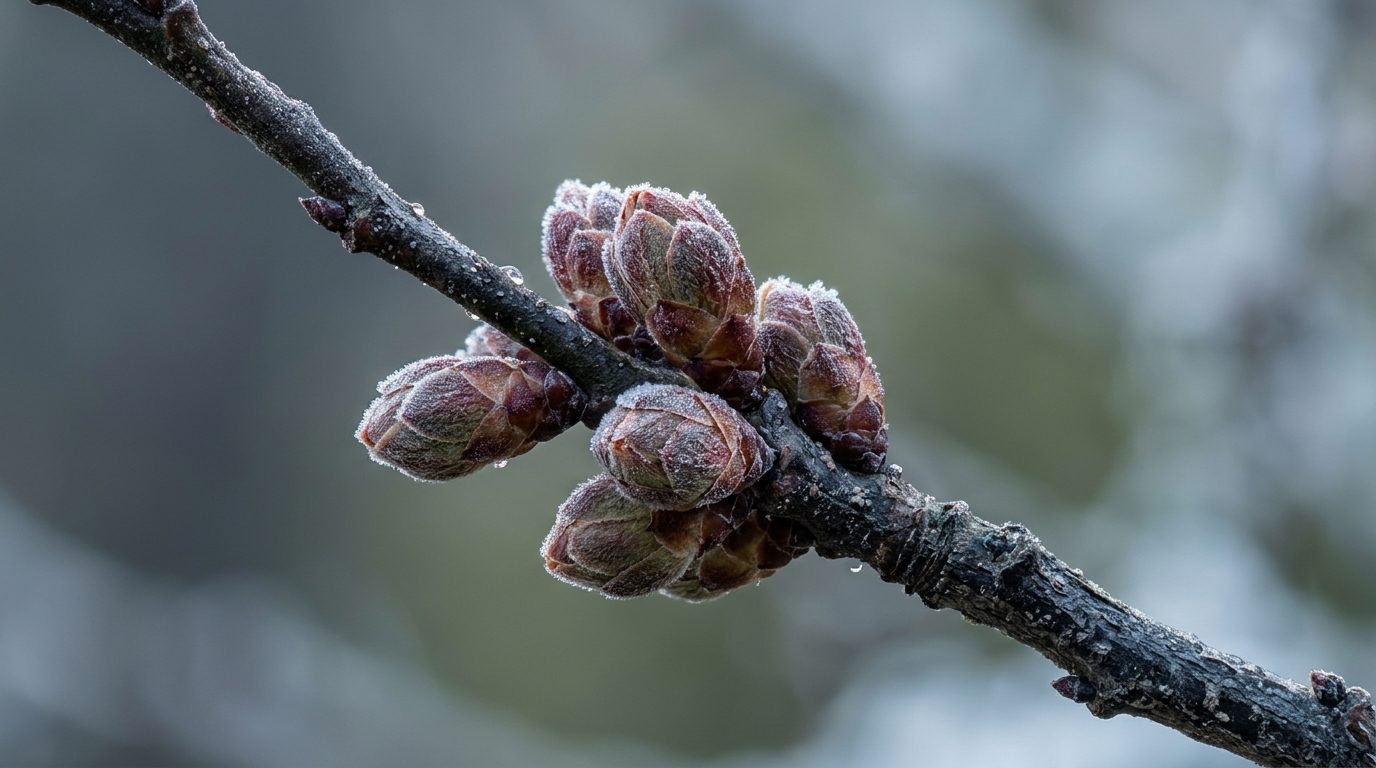
A MADS-box transcription factor gene called PmFLC-like, a homolog of the Arabidopsis vernalization regulator FLC, appears to sit at the center of a hormonal control system that keeps Japanese apricot (Prunus mume) flower buds developing slowly through autumn and winter while blocking them from blooming even under forcing conditions. Researchers at Kyoto University and Ishikawa Prefectural University report that molecular and physiological analyses of transgenic Arabidopsis overexpressing the gene, together with Japanese apricot cultivars that bloom at different times, point to a critical role for PmFLC-like in phytohormone metabolism.
The team had previously identified PmFLC-like as a gene that is highly expressed in Prunus mume flower buds during autumn and winter. The gene is conserved as a single copy across several Prunus fruit tree species, a pattern that suggested a significant role in winter flower buds, where bud development continues slowly while blooming is inhibited.
When the researchers ectopically overexpressed PmFLC-like in Arabidopsis, the plants showed two clear effects: flowering was delayed and overall plant size was reduced. Consistent with that result, expression of PmFLC-like was significantly higher in the flower buds of a late-blooming Japanese apricot cultivar than in an early-blooming one, linking higher gene activity with a longer delay before flowers open.
Overexpression of PmFLC-like led to increased accumulation of abscisic acid (ABA) and decreased accumulation of cytokinin (CTK). These changes aligned with observations in the apricot flower buds themselves, where PmFLC-like expression correlated positively with ABA levels and negatively with CTK levels.
Transcriptome analysis added a layer of molecular detail. The data suggested that PmFLC-like expression is associated with ABA- and cytokinin-related co-expression modules, including genes involved in ABA catabolism such as CYP707A and UDP-glycosyltransferases, as well as Cytokinin dehydrogenase (CKX).
Treatment experiments strengthened the case for a feedback relationship. Exogenous application of ABA upregulated PmFLC-like expression, while fluridone downregulated it. The researchers interpret this reciprocal response as an ABA-PmFLC-like positive feedforward loop operating during flower bud development: ABA promotes the gene’s activity, and the gene in turn is associated with higher ABA accumulation.
Beyond the hormone modules, co-expression with genes involved in ncRNA metabolism and histone modification suggests a possible link with chromatin-related regulatory processes.
The study, published as an original research article in Frontiers in Plant Physiology, combines work in two systems: transgenic Arabidopsis, where the gene’s effects on flowering time, plant size and hormone levels could be tested directly, and Japanese apricot cultivars with contrasting blooming dates, where natural variation in gene expression could be compared with hormone profiles and bud behavior. The convergence of these two approaches is what supports the authors’ conclusion that PmFLC-like is associated with ABA and CTK metabolism and with winter flower bud development in Prunus mume.
Subject of Research: Role of the FLC-like gene PmFLC-like in hormone metabolism and winter flower bud development of Japanese apricot
Article Title: Functional characterization of FLC-like in relation to flower bud development of Prunus mume
Article References: Hsiang, T.-F., Chen, Y.-Y., Gao-Takai, M., & Yamane, H. (2026). Functional characterization of FLC-like in relation to flower bud development of Prunus mume. Frontiers in Plant Physiology, 4, Article 1963601. https://doi.org/10.3389/fphgy.2026.1963601
Image Credits: AI Generated
DOI: 10.3389/fphgy.2026.1963601
Keywords: PmFLC-like, FLOWERING LOCUS C, Prunus mume, abscisic acid, cytokinin, flower bud development, MADS-box transcription factor, bud dormancy, transcriptome, Arabidopsis, vernalization, Japanese apricot
News Source: Juliet Wilcox. (November 5, 2026). FLC-like gene shapes hormone balance in Japanese apricot winter buds. Scienmag.