Researchers in Mexico have combined Raman spectroscopy, a chaotically modulated pulsed laser, and fractional heat-transfer modeling to detect lead-associated changes in reservoir water without labels or chemical reagents. In a study published in Results in Optics, the team from institutions working with La Requena Reservoir water in Tepeji del Río, Hidalgo, showed that lead nitrate and lead chloride produced concordant, concentration-dependent changes in the geometry of a chaotic optical attractor across a validated range of 0.05 to 12 milligrams of lead per liter, while nitrate-matched sodium nitrate controls remained substantially weaker. The work is presented as a proof-of-concept screening platform, not a replacement for established elemental analysis such as ICP-MS or atomic absorption spectroscopy.
The central challenge the authors set out to address is a familiar one in optical sensing: dissolved lead(II) in natural waters is notoriously difficult to discriminate because counterions, suspended matter, dissolved organic species, and matrix-dependent optical effects can obscure the very signals a sensor is trying to measure. Lead nitrate is a convenient calibration salt, but its nitrate counterion carries a strong Raman fingerprint in the 1000 to 1100 per centimeter region, which risks being mistaken for a lead signature. The team therefore designed a counterion-resolved protocol in which every lead response had to pass a strict test: it had to show a consistent concentration-dependent trend for both lead nitrate and lead chloride, while being absent or significantly weaker in sodium nitrate controls prepared at twice the molar nitrate concentration of the corresponding lead nitrate standard.
The Raman measurements themselves delivered a sobering verdict on steady-state spectra as a direct lead probe. Using a HORIBA Xplora Plus microscope with 532 nanometer excitation, roughly 5 milliwatts at the sample, and 18 seconds of total acquisition per spectrum, the researchers found that the band in the 1000 to 1100 per centimeter interval appeared in lead nitrate and nitrate-matched sodium nitrate solutions but was absent or substantially weaker in unspiked reservoir water and lead chloride. That comparison demonstrated the feature is primarily the symmetric stretching vibration of nitrate, not a direct vibrational signature of lead. The nitrate band was therefore used as a control for salt addition and solution preparation rather than as an independent marker of dissolved lead, and the OH-stretching envelope between 2800 and 3800 per centimeter served to track changes in water structure and background distortion.
Ultraviolet-visible absorption measurements reinforced the same caution. Lead nitrate solutions showed the strongest ultraviolet response, with high absorbance near 270 nanometers, a shoulder between roughly 290 and 310 nanometers, and a progressive decline toward the instrumental baseline above about 370 nanometers. The nitrate-matched sodium nitrate control displayed a similar spectral profile, indicating that a substantial fraction of the ultraviolet response belongs to the nitrate counterion. Lead chloride, by contrast, exhibited a considerably weaker ultraviolet signal, and reservoir water contributed a broad matrix-dependent background attributed to dissolved and suspended components. These absorption data were not merely descriptive: the absorbance at 532 nanometers fed directly into the photothermal model through a Beer-Lambert estimate of the effective absorption coefficient of the cuvette-solution system.
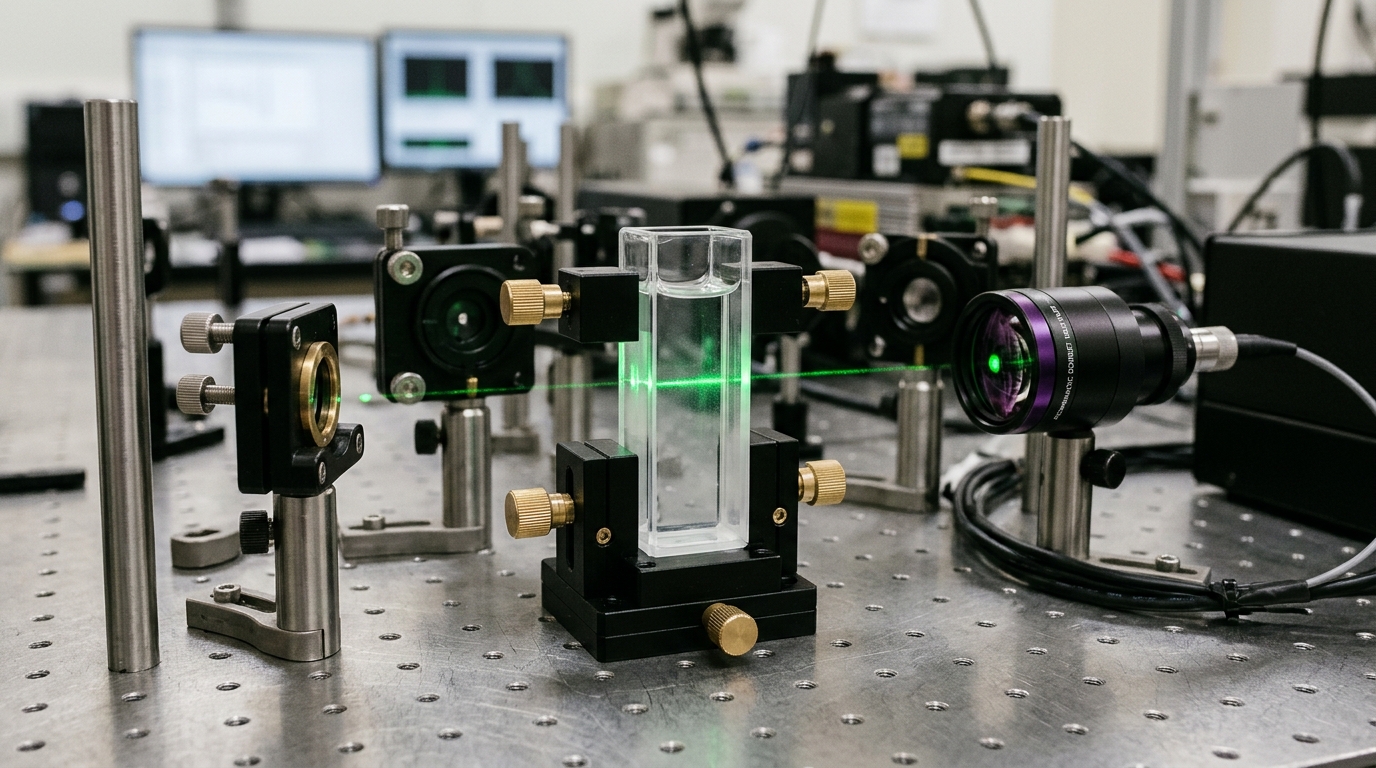
The genuinely novel element of the study is the chaos-assisted photothermal readout. A neodymium-doped yttrium orthovanadate pulsed laser at 532 nanometers delivered 2 to 7 microjoule pulses of 10 nanoseconds duration at a fixed 10 kilohertz repetition rate toward the sample cuvette. The beam passed through an electrically focus-tunable lens driven by a deterministic Newton-Leipnik chaotic waveform, numerically integrated with fixed parameters and initial conditions lying in the multistable chaotic regime reported in the original 1981 system description. Because the oscillator parameters, waveform scaling, pulse energy, repetition frequency, focusing geometry, and acquisition duration were held identical for every sample, any differences in the recorded photodetector voltage had to originate from the optical response of the liquid itself rather than from sample-specific modifications of the chaotic drive.
Each detector record was reconstructed in a three-dimensional phase space using delay coordinates with an embedding delay of 19 samples, corresponding to a 19 millisecond lag at the 1 kilohertz sampling frequency. Four consecutive 2500-point records were concatenated into a 10,000-sample, 10-second time series. From these trajectories the team computed three geometric and statistical metrics: the radius of gyration, which quantifies the overall size of the attractor trajectory; the three-dimensional convex-hull volume, which measures the occupied phase-space region; and the root-mean-square detector voltage, which tracks signal amplitude. Under the predeclared criterion that a response is lead-associated only when both lead salts behave concordantly and the nitrate control does not, the radius of gyration emerged as the primary metric, exhibiting consistent concentration-dependent increases for both lead nitrate and lead chloride across the validated 0.05 to 12 milligram per liter interval.
The authors are careful about what this does and does not prove. The gradual increase observed for the sodium nitrate control at higher lead-equivalent concentrations shows that nitrate-related and matrix-dependent contributions are not negligible, and the team explicitly warns that the results should not be extrapolated to waters containing nitrate concentrations substantially above the investigated range without additional nitrate-specific correction or calibration. Potentially coexisting metal ions such as copper and cadmium, as well as variable dissolved organic matter and other optically active interferents, were not independently evaluated, which is why the paper consistently uses the phrase lead-associated rather than lead-specific. A systematic interferent study will be required before analytical selectivity can be claimed for natural-water applications.
A second analytical layer came from fractional calculus. Classical Newton cooling assumes a memory-less, single-exponential decay of excess temperature, but photothermal experiments in heterogeneous media often show long-tailed, history-dependent relaxations. By replacing the first-order time derivative with a Caputo derivative of order between zero and one, the fractional Newton cooling law yields solutions built on Mittag-Leffler functions that interpolate between stretched-exponential and diffusive behavior. The researchers extracted slowly varying envelopes from the chaotic time traces using a sliding root-mean-square operator and fitted the fractional order and effective cooling coefficient jointly. Unspiked reservoir water yielded a fractional order of approximately 0.98, close to the classical exponential limit, while ultrapure water containing 12 milligrams per liter of lead as lead nitrate gave about 0.90, and reservoir water at the same lead loading dropped to roughly 0.80. Lower fractional orders correspond to stronger non-exponential relaxation and longer effective photothermal memory, and the deviation from the classical limit increased across the sample conditions in agreement with the phase-space expansion seen in the attractor analysis.
The team stresses that these envelopes are normalized photothermal-response proxies, not direct temperature measurements. No independent thermocouple or infrared thermometry was performed, so the fitted fractional order is an effective descriptor of slow optical relaxation rather than a directly calibrated thermal parameter, and direct thermometry will be needed to establish the quantitative relationship between the optical envelope and actual temperature evolution. In parallel, one-dimensional heat-conduction simulations of the quartz-solution slab, driven by a weak volumetric heat source inferred from the ultraviolet-visible absorption tail at 532 nanometers, showed that larger effective thermal-diffusion lengths produce higher simulated peak temperatures and longer relaxation times, confirming that container geometry and absorption profile jointly control the magnitude and persistence of photothermal effects. A separate instrumental calibration of the photodetector-oscilloscope chain under steady illumination established a linear response with a sensitivity of 21.23 volts per megawatt per square centimeter, a correlation coefficient of 0.9992, and a coefficient of determination of 0.9983 over the 0 to 0.990 megawatt per square centimeter range, though the authors emphasize this characterizes the optics and electronics, not analytical sensitivity to lead.
Context matters for interpreting the significance. The World Health Organization maintains a provisional guideline value of 10 micrograms per liter for lead in drinking water, emphasizing that it is not health-based but reflects treatment and analytical achievability, while the United States Lead and Copper Rule Improvements lower the action level to the same 10 micrograms per liter and tighten tap-sampling and public notification requirements. The lowest concentration prepared in this study was 0.01 milligrams per liter, equivalent to the guideline value, but the concentration-dependent phase-space response validated in the dataset spans 0.05 to 12 milligrams per liter, so the study does not establish an analytical limit of detection or quantification for regulatory monitoring. Achieving reliable sub-guideline detection, the authors write, will require improved signal-to-noise performance, optimization of the optical interaction and modulation conditions, a denser low-concentration calibration series, and validation against an independent elemental method. All reservoir-water experiments used material from a single sampling campaign on March 24, 2025, so seasonal variations in dissolved organic matter, turbidity, ionic strength, and suspended solids were not evaluated, and transferability across seasons and water sources remains unestablished. Within those limits, the platform offers a label-free optical configuration that associates lead-containing samples with reproducible changes in the geometry and temporal evolution of a detector signal, positioning it as a preliminary screening strategy for identifying water samples that require confirmatory elemental analysis rather than as a standalone quantification tool.
Subject of Research: Counterion-resolved detection of lead-associated optical responses in reservoir water using Raman controls, chaotic photothermal phase-space analysis, and fractional heat-transfer modeling
Article Title: Counterion-resolved Pb(II) fingerprinting in reservoir water by Raman-guided chaotic photothermal analysis
Article References: Martines-Arano, H., García-Merino, J. A., Hernández-Rendón, A., Torres-Torres, C., Bornacelli, J., Martínez-Ayala, L., & Munoz-Hernandez, G. A. (2026). Counterion-resolved Pb(II) fingerprinting in reservoir water by Raman-guided chaotic photothermal analysis. Results in Optics, Article 101192. https://doi.org/10.1016/j.rio.2026.101192
Image Credits: AI Generated
DOI: 10.1016/j.rio.2026.101192
Keywords: lead detection, Raman spectroscopy, photothermal effect, chaotic systems, fractional calculus, reservoir water, water quality, Newton-Leipnik attractor, nitrate interference, optical sensing, environmental monitoring, phase-space analysis
News Source: Violet Maxwell. (November 5, 2026). Chaotic laser pulses and Raman controls reveal lead fingerprints in reservoir water. Scienmag.