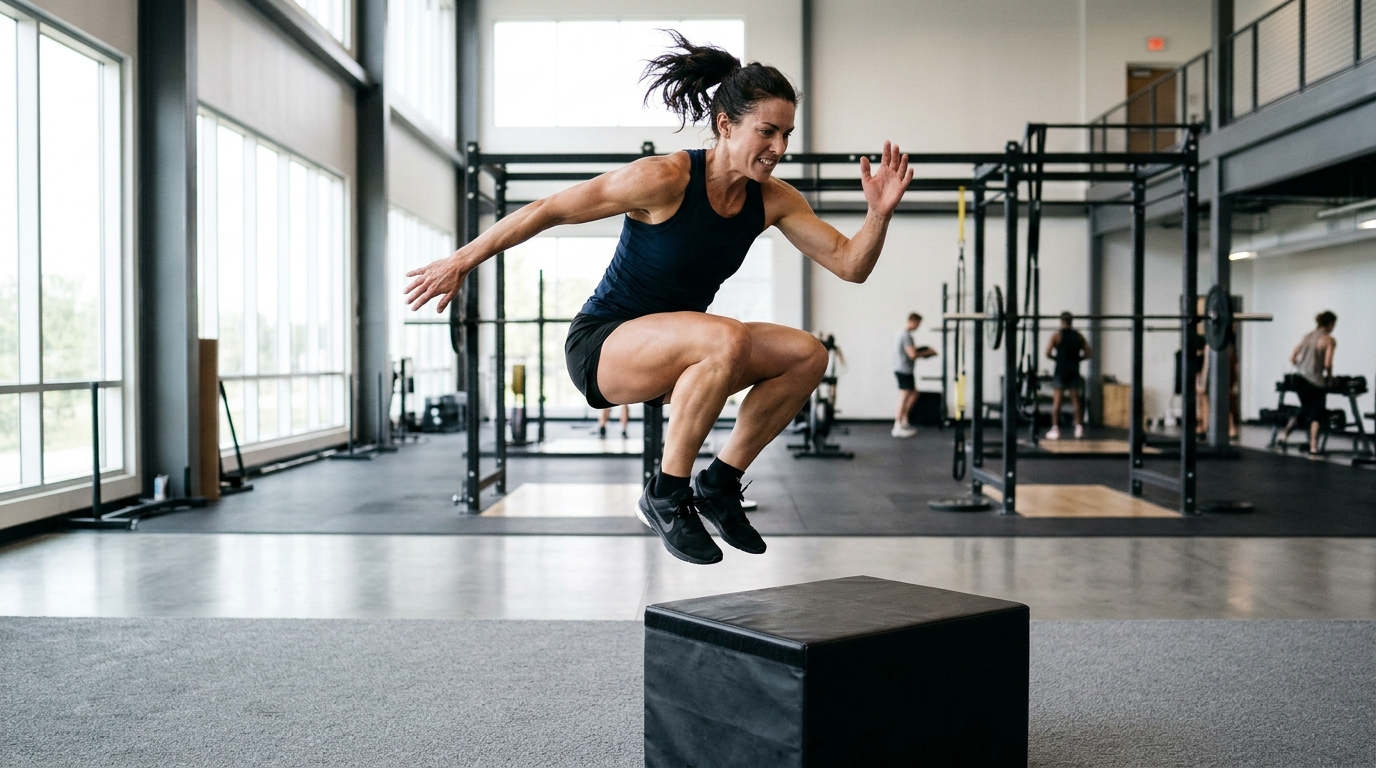
Plyometric jump training can meaningfully improve the jumping, sprinting and change-of-direction performance of adult female team-sport athletes, according to a systematic review and meta-analysis published in Sports Medicine – Open. The review pooled data from 31 studies involving 609 athletes and found that, compared with control conditions, plyometric jump training produced significant gains across countermovement jump height, drop jump performance, linear sprint times and agility test times. The work is notable because adult female team-sport athletes have been largely under-represented in previous syntheses of plyometric training research, with most existing evidence drawn from male, mixed-sex or adolescent cohorts.
The research team, led by Andrew Lane and Paul J. Byrne with colleagues including Rodrigo Ramirez-Campillo, searched PubMed, Web of Science, Scopus and EBSCO up to March 2026. Studies qualified for inclusion if they recruited healthy female team-sport athletes with a mean age of at least 18 years, applied a plyometric jump training programme lasting at least two weeks, included comparator groups, and assessed physical fitness, jump performance or kinematics. Thirty-one articles met the criteria, and 25 of them provided data suitable for meta-analysis. The authors assessed risk of bias using the Physiotherapy Evidence Database scale, finding two studies at high risk, twenty at moderate risk and nine at low risk.
The meta-analyses used Hedges’ g effect sizes with 95% confidence intervals under a random-effects model. Compared with controls, plyometric jump training improved countermovement jump height with an effect size of 0.550, countermovement jump peak concentric velocity with an effect size of 0.623, drop jump reactive strength index with an effect size of 0.926, and drop jump height with an effect size of 0.721. All of these reached statistical significance. Heterogeneity, measured by the I2 statistic, was negligible for countermovement jump height, peak concentric velocity and drop jump height, which suggests that future comparable studies would be likely to show similar improvements.
Sprint performance also improved. The pooled analysis showed significant effects for 10 metre sprint time with an effect size of 0.712, 20 metre sprint time with an effect size of 0.709, and 30 metre sprint time with an effect size of 1.018. Change-of-direction speed benefited as well, with a large effect for the Illinois agility test, where the effect size reached 1.225, and a moderate effect for the T test, where the effect size was 0.965. However, several of these sprint and agility results carried wide prediction intervals that crossed the null effect, meaning the true effect in a similar future study could plausibly range from a negative to a strongly positive value. The authors attribute this uncertainty to the small number of contributing studies and variation in intervention design.
One of the clearest dose-response signals emerged from the subgroup analyses. Interventions lasting longer than six weeks produced significantly greater improvements in drop jump reactive strength index than shorter programmes, and interventions lasting at least eight weeks were more effective for the Illinois agility test and for 10 metre sprint times. Specifically, 10 metre sprint improvements were substantially larger in programmes exceeding eight weeks, with an effect size of 1.439 compared with 0.306 for shorter programmes. For the Illinois test, programmes of at least eight weeks achieved an effect size of 2.264 versus 0.733 for shorter interventions. The authors suggest that longer programmes allow more time for neuromuscular adaptations to develop, including enhanced motor unit recruitment and improved force transfer.
The review also examined jump kinematics, a mechanistic layer that earlier syntheses had largely overlooked. Countermovement jump peak concentric velocity and drop jump reactive strength index both improved significantly, indicating that plyometric jump training affects not just jump height but the underlying stretch-shortening cycle function. The stretch-shortening cycle involves an eccentric lengthening phase followed rapidly by a concentric shortening phase, enabling rapid storage and release of elastic energy in muscles and tendons. Improvements in this cycle are associated with greater motor unit recruitment, faster muscle contractions, improved rate of force development and greater neuromuscular efficiency, all of which underpin jumping, sprinting and change-of-direction actions in team sport.
Not every outcome could be pooled. Balance and maximal lower-body strength were reported in too few studies using comparable tests to permit meta-analysis. Four studies assessed balance using the star excursion balance test, the Y-balance test or the Romberg test, with mixed results: dynamic balance improved significantly in three studies, while static balance measured by the Romberg test did not improve significantly. Five studies examined lower limb strength using isokinetic dynamometry or one-repetition maximum squats, and improvements were reported across these studies, though differing testing velocities and protocols prevented direct comparison. The authors note that the certainty of evidence for strength and balance should be considered very low given the small number of heterogeneous studies.
Certainty of evidence for the main outcomes was rated low to moderate using the GRADE framework. Drop jump height and reactive strength index reached moderate certainty, while countermovement jump variables, linear sprint times and change-of-direction tests were rated low, partly because fewer than 800 participants were available for most comparisons. Adverse effects were rarely reported, but two studies documented a total of three participants who possibly sustained injuries during plyometric jump training, and a further two studies reported four dropouts due to injuries unrelated to the intervention. The authors caution that most included studies did not systematically report soreness, pain, fatigue or injury.
Practically, the review offers population-specific prescription guidance. The minimum effective dose for significant improvements in countermovement jump height and peak concentric velocity was eight to twelve weeks and eight weeks respectively, with eight to twenty sessions at one to two and a half sessions per week. Drop jump height improvements required at least eight weeks, thirteen sessions and a minimum frequency of one and a half sessions per week. Improvements in change-of-direction speed generally required sixteen or more sessions. Because plyometric jump training requires little or no equipment and uses body weight, the authors describe it as a highly efficient and cost-effective training strategy for adult female team-sport athletes, reducing the need to extrapolate recommendations from male or adolescent populations.
The authors flag several limitations. Thirteen of the thirty-one studies involved soccer players, making it the dominant sport in the evidence base and raising questions about transferability to other team sports. Only three sports, soccer, basketball and volleyball, could be compared in subgroup analyses. Risk of bias was predominantly moderate, and blinding remains difficult in plyometric training research. Future work, the authors suggest, should record a wider range of performance variables, including ground contact time and jump-related kinetics, and should extend research to sports beyond soccer and basketball to establish how broadly the benefits apply.
Subject of Research: Effects of plyometric jump training on physical fitness and jump performance kinematics in adult female team-sport athletes
Article Title: Female Team-Sport Athletes’ Physical Fitness and Jump Performance Kinematics After Plyometric Jump Training: A Systematic Review and Meta-analysis
Article References: Lane, A., Ramirez-Campillo, R., Connors, P., Bolger, R., Moody, J. A., Thapa, R. K., & Byrne, P. J. (2026). Female Team-Sport Athletes’ Physical Fitness and Jump Performance Kinematics After Plyometric Jump Training: A Systematic Review and Meta-analysis. Sports Medicine – Open, 12(1), Article 164. https://doi.org/10.1186/s40798-026-01136-4
Image Credits: AI Generated
DOI: 10.1186/s40798-026-01136-4
Keywords: plyometric jump training, female team-sport athletes, systematic review, meta-analysis, countermovement jump, drop jump reactive strength index, sprint performance, change-of-direction speed, stretch-shortening cycle, sports medicine, exercise prescription, neuromuscular adaptation
News Source: Ophelia Keating. (November 5, 2026). Plyometric Jump Training Boosts Jump, Sprint and Agility Performance in Adult Female Team-Sport Athletes. Scienmag.