Worn stainless steel components can be expensive to replace, and a new study reports that a modular electromagnetic device attached to a plasma surfacing torch measurably improves the quality of the deposited metal. Researchers developed and tested a universal modular device that generates an externally controlled volumetric magnetic field in the plasma arc zone during plasma transferred arc (PTA) surfacing with axial powder feed of 12Х18Н10Т stainless steel, known internationally as AISI 321. In their experiments, applying the magnetic field halved the size of dendritic cells in the deposited layer, cut porosity from 0.5–1.0% down to as low as 0.1–0.2%, and raised microhardness from 180 HV0.2 without a field to 370 HV0.2 with a combined magnetic field configuration.
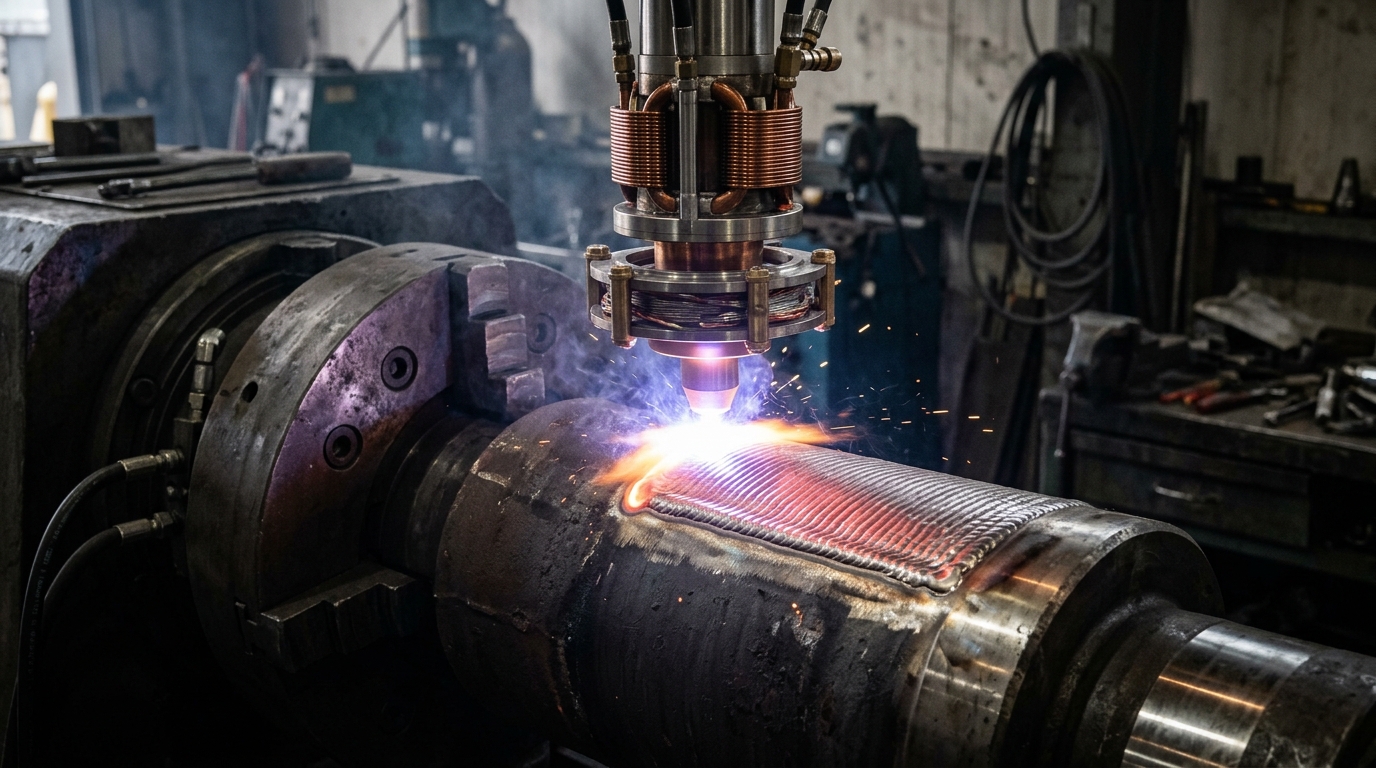
The work, published in Discover Mechanical Engineering, addresses a known shortcoming of conventional PTA torches with axial powder feed. Such torches comprise a plasma torch, an anode nozzle, and an axial powder feed assembly, but they lack means for the operational control of the spatial parameters of the plasma arc during surfacing. According to the authors, this absence can affect the uniformity of thermal energy distribution in the plume and the homogeneity of powder material melting. Their answer is a device built from three magnetic cores with electric coils, inclined at an angle of 30–40° to the electrode axis and spaced at 120° to each other, which together form a controlled volumetric magnetic field around the plasma arc zone.
The host torch itself is deliberately designed to cooperate with the device. The body is made of a heat-resistant non-magnetic material and carries a water-cooling system, which prevents overheating and distortion of the magnetic field. A cathode electrode sits in the upper part of the torch with an anode nozzle below, plasma-forming gas is supplied through lateral channels, and beneath the anode nozzle an axial powder feed assembly takes the form of an annular chamber with outlet nozzles oriented along the torch axis. The modular device is fixed to the torch body inside a housing made of non-magnetic materials, preferably aluminium, a choice that prevents distortion of the generated field, matters for robotic systems, and reduces the device’s weight.
Each of the three ferromagnetic cores of rectangular cross-section is wound with copper insulated wire containing 70–100 turns of 2 mm wire. The coil current is independently regulated for each core and is expected to operate in the range of 20–40 A, corresponding to a magnetomotive force of 1600–4000 A-turns. Using an analytical estimation methodology reported in earlier studies, the team calculates a magnetic flux density in the arc zone in the order of 25–30 mT, which they consider sufficient for effective control of the weld pool dynamics. The electrical power consumed by each coil, estimated as P = I²R at a coil resistance of roughly 0.1–0.2 Ω, falls in the range of 40–320 W, small compared with the typical PTA arc power of 5–10 kW, although the authors note that a detailed energy-efficiency assessment was beyond the scope of the study.
The coils were supplied with a modulated current at a frequency of 5 Hz, a value consistent with the frequency range reported for structural refinement in arc processes, and they are cooled by the torch body’s water-cooling system to prevent overheating during extended operation. The excitation waveform and the phase shift between the coils were not specifically addressed and remain directions for future investigations. The magnetic flux density was estimated with an analytical formula combining the magnetic constant, coil current, number of turns, coil length and core radius, but the exact distribution of magnetic flux density was not measured in the present study. A controller supplies current to the coils and enables coordinated or independent regulation of the current in each coil, thereby altering the spatial distribution of magnetic induction.
The operating principle is straightforward in outline. During surfacing, the cathode electrode generates a plasma arc, the 12Х18Н10Т steel powder is fed concentrically around the arc through the axial feed assembly, and a robotic manipulator moves the torch along a specified trajectory. Control signals sent to the electromagnetic coils form a controlled volumetric magnetic field around the plasma arc zone, and varying the coil currents changes the direction and intensity of that field, influencing the shape and dynamics of the weld pool, arc stability, and electrode metal transfer. The magnetic field exerts a dual effect. The longitudinal component causes rotation of the arc around its axis, leading to arc constriction and redistribution of the thermal flux; previous studies cited by the authors report a decrease in penetration depth by a factor of 2 and an increase in bead width by 15–20% under similar conditions. At the same time, electromagnetic forces induced in the liquid metal generate convective flows with velocities up to 0.1–0.2 m/s, providing complete mixing of the melt along the entire pool length, promoting dendritic fragmentation by a factor of 1.3–1.5, reducing chemical heterogeneity, and decreasing porosity.
The experimental work was conducted during surfacing onto plates of 12Х18Н10Т stainless steel using powder material of the corresponding composition, on an experimental setup equipped with a controlled magnetic influence system capable of forming longitudinal, transverse, and combined magnetic fields in the arc zone. Within each experimental series the same preset process parameters were maintained, and only the magnetic field configuration was varied. A detailed characterisation of the powder feedstock, including particle size distribution, atomization method and interstitial impurity content, was not performed and is identified as a promising direction for future investigations. Microstructures were examined by scanning electron microscopy using a ZEISS EVO 40 XVP microscope in secondary electron imaging mode at an accelerating voltage of 20 kV, and porosity was quantified by thresholding SEM micrographs in image processing software, analysing at least five fields of view at ×500 magnification for each configuration and reporting mean values with standard deviations. Microhardness was determined by the Vickers method (HV0.2) on a Micron-Gamma universal micro-/nano-hardness tester.
The microstructural results trace a clear progression across the magnetic field configurations. Without a magnetic field, the deposited metal shows a coarse columnar-dendritic structure with large dendritic cells, clearly defined interdendritic spaces and isolated pores, and quantitative analysis of SEM images gives a porosity of 0.5–1.0%. With a longitudinal magnetic field, the dendritic structure is noticeably refined: electromagnetic convection of the melt promotes fragmentation of secondary dendritic arms, the formation of additional crystallisation centres, and a more uniform distribution of structural constituents, reducing the size of dendritic cells by almost half and lowering porosity to 0.2–0.3%. With a combined magnetic field, the deposited metal displays the most homogeneous fine-dendritic structure with a uniform phase distribution, and porosity falls to 0.1–0.2%. The transverse field configuration was studied only quantitatively, and the authors report that its results confirm an intermediate position between the longitudinal and combined configurations.
The microhardness increase from 180 HV0.2 without a field to 370 HV0.2 with the combined field is presented with appropriate caution. While the Hall–Petch relationship can partially explain the increase through dendritic cell refinement, the authors state that the magnitude of the effect suggests additional mechanisms may contribute, with possible factors including phase constitution changes associated with rapid solidification, local strain effects, and precipitation phenomena. Because phase-specific characterisation such as XRD, EBSD and EDS was not performed, these mechanisms cannot be confirmed, and the microhardness values should be considered indicative rather than fully explained. Quantitative analysis of bead geometry, penetration depth and dilution ratio with the substrate was also outside the scope of the study and is recommended for further work. The authors additionally note that arc constriction caused by the magnetic field may contribute to improved coating properties by increasing energy transfer efficiency from the arc to the substrate, but the relative contribution of this plasma-related effect was not separately quantified.
Beyond the laboratory results, the study positions the device within a broader technological context. A comparison with plasma spraying, based on published data rather than a direct comparative experiment, highlights that sprayed coatings bond to the substrate predominantly mechanically and typically exhibit elevated porosity, whereas PTA surfacing completely melts both substrate and powder, providing a continuous layer with a metallurgical bond and, in this work, porosity down to 0.1–0.2%. The authors emphasise that the influence of electromagnetic stirring on corrosion resistance was outside the scope of the study, and the expectation that the approach may offer advantages for restoring components operating under increased loads remains a hypothesis to be tested. The modular design allows integration onto various types of welding and surfacing equipment, including robotic complexes and gantry systems, automatically synchronising operation with the tool’s trajectory, and a promising research direction is a control strategy based on optical monitoring of arc brightness. The team concludes that the device has potential for implementation in technologies for restoring components made of stainless steels in mechanical engineering, power generation, aerospace, and rocketry.
Subject of Research: Electromagnetic control of plasma transferred arc surfacing with axial powder feed of 12Х18Н10Т stainless steel
Article Title: Electromagnetic control in plasma transferred arc surfacing with axial powder feed of 12Х18Н10Т steel
Article References: Nataliia, M. A., Kushchii, H. M., Oleksandr, B. A., & Yurii Yu, B. (2026). Electromagnetic control in plasma transferred arc surfacing with axial powder feed of 12Х18Н10Т steel. Discover Mechanical Engineering, 5(1), Article 213. https://doi.org/10.1007/s44245-026-00414-5
Image Credits: AI Generated
DOI: 10.1007/s44245-026-00414-5
Keywords: plasma transferred arc, surfacing, magnetic field, stainless steel, 12Х18Н10Т, porosity, microhardness, dendritic structure, weld pool, powder feed, robotic welding, coatings
News Source: Denise Maddox. (November 5, 2026). Magnetic Fields Refine Stainless Steel Coatings in Plasma Arc Surfacing. Scienmag.