When a patient arrives in the emergency department with a small bowel obstruction, radiologists face a critical question: is the trapped segment of bowel still alive?
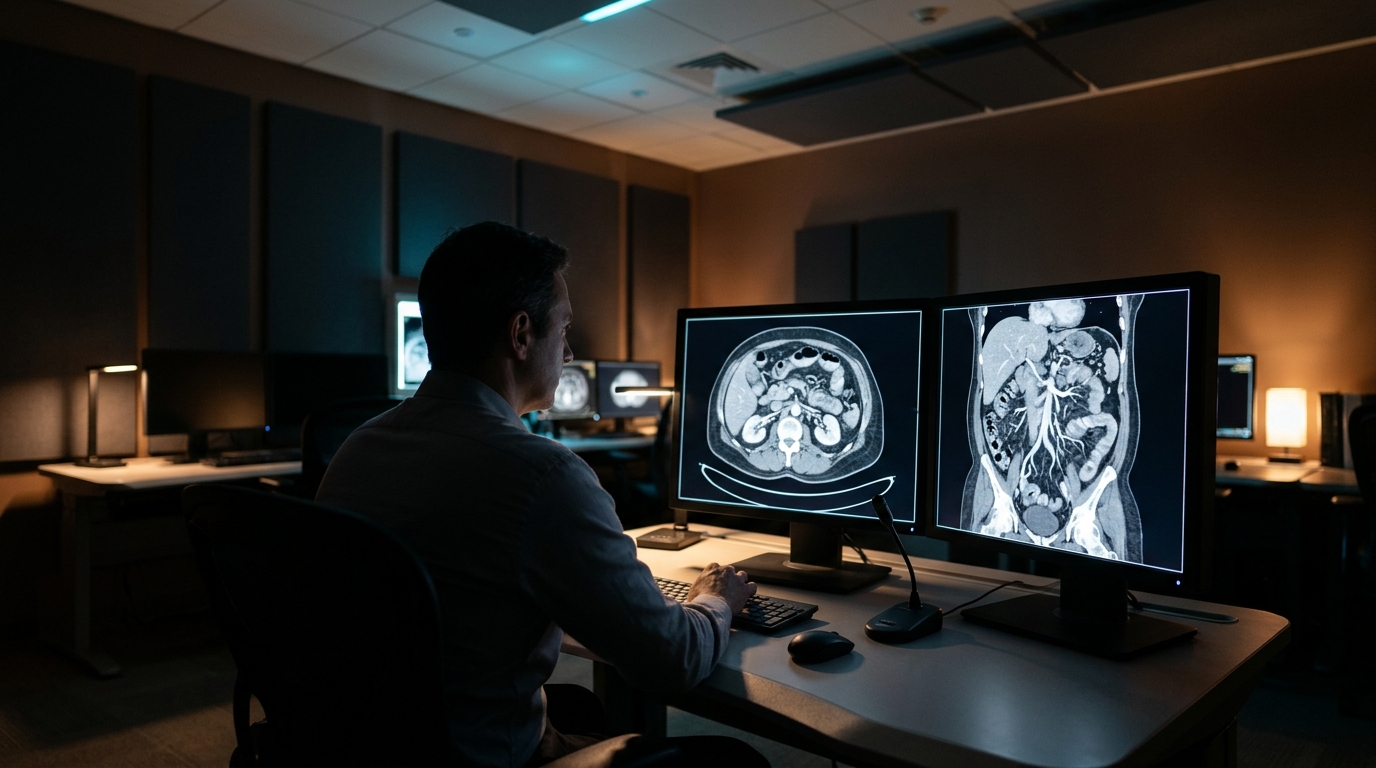
The research, published in European Radiology Abdomen, examined 158 consecutive patients with mechanical small-bowel obstruction who underwent a triphasic CT scan between January 2014 and December 2024. Each scan included unenhanced, arterial, and portal venous phases. Two senior gastrointestinal radiologists independently reviewed the images in a blinded, retrospective fashion, first reading the unenhanced images alongside the arterial phase, then, after a four-week washout interval, the unenhanced images alongside the portal phase. When they disagreed, a third senior radiologist joined a consensus reading. The reference standard for ischemia was surgical findings or, in patients managed without surgery, favorable clinical follow-up of more than one month.
Ischemia was confirmed in 48 of the 158 patients, or 30.4 percent. After consensus, the sensitivity of decreased bowel-wall enhancement as a sign of ischemia was 75 percent at the arterial phase and 65 percent at the portal phase. Specificity moved in the opposite direction: 85 percent at the arterial phase versus 91 percent at the portal phase. Neither difference reached statistical significance. The positive predictive value was 69 percent at the arterial phase and 76 percent at the portal phase, while the negative predictive value was 89 percent and 85 percent respectively.
The disagreement between phases proved revealing. In 17 of 158 patients, or 10.8 percent, the consensus reading differed between the arterial and portal phases. Fourteen of these patients showed decreased bowel-wall enhancement at the arterial phase but not at the portal phase, and six of them, or 43 percent, had documented ischemia. Conversely, three patients had decreased enhancement only at the portal phase, and one of them, or 33 percent, had confirmed ischemia. Among the 14 arterial-only positives, eight patients did not have ischemia, meaning the arterial phase generated more false positives even as it detected more true cases.
Interobserver agreement for detecting decreased bowel-wall enhancement was good and nearly identical across phases, with a Cohen’s kappa of 0.72 at the arterial phase and 0.70 at the portal phase. The radiologists systematically compared post-contrast bowel-wall attenuation with both adjacent normally enhancing loops and the corresponding loop on the unenhanced acquisition, a technique the authors credit with improving sensitivity. The study also found that requiring concordance at both phases lowered sensitivity to 62 percent but raised specificity to 93 percent, suggesting that bi-phasic agreement could serve as a high-specificity confirmatory test rather than a primary screening criterion.
The radiation cost of the extra phase was not trivial. The median dose-length product for the triphasic acquisition was 1126 mGy·cm, compared with 744 mGy·cm without the arterial phase, and the size-specific dose estimate rose from 20.67 mGy to 31.66 mGy. That represents roughly a 53 percent increase in dose, a burden the authors describe as particularly unwelcome given that it was not accompanied by a statistically significant improvement in diagnostic performance.
Decreased bowel-wall enhancement is already recognized as the most specific CT sign of small-bowel ischemia, with reported specificity of 94 to 100 percent across earlier studies and a positive likelihood ratio of 11. Yet nearly all prior work evaluated the sign only at the portal phase. Arterial-phase imaging has long been standard for suspected acute mesenteric ischemia of arterial origin, but its value in mechanical small-bowel obstruction, where ischemia typically results from venous compromise and strangulation, has been less well characterized. A small earlier study using quantitative region-of-interest measurements found that the attenuation difference between ischemic and non-ischemic bowel wall was larger at the arterial phase than at the portal phase, hinting that arterial imaging might be more sensitive.
The Paris cohort differed from many previous studies in its breadth. The population was also older, with a mean age of 73.7 years, and had a higher prevalence of ischemia than recent publications, at 30.4 percent versus 11 to 26 percent. The authors acknowledge that this selection bias toward greater disease severity may have influenced some diagnostic estimates, though they argue it did not alter the comparison between phases. A pre-specified sensitivity analysis excluding the 12 patients with suboptimal arterial-phase timing yielded essentially unchanged results.
Based on their findings, the researchers do not recommend routine addition of the arterial phase for all patients with suspected small-bowel obstruction. Instead, they suggest a low threshold for adding it in a specific high-risk subgroup: elderly patients with cardiovascular risk factors and a clinical presentation suggestive of severe disease, such as opioid-resistant pain, guarding, or shock. In these patients, the arterial phase may not only increase sensitivity for detecting decreased bowel-wall enhancement but also ensure adequate evaluation of the mesenteric vasculature, helping to distinguish mechanical obstruction from acute mesenteric ischemia of arterial origin.
The study has limitations. It was retrospective and conducted at a single center. The reference standard relied on intra-operative findings in surgical patients, which may be open to criticism when no resection was performed, and some patients may have experienced reversible ischemia that spuriously increased false positives. The CT findings themselves may have influenced the decision to operate, and ischemia can develop rapidly between scanning and surgery, though the interval was never longer than 24 hours. The authors also note that they did not evaluate other accepted signs of ischemia, such as diffuse mesenteric haziness, closed-loop configuration, bowel-wall thickening, or large ascites, though these can be assessed on either phase.
Subject of Research: Diagnostic performance of arterial versus portal phase CT for detecting decreased bowel-wall enhancement as a sign of ischemia in mechanical small-bowel obstruction
Article Title: Qualitative evaluation of decreased bowel-wall enhancement by CT as supporting ischemia in mechanical small bowel obstruction: diagnostic performance of the arterial vs. the portal phase
Article References: Obadia, I., Dallongeville, A., Pasqualin, F., Fels, A., Boulay-Coletta, I., Tardivel, A. M., & Zins, M. (2026). Qualitative evaluation of decreased bowel-wall enhancement by CT as supporting ischemia in mechanical small bowel obstruction: diagnostic performance of the arterial vs. the portal phase. European Radiology Abdomen, 1(1), Article 15. https://doi.org/10.1007/s44501-026-00009-1
Image Credits: AI Generated
DOI: 10.1007/s44501-026-00009-1
Keywords: small bowel obstruction, bowel ischemia, decreased bowel-wall enhancement, arterial phase CT, portal phase CT, diagnostic performance, radiation dose, emergency radiology, closed-loop obstruction, consensus reading, interobserver agreement, triphasic CT
News Source: Ophelia Keating. (November 5, 2026). Arterial-phase CT spots bowel ischemia sooner in small-bowel obstruction, at a radiation cost. Scienmag.