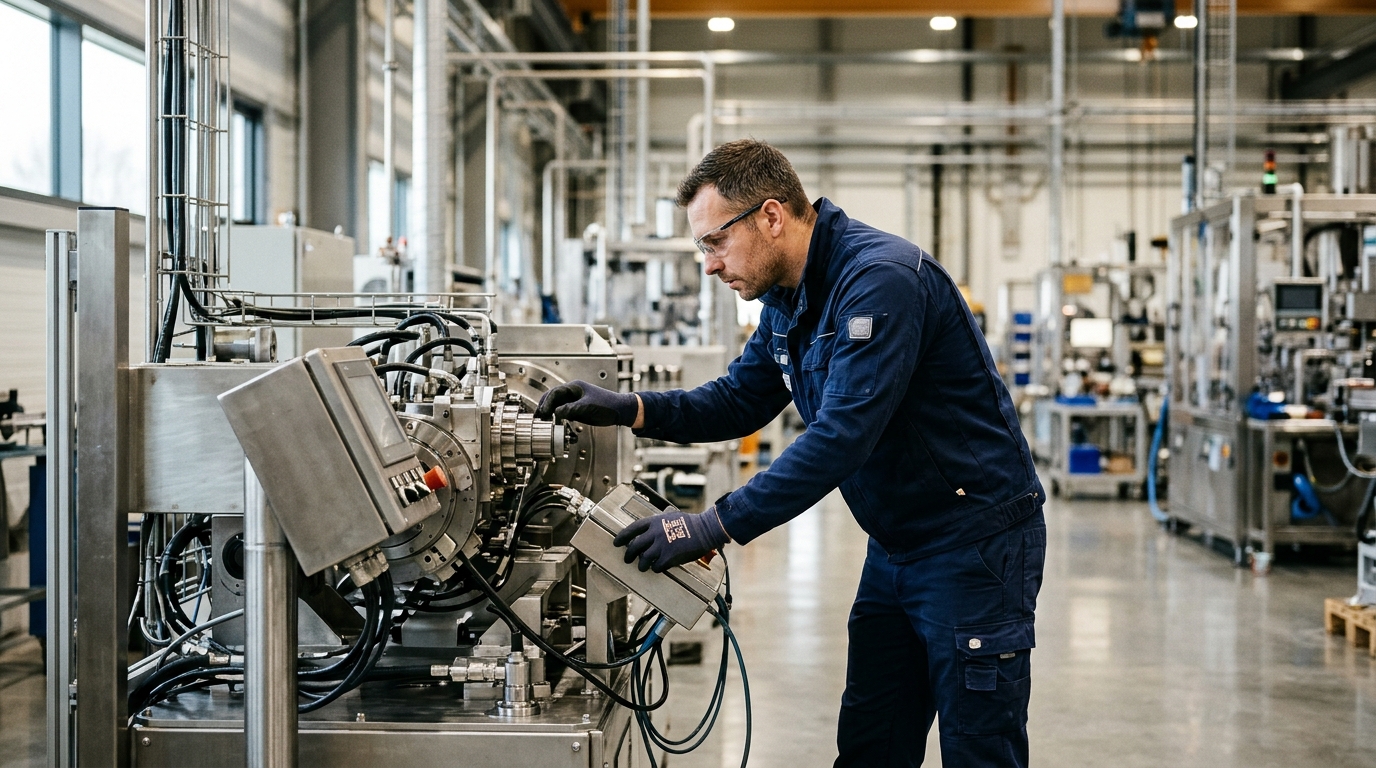
Industrial maintenance is often imagined as a purely mechanical discipline of wrenches, sensors, and replacement parts. A new systematic review argues that this picture is incomplete: the human beings who plan, execute, and supervise maintenance work have become a central research concern in their own right. The study, published in Frontiers in Manufacturing Technology, mapped 355 documents indexed in Scopus and Web of Science between 2010 and 2025 to trace how human factors—error, reliability, ergonomics, safety culture, competencies, and human–technology interaction—have shaped the science of keeping industrial systems running.
The bibliometric analysis, led by Yusimit Zamora Hernández of the Universidad Técnica Estatal de Quevedo and colleagues at Ecuadorian universities, found a field expanding at a compound annual growth rate of 11.69 percent. Output rose from an average of 13 documents per year between 2010 and 2014 to 63 publications in 2025, a 133 percent increase over 2024. Growth accelerated visibly from 2019 onward, a timing the authors link to rising academic and industrial interest in what Industry 4.0 technologies mean for the maintenance workforce. Citation peaks clustered in 2014 and 2020, tied to influential work on maintenance performance metrics and Industry 4.0 transformation.
The numbers behind the corpus reveal a discipline that is international but dispersed. The 355 documents appeared across 227 journals, written by 347 unique authors from 72 countries. Most were research articles—335 articles against 20 reviews—with an average of 3.42 co-authors per document and 42 single-authored works. Average citations per document stood at 16.56, which the authors describe as a moderate level of scientific influence. The 1,206 unique author keywords point to a conceptual field that blends maintenance management, human reliability, ergonomics, safety culture, workforce management, and digital transformation rather than converging on a single specialized outlet.
Geographically, China leads scientific production with 28 documents, or 7.89 percent of the total, followed by India with 21 and Canada with 18. The United States and Italy each contributed 16 documents, and the top 15 countries together account for 58.59 percent of output. Yet the analysis also exposes stark gaps: Latin America is represented mainly by Brazil with 8 publications, and African participation beyond Nigeria and South Africa is minimal. The authors caution that uneven regional and linguistic coverage in Scopus and Web of Science can reduce the visibility of research published in locally oriented or non-English journals, so the maps should not be read as an absence of industrial need or locally generated knowledge in underrepresented regions.
Institutionally, Ferdowsi University of Mashhad in Iran leads with 11 articles, followed by Memorial University of Newfoundland in Canada and the University of Lagos in Nigeria with 9 each. The prominence of universities from Iran, Nigeria, Turkey, Malaysia, and India suggests, according to the authors, that human factor research in maintenance responds to practical industrial needs in emerging economies, not only to the agendas of highly industrialized countries. The strongest bilateral collaboration link is between Australia and Canada, with 8 joint publications, followed by Canada–United States with 5 and Australia–United States with 4—an Anglophone axis the review associates with shared traditions in human reliability analysis, safety engineering, maritime systems, and offshore operations.
The intellectual foundations of the field trace back to a single landmark. Co-citation analysis confirms Reason’s 1990 human error model as the dominant theoretical reference. That model categorized human failures as slips, lapses, mistakes, and violations within a systemic framework, and the review finds research has since progressed toward more comprehensive approaches integrating cognitive, organizational, and contextual variables. Keyword analysis identifies “maintenance” with 39 occurrences, “human factors” with 31, and “human error” with 24 as the conceptual core, while “Industry 4.0” with 19, “predictive maintenance” with 18, and “artificial intelligence” with 10 reflect the growing digital influence. Technology-oriented keywords accelerated sharply after 2020, indicating a shift from retrospective error analysis toward prospective integration of human capabilities with intelligent systems.
The most cited individual works reinforce this dual character. Silvestri and colleagues’ 2020 paper on maintenance transformation through Industry 4.0 tops the list with 271 citations, followed by Kumar and colleagues’ 2013 state-of-the-art review of maintenance performance metrics with 191. Noroozi and colleagues’ 2013 analysis of human error in risk analysis earned 123 citations, and four of the ten most cited documents focus directly on human error and human reliability. The inclusion of Herrmann and Pfeiffer’s 2023 work on keeping the organization in the loop, with 99 citations, signals an emerging orientation toward human-centric artificial intelligence and socio-technical approaches.
Beyond the bibliometric counts, the authors conducted a directed qualitative content synthesis of all 355 records, which revealed four interdependent research streams. The first centers on human error and reliability assessment, where methods such as SLIM, HEART, SHERPA, Bayesian networks, and fuzzy approaches quantify error probabilities in process, maritime, aviation, railway, and power-plant maintenance. The second addresses organizational, ergonomic, and competency factors, including safety culture, fatigue, cognitive load, motivation, and training. The third focuses on workforce planning and maintenance optimization—scheduling, workforce sizing, multi-skilling, and dispatching policies that demonstrably affect productive system performance. The fourth examines human–technology interaction under Industry 4.0 and 5.0, where augmented reality, artificial intelligence, digital twins, and robotics are redefining the operator’s role and decision environment.
The synthesis also exposes an asymmetric field with uneven maturity. Human-error quantification is methodologically established but remains dominated by retrospective or static models that are often task-specific; the authors call for dynamic, longitudinal, and cross-sector models linking performance-shaping factors to observed safety and availability outcomes. Meanwhile, the fastest-growing digital stream has limited field evidence about cognitive workload, trust in automation, skill transformation, and long-term safety consequences, with much of the existing evidence described as conceptual, laboratory-based, or prototype-level. Organizational and workforce studies bridge these streams but seldom combine individual, team, organizational, and equipment-level outcomes within a single design. Augmented reality has been identified as a promising tool for reducing human errors during complex maintenance tasks by providing contextualized real-time instructions, though Frontiers research cited in the review emphasizes that such tools should be evaluated in real maintenance environments, considering usability, user satisfaction, task conditions, and cognitive demands among workers.
The review concludes that human-centered maintenance management is emerging as a socio-technical field at the intersection of human reliability, digital transformation, ergonomics, organizational safety, and workforce development. Three cross-cutting gaps define its future agenda: multilevel socio-technical models connecting cognition, organizational conditions, and maintenance performance; longitudinal, real-world evaluation of human-in-the-loop predictive maintenance and explainable artificial intelligence; and comparative evidence from underrepresented regions, especially Latin America and Africa. For practitioners, the authors recommend that evaluations of digital maintenance report not only availability, cost, and error rates, but also workload, trust in automation, usability, skill retention, recovery from anomalies, and safe human oversight. They also suggest periodic bibliometric updates, ideally every five years, to monitor a field that is expanding too quickly for any single snapshot to hold for long.
Subject of Research: Bibliometric analysis of human factor dimensions in industrial maintenance management research from 2010 to 2025
Article Title: Human factor dimensions in industrial maintenance management: a systematic literature review and bibliometric analysis (2010–2025)
Article References: Hernández, Y. Z., Orellana, S. M., Tamayo, Y. M., & Fajardo Aguilar, P. J. (2026). Human factor dimensions in industrial maintenance management: a systematic literature review and bibliometric analysis (2010–2025). Frontiers in Manufacturing Technology, 6, Article 1881712. https://doi.org/10.3389/fmtec.2026.1881712
Image Credits: AI Generated
DOI: 10.3389/fmtec.2026.1881712
Keywords: industrial maintenance, human factors, human error, bibliometric analysis, human reliability, Industry 4.0, Industry 5.0, predictive maintenance, ergonomics, safety culture, systematic review, digital transformation
News Source: Denise Maddox. (November 5, 2026). Human factors take center stage in industrial maintenance research surge. Scienmag.