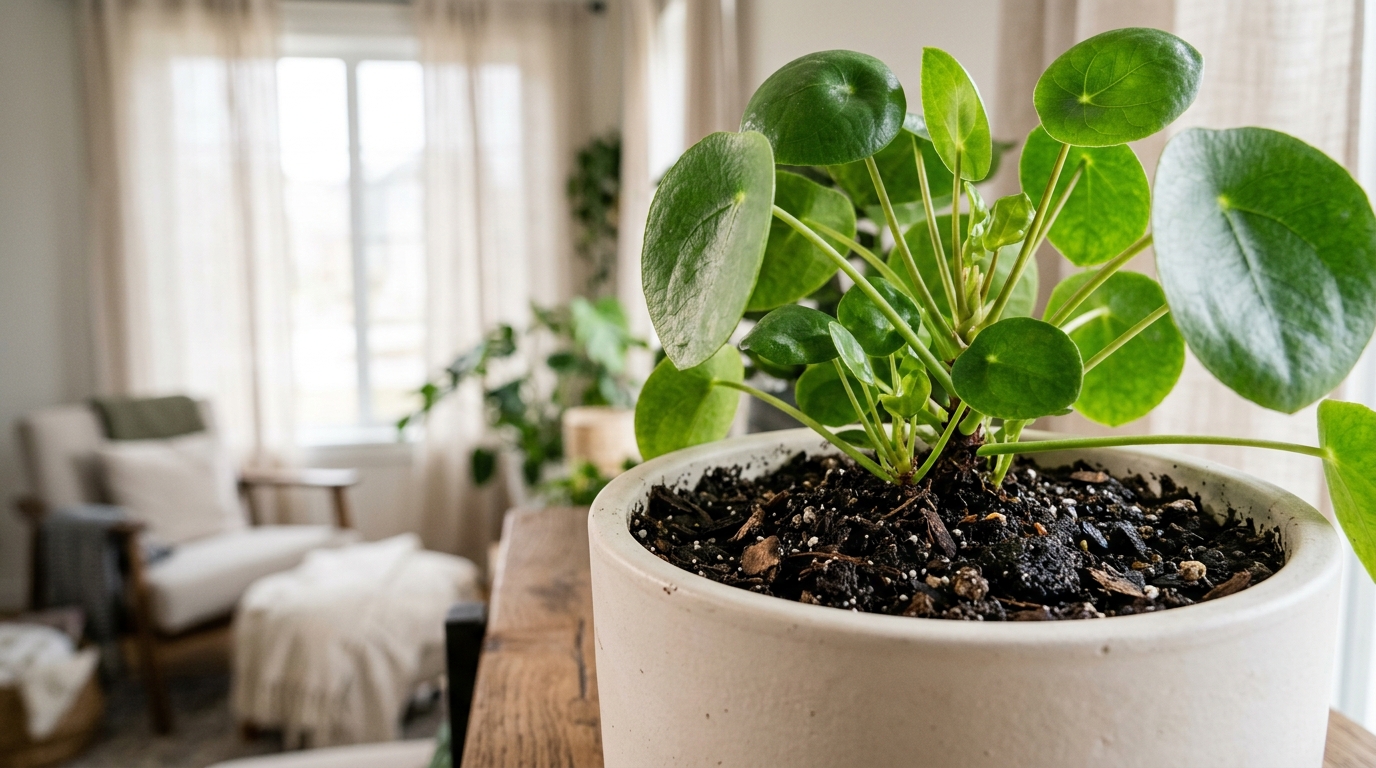
Ammonia is best known as an agricultural and industrial pollutant, but a new study suggests that a common ornamental houseplant working together with its potting substrate could help strip it from the air. Researchers tested Radermachera sinica, the China doll plant, in combination with its growing medium and found that the pairing removed a substantial share of ammonia delivered through an enclosed system, with performance depending strongly on how the air reached the plant.
The study, published in the journal Air Quality, Atmosphere & Health, evaluated both purification efficiency and plant tolerance under ammonia exposure. The team forced air containing ammonia through the plant–substrate system at three inlet concentrations: 6.8 milligrams per cubic meter, 12.1 milligrams per cubic meter, and 18.9 milligrams per cubic meter. In this active mode, where air was pushed through the substrate, removal efficiency reached 78 to 92 percent when plants were present and 55 to 86 percent with substrate alone.
Performance dropped considerably when ammonia was not forced through the system. Under passive fumigation, the plant–substrate combination removed 25 to 64 percent of the ammonia, while substrate alone managed only 10 to 42 percent. The contrast indicates that contact between the polluted air and the substrate is a key factor: the more thoroughly the air passes through the growing medium, the more ammonia is captured.
That substrate contribution is one of the study’s central findings. Most of the ammonia captured by the substrate was held in the form of ammonium nitrogen, or NH4+-N, meaning the growing medium acted as a significant chemical sink rather than a passive support for the roots. The authors note that further work could explore converting this ammonium nitrogen into nitrate nitrogen, a form the plant can take up more readily, which would in turn reduce the ammonia stress experienced by the plant.
The plant itself responded measurably to the ammonia it helped remove. Leaf chlorophyll content increased after the purification period, and the increase was greatest at the highest ammonia concentration tested. Leaf nitrogen content also rose, consistent with the plant absorbing some of the nitrogen contained in the ammonia it encountered.
Not every response was benign. The researchers measured elevated levels of malondialdehyde, a marker of lipid damage in cell membranes, along with increased electrolyte leakage, both of which signaled adverse effects from ammonia exposure. In response, peroxidase activity in the leaves increased, an enzymatic shift the authors interpret as a mechanism that helps the plant tolerate the ammonia burden. The pattern suggests the plant was under physiological stress even as it participated in removing the pollutant.
The findings position plant–substrate systems as a candidate nature-based approach for ammonia removal, a pollutant the authors describe as a threat to the ecological environment. Because the active mode, in which air is forced through the substrate, consistently outperformed passive exposure, practical applications would likely require engineered airflow rather than simply placing a plant in a room. The study also highlights that the substrate, not only the foliage, does much of the removal work, which has implications for how such systems are designed and maintained.
The work remains at the laboratory stage, with results drawn from controlled chamber experiments at specific ammonia concentrations rather than from measurements in occupied buildings or open environments. The reported efficiencies apply to the tested inlet levels and airflow conditions, and the physiological measurements reflect short-term responses under experimental exposure. The authors frame their results as a basis for further study, particularly on the transformation of captured ammonium nitrogen into nitrate, rather than as a demonstration of a ready-to-deploy air purification technology.
Even with those limits, the study adds a quantified data point to the growing literature on phytoremediation, the use of plants and their associated media to remove pollutants from air. By reporting removal efficiencies across three ammonia concentrations, in both active and passive modes, and by tracking the plant’s chlorophyll, membrane damage, and enzyme responses alongside the substrate’s nitrogen capture, the research offers a detailed picture of how a single ornamental species and its growing medium perform when asked to clean ammonia from the air.
Subject of Research: Phytoremediation of airborne ammonia using Radermachera sinica plants and growing substrate, including plant tolerance responses under ammonia exposure.
Article Title: Phytoremediation potential of Radermachera sinica – substrate for NH3 and plant tolerance
Article References: Yu, W.-J., Yao, K.-Z., Wang, Y., Lin, S., Hu, R.-G., & Xiang, R.-B. (2026). Phytoremediation potential of Radermachera sinica – substrate for NH3 and plant tolerance. Air Quality, Atmosphere & Health, 19(11), Article 252. https://doi.org/10.1007/s11869-026-02147-6
Image Credits: AI Generated
DOI: 10.1007/s11869-026-02147-6
Keywords: ammonia, phytoremediation, Radermachera sinica, air purification, plant tolerance, chlorophyll, malondialdehyde, electrolyte leakage, peroxidase, substrate, ammonium nitrogen, indoor air quality
News Source: Russell Cooper. (November 5, 2026). Houseplant and potting soil strip ammonia from air, study finds. Scienmag.