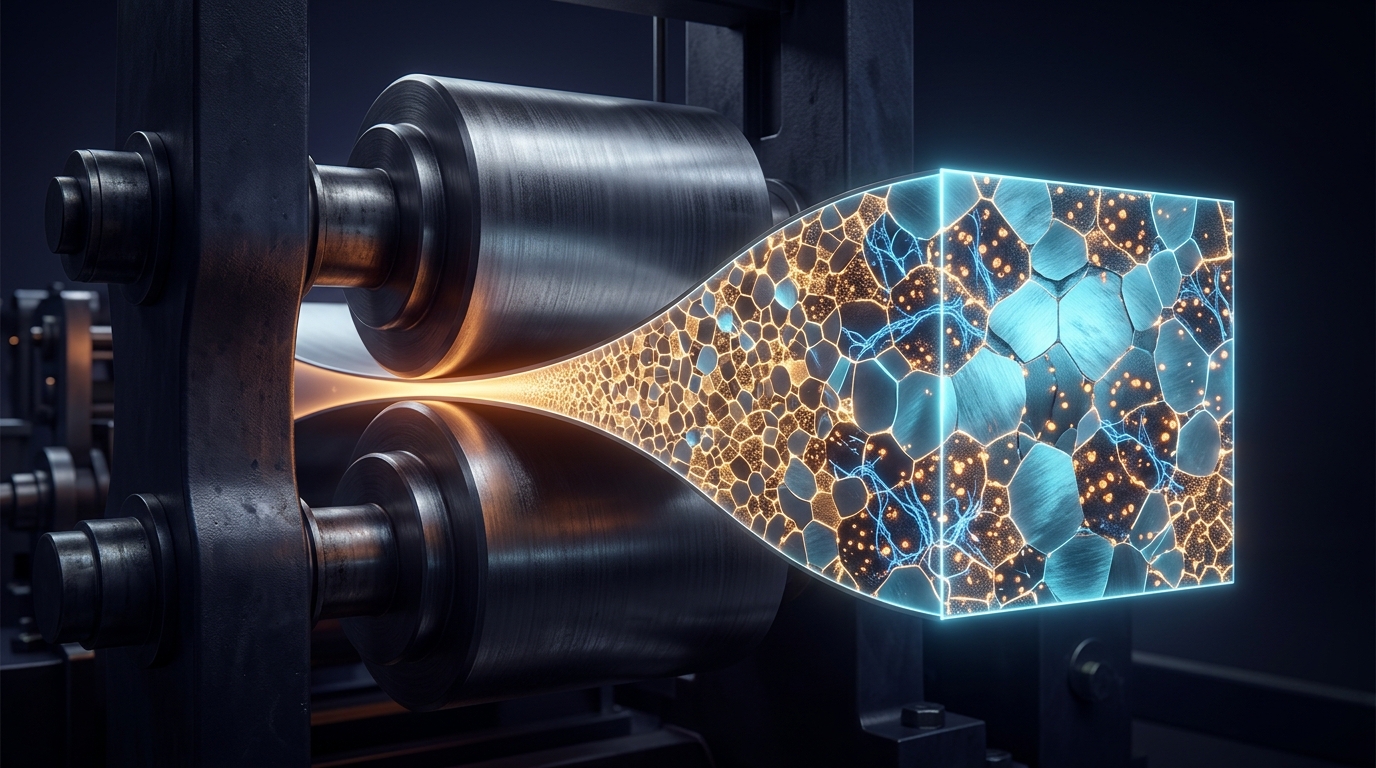
Heterogeneous metallic materials have attracted attention because they can soften the usual trade-off between strength and ductility, in which microstructures that resist deformation tend to fail early, while microstructures that deform easily tend to be weak. A new study reports an industrially feasible route to a more advanced version of this idea in high-strength aluminum alloys: instead of tuning a single microstructural feature such as grain size, the researchers created dual heterogeneity, in which both the fibrous grain structure and the crystallographic texture vary non-uniformly through the material. The work appears in the Journal of Materials Science.
The strategy centers on a variable that is already familiar in industrial metalworking: the number of rolling passes. The authors thermomechanically processed Al–Zn–Mg–Cu alloys while keeping the total rolling strain the same, but distributing that strain over different numbers of passes. They compared conditions with 5, 8 and 11 passes and tracked how the microstructure responded to this change in deformation history.
The results show that pass number acts as a sensitive control knob for microstructural uniformity. As the pass count rose from 5 to 8 and then to 11, the fibrous grain microstructure evolved from a homogeneous distribution to a heterogeneous one and then back to a nearly homogeneous state, despite the identical total rolling strain. In other words, the same overall deformation produced markedly different grain architectures depending on how it was applied.
The retained rolling texture followed a parallel but distinct trajectory. The fraction of retained rolling texture decreased from 66.9% in the 5-pass condition to 34.2% in the 8-pass condition, then rose again to 41.2% in the 11-pass condition. Because texture describes the preferred orientation of grains and strongly influences anisotropic mechanical behavior, this non-monotonic response means that pass regulation reshaped both major microstructural levers simultaneously rather than only one.
Among all the conditions examined, the 8-pass alloys displayed the most pronounced dual heterogeneity in both the fibrous grain structure and the texture. This intermediate pass count apparently creates a processing window in which neither feature has relaxed back toward uniformity, allowing the two heterogeneous distributions to coexist in the same material.
That microstructural state translated directly into mechanical performance. The 8-pass alloy achieved an optimal strength–ductility synergy, recording a yield strength of 542.2 MPa together with an elongation of 14.5%. For Al–Zn–Mg–Cu systems, which are prized as 7xxx-series aerospace-grade aluminum alloys, combining a yield strength above half a gigapascal with double-digit elongation represents a favorable balance of the two properties that usually compete.
The significance of the result lies partly in its scalability. The authors note that current fabrication strategies for dual-heterogeneous microstructures have largely been limited to laboratory-scale production, whereas rolling pass regulation relies on equipment and process steps already standard in industrial thermomechanical treatment. Adjusting how many passes are used to deliver a fixed rolling strain requires no exotic alloying additions or novel processing platforms, which makes the approach straightforward to test on existing production lines.
The study also adds a conceptual point to the heterogeneous materials literature: pass number is not a monotonic dial. Because grain heterogeneity peaked at 8 passes while texture retention followed a dip-and-recover pattern, achieving the most useful dual heterogeneity depends on hitting an intermediate processing condition rather than simply increasing or decreasing deformation intensity. The authors frame the work as providing an industrially applicable approach for fabricating dual-heterogeneous metallic materials with enhanced strength–ductility synergy through regulation of the rolling pass.
For engineers working on lightweight structural metals, the findings suggest a practical lever for tailoring microstructure in high-strength aluminum alloys: by regulating how a fixed rolling strain is divided into passes, producers can steer the material between homogeneous and heterogeneous grain and texture states, and select the pass count that yields the best combination of strength and ductility for a given application.
Subject of Research: Industrial-scale fabrication of dual-heterogeneous Al–Zn–Mg–Cu aluminum alloys by regulating rolling pass number during thermomechanical treatment
Article Title: Dual-heterogeneous Al–Zn–Mg–Cu alloys with improved strength–ductility synergy by rolling pass regulation
Article References: Liang, E., Lin, X., & Li, D. (2026). Dual-heterogeneous Al–Zn–Mg–Cu alloys with improved strength–ductility synergy by rolling pass regulation. Journal of Materials Science. https://doi.org/10.1007/s10853-026-14022-x
Image Credits: AI Generated
DOI: 10.1007/s10853-026-14022-x
Keywords: Al–Zn–Mg–Cu alloys, dual heterogeneity, rolling passes, thermomechanical treatment, strength–ductility synergy, yield strength, elongation, fibrous grain structure, rolling texture, Journal of Materials Science, industrial-scale processing, high-strength aluminum alloys
News Source: Denise Maddox. (November 4, 2026). Rolling pass count tunes dual-heterogeneous Al–Zn–Mg–Cu alloys for strength–ductility synergy. Scienmag.