• HOME
  • NEWS
  • EXPLORE
    • CAREER
      • Companies
      • Jobs
    • EVENTS
    • iGEM
      • News
      • Team
    • PHOTOS
    • VIDEO
    • WIKI
  • BLOG
  • COMMUNITY
    • FACEBOOK
    • INSTAGRAM
    • TWITTER
Wednesday, April 1, 2026
BIOENGINEER.ORG
No Result
View All Result
  • Login
  • HOME
  • NEWS
  • EXPLORE
    • CAREER
      • Companies
      • Jobs
        • Lecturer
        • PhD Studentship
        • Postdoc
        • Research Assistant
    • EVENTS
    • iGEM
      • News
      • Team
    • PHOTOS
    • VIDEO
    • WIKI
  • BLOG
  • COMMUNITY
    • FACEBOOK
    • INSTAGRAM
    • TWITTER
  • HOME
  • NEWS
  • EXPLORE
    • CAREER
      • Companies
      • Jobs
        • Lecturer
        • PhD Studentship
        • Postdoc
        • Research Assistant
    • EVENTS
    • iGEM
      • News
      • Team
    • PHOTOS
    • VIDEO
    • WIKI
  • BLOG
  • COMMUNITY
    • FACEBOOK
    • INSTAGRAM
    • TWITTER
No Result
View All Result
Bioengineer.org
No Result
View All Result
Home NEWS Science News

CCNY-led team develops cancer imaging aid from horse chestnuts

Bioengineer by Bioengineer
December 12, 2017
in Science News
Reading Time: 2 mins read
0
Share on FacebookShare on TwitterShare on LinkedinShare on RedditShare on Telegram
IMAGE

Credit: City College of New York

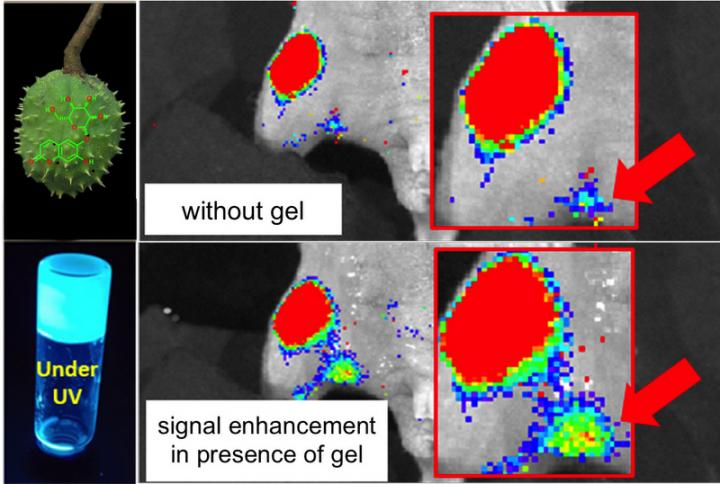
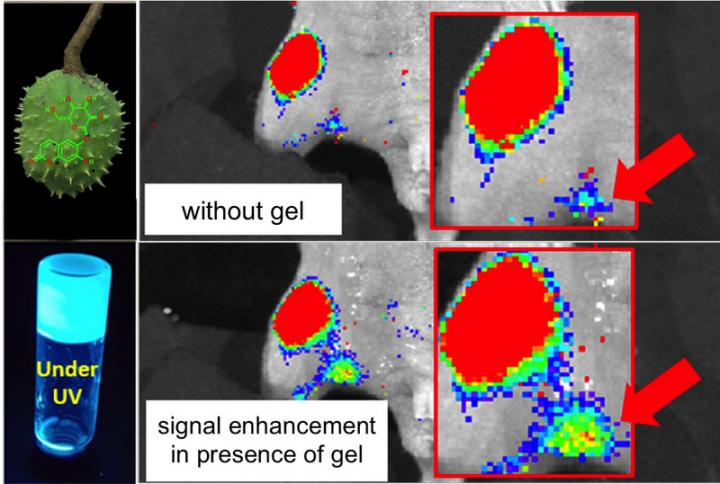
Research at The City College of New York shows that cancer imaging can be simplified by a photonic process utilizing molecules derived from horse chestnuts. The study with potential to better detect the presence of cancer is led by George John, professor in City College's Division of Science, in collaboration with Jan Grimm, a physician scientist at Sloan Kettering Institute who is also affiliated with Memorial Sloan Kettering Cancer Center and Weill Cornell Medical College.

The team has developed a radiation responsive esculin-derived molecular gel, that is both scintillating and fluorescent, to enhance the optical photon output in image mapping for cancer imaging.

Esculin, or Æsculin, is a coumarin glucoside that naturally occurs in the horse chestnut, a plant extract. It is beneficial to circulatory health.

A challenge currently in cancer imaging is that optical imaging of radiotracers through Cerenkov light (the Grimm lab is one of the leading labs in this field) often produces light that is typically low in intensity and blue-weighted (greatly scattered and absorbed in vivo). It is therefore imperative to increase or shift the photon flux for improved detection.

The gel has been developed to address this challenge.

"Tailoring biobased materials to synthesize thixotropic thermo-reversible hydrogels offers image-aiding systems which are not only functional but also potentially economical, safe, and environmentally friendly," said John.

"The possibility of developing a topical application from the gel makes this innovation an attractive potential improvement to current techniques of cancer imaging with Cerenkov light," added Grimm.

A Fellow of Britain's Royal Society of Chemistry, John's research is rooted in the idea that innovation can be inspired by nature to develop economical and green technologies for a sustainable future.

###

Also involved in the research at CCNY's Center for Discovery and Innovation and scientists from Memorial Sloan Kettering Cancer Center, Weill Cornell Medical College, the Graduate Center, CUNY and Hunter College. The team includes Julian Silverman, Nabendu B. Pramanik, Malick Samateh and Sai Sateesh Sagiri from City College; Travis Shaffer and Qize Zhang from MSKCC.

The study appears in the journal ACS Appl Mater Interfaces.

Media Contact

Jay Mwamba
[email protected]
212-650-7580

http://www2.ccny.cuny.edu

Original Source

https://www.ccny.cuny.edu/news/ccny-led-team-develops-cancer-imaging-aid-horse-chestnuts

Share12Tweet8Share2ShareShareShare2

Related Posts

Tracking Research on Adult Outcomes After Complex Perinatal History

April 1, 2026

Unveiling the Biological Pathways Linking Pesticides to Cancer Risk: New Study Sheds Light on Environmental Health Impacts

April 1, 2026

Inequities in Family Engagement Within the NICU

April 1, 2026

FGFR2b Links to Biomarkers, Tumor Diversity, Survival

April 1, 2026
Please login to join discussion

POPULAR NEWS

  • blank

    Revolutionary AI Model Enhances Precision in Detecting Food Contamination

    96 shares
    Share 38 Tweet 24
  • Imagine a Social Media Feed That Challenges Your Views Instead of Reinforcing Them

    1006 shares
    Share 398 Tweet 249
  • Promising Outcomes from First Clinical Trials of Gene Regulation in Epilepsy

    51 shares
    Share 20 Tweet 13
  • Popular Anti-Aging Compound Linked to Damage in Corpus Callosum, Study Finds

    43 shares
    Share 17 Tweet 11

About

We bring you the latest biotechnology news from best research centers and universities around the world. Check our website.

Follow us

Recent News

Tracking Research on Adult Outcomes After Complex Perinatal History

Unveiling the Biological Pathways Linking Pesticides to Cancer Risk: New Study Sheds Light on Environmental Health Impacts

Inequities in Family Engagement Within the NICU

Subscribe to Blog via Email

Success! An email was just sent to confirm your subscription. Please find the email now and click 'Confirm' to start subscribing.

Join 78 other subscribers
  • Contact Us

Bioengineer.org © Copyright 2023 All Rights Reserved.

Welcome Back!

Login to your account below

Forgotten Password?

Retrieve your password

Please enter your username or email address to reset your password.

Log In
No Result
View All Result
  • Homepages
    • Home Page 1
    • Home Page 2
  • News
  • National
  • Business
  • Health
  • Lifestyle
  • Science

Bioengineer.org © Copyright 2023 All Rights Reserved.