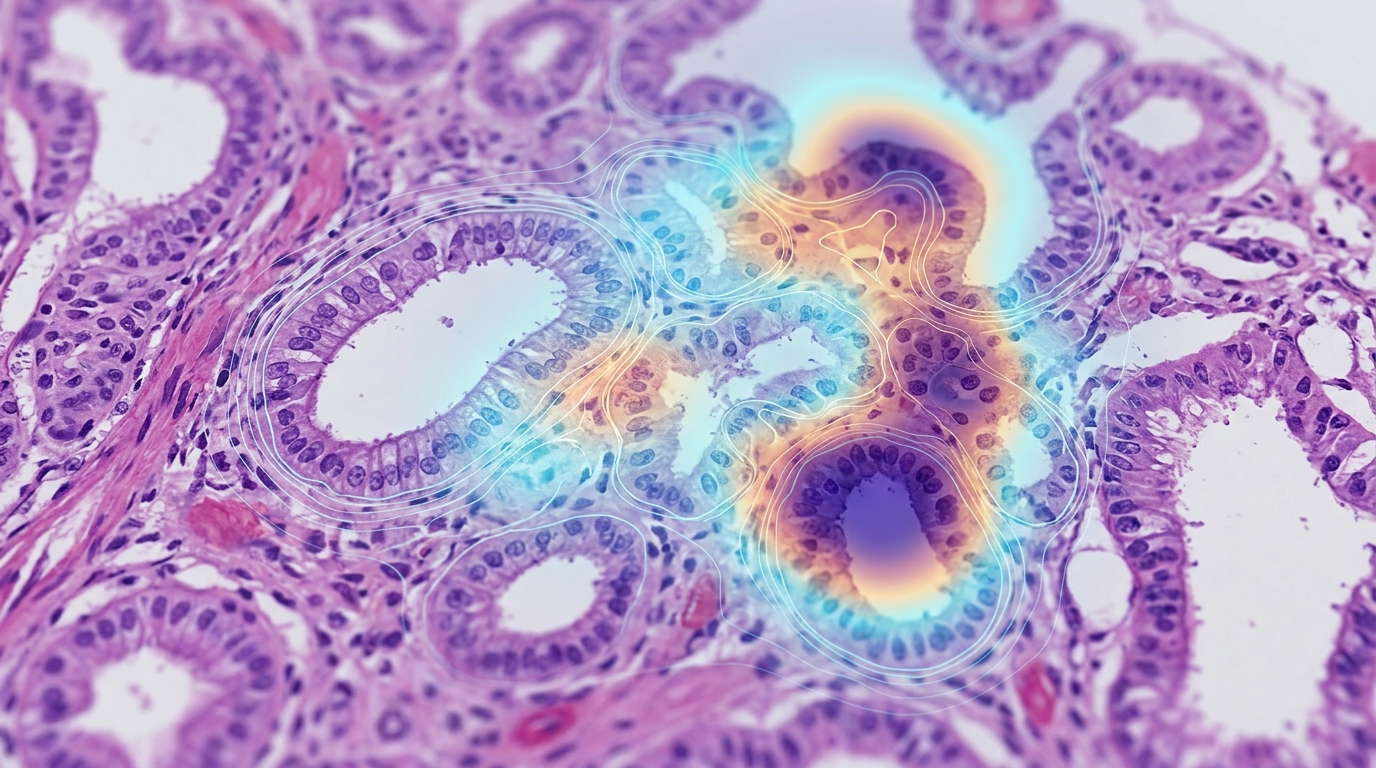
Artificial intelligence assistance measurably improved the diagnostic performance of pathology residents interpreting prostate core biopsies, with the largest gains seen among the least experienced trainees, according to a prospective within-subject study published in BMC Medical Education.
The results showed a clear accuracy improvement in both experience groups, but the magnitude differed sharply. Among less experienced residents, observed accuracy rose from 62.3 percent to 75.1 percent, an increase of 12.9 percentage points with a 95 percent confidence interval of 7.8 to 18.7. Among experienced residents, accuracy rose from 77.9 percent to 83.0 percent, a gain of 5.1 percentage points with a 95 percent confidence interval of 3.2 to 7.5. In other words, the AI tool narrowed the performance gap between junior and senior trainees during assisted reading.
At the level of individual diagnostic decisions, the model estimated that AI assistance increased the odds of a correct diagnosis by a factor of 2.39, with a 95 percent credible interval of 1.94 to 2.96. The odds of detecting cancer rose by a factor of 2.55, with a credible interval of 1.83 to 3.62, and the odds of correctly classifying a benign slide rose by a factor of 2.76, with a credible interval of 2.04 to 3.74. These estimates come from the hierarchical model rather than from simple raw counts, which allows uncertainty to be quantified for each effect.
The interaction between AI assistance and experience told a more nuanced story. For experienced residents, the relative benefit of AI was smaller for accuracy, with an odds ratio of 0.65 and a credible interval of 0.48 to 0.87, and for specificity, with an odds ratio of 0.49 and a credible interval of 0.32 to 0.74. For sensitivity, however, the interaction was not statistically clear, with an odds ratio of 0.82 and a credible interval of 0.51 to 1.37. This pattern suggests that experienced residents had less room to improve on benign classifications, where their unaided performance was already strong, while cancer detection gains were more comparable across experience levels.
Error accounting revealed how the AI display changed diagnostic outcomes slide by slide. Of the 786 errors residents made during unaided review, 307, or 39 percent, were converted into correct diagnoses when the AI annotations were displayed. At the same time, 75 of the 1913 correct unaided diagnoses, or 3.9 percent, were flipped into errors under assistance. This asymmetry, roughly ten correct conversions for every incorrect one, underlies the net accuracy gains reported in the study and illustrates the trade-off inherent in any decision-support system that can both correct and introduce mistakes.
AI benefit was larger on more difficult slides, a finding the authors interpret as consistent with ceiling effects on easy slides, where residents performed near the maximum and the tool had little room to add value. This difficulty dependence matters for deployment decisions, because it implies that AI assistance may contribute most where diagnostic uncertainty is greatest, such as subtle or borderline prostate lesions.
The study design carries important limitations that the authors state explicitly. Because the fixed reading order always placed unaided review before AI-assisted review of the same slides, the analysis cannot separate the effect of AI assistance from the effect of a second look at the slides. Learning and retention were not measured, so the findings speak only to performance during assisted reading, not to whether residents internalize the AI’s diagnostic cues or improve over time as a result of using the tool. The authors therefore frame AI as a diagnostic decision-support tool for trainees and describe its educational value as a hypothesis that requires longitudinal, counterbalanced studies to test.
Within those constraints, the study adds quantitative evidence to a growing body of work on AI in digital pathology. The combination of a within-subject design, a defined slide set spanning malignant, benign and atypical categories, experience-based stratification and Bayesian modeling with credible intervals gives the results a level of precision uncommon in early evaluations of AI decision support for trainees. The reported effects, a 2.39-fold increase in the odds of a correct diagnosis and a 12.9 percentage point accuracy gain among less experienced residents, are large enough to be clinically relevant if they hold in settings where the reading order is counterbalanced and long-term learning outcomes are tracked. For now, the study supports AI assistance as a tool that improves resident performance on prostate biopsy interpretation in the moment, with the greatest benefit for junior trainees and challenging cases, while leaving open the question of how such assistance shapes the development of independent diagnostic skill.
Subject of Research: AI-assisted digital pathology and diagnostic accuracy of pathology residents interpreting prostate biopsies
Article Title: AI-assisted digital pathology improves diagnostic performance and reduces experience-related performance gaps in pathology residents interpreting prostate biopsies
Article References: Zhu, M., Shi, W., Jin, T., An, R., Chen, S., Duan, X., Guo, L., Han, F., Harmon, C., Li, S., Ren, D., Wang, T., Wang, X., Yu, H., Zhang, M., Zhou, R., Zhang, V., Deng, F.-M., Lee, P., … Sali, R. (2026). AI-assisted digital pathology improves diagnostic performance and reduces experience-related performance gaps in pathology residents interpreting prostate biopsies. BMC Medical Education. https://doi.org/10.1186/s12909-026-10742-5
Image Credits: AI Generated
DOI: 10.1186/s12909-026-10742-5
Keywords: artificial intelligence, digital pathology, prostate biopsy, pathology residents, diagnostic accuracy, Gleason grading, Bayesian hierarchical models, medical education, decision support, genitourinary pathology, AI-assisted, digital
News Source: Ophelia Keating. (November 4, 2026). AI Tool Helps Pathology Residents Read Prostate Biopsies More Accurately. Scienmag.