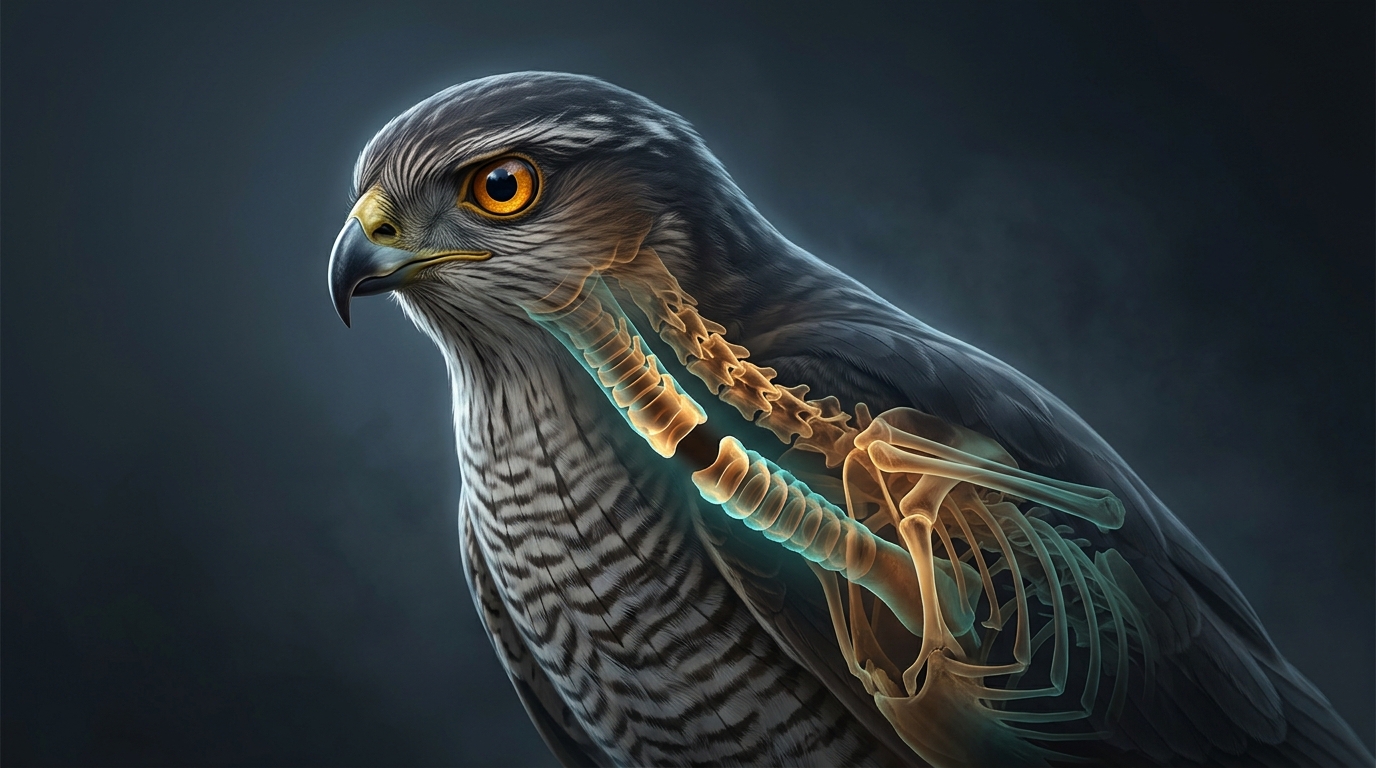
A Eurasian sparrowhawk (Accipiter nisus) examined by veterinary researchers was found to be missing one of the cartilaginous rings that stiffen its windpipe, a defect invisible from the outside. The gap was documented using non-destructive, high-resolution micro-computed tomography at a spatial resolution of 0.048 mm, which revealed the absence of the 45th tracheal ring with no evidence of additional skeletal abnormalities. Writing in BMC Veterinary Research, the team describes this as, to the best of their knowledge, the first report of congenital absence of a tracheal ring in a wild bird imaged with micro-CT.
Congenital tracheal developmental disorders in birds are rarely reported in the veterinary literature, and the authors argue they may be underdetected in wild populations because diagnostic and post-mortem investigations are limited. An animal that dies in rehabilitation is seldom examined with equipment capable of resolving a single missing cartilage ring, so anomalies of this kind can pass unnoticed even when a carcass is available.
The clinical significance lies in what a gap in the airway’s scaffolding can do. The authors note that the anomaly may be associated with manifestations consistent with tracheal instability, including respiratory stridor, abnormal respiratory sounds, coughing, wheezing and altered vocalisation. A segment of windpipe lacking rigid support can deform as the bird breathes, vibrate audibly and interfere with normal airflow.
Vocalisation matters in a raptor. The authors point out that vocal communication plays a role in territorial behaviour and reproduction, so a structural abnormality that alters the voice may have functional and ecological consequences. A hawk whose calls are changed by an unstable airway could, in principle, be disadvantaged in holding a territory or attracting a mate, although the report does not claim to have measured such effects in this individual.
That caution matters. This is a single case report of one specimen, examined after the fact, and it establishes that the anomaly can occur and be detected, not how often it occurs or how it affects survival. The authors frame the implications carefully: such anomalies may affect individual fitness, rehabilitation outcomes and survival, with potential implications for population-level assessments, language describing plausible consequences rather than demonstrated ones.
The technical achievement is nonetheless concrete. Micro-computed tomography resolves structures at a fraction of a millimetre, and at 0.048 mm it can distinguish individual tracheal rings and confirm the 45th is absent while surrounding rings are intact. The scan was non-destructive, so the anatomy remained available for further study, an advantage over dissection when a rare specimen must be preserved. It also ruled out additional skeletal abnormalities, helping distinguish an isolated ring deficiency from broader developmental syndromes.
For wildlife rehabilitation, the practical message is that subtle anatomical defects can hide behind non-specific respiratory signs. A raptor presenting with stridor, wheezing or an odd voice is usually worked up for infection, trauma or inhaled foreign material; a congenital gap in the tracheal skeleton would not appear on that list unless advanced imaging is used. The authors suggest that high-resolution micro-CT may contribute to improved diagnostics, rehabilitation strategies and population health assessments in wildlife species.
What the case ultimately establishes is methodological. A congenital tracheal anomaly can occur in a wild raptor species and can remain undetected without advanced imaging; micro-CT can find it non-destructively; and the finding is now on record for Accipiter nisus. Whether the missing ring shaped this hawk’s life, its voice or its territory remains unknown, but the anatomy is documented and the technique is validated.
Subject of Research: Congenital absence of a tracheal ring in a Eurasian sparrowhawk documented by micro-computed tomography
Article Title: Congenital deficiency of a tracheal ring in a Eurasian sparrowhawk (Accipiter nisus): a micro-computed tomography case report
Article References: Masztakowski, J., Kowaluk, T., & Bartyzel, B. J. (2026). Congenital deficiency of a tracheal ring in a Eurasian sparrowhawk (Accipiter nisus): a micro-computed tomography case report. BMC Veterinary Research. https://doi.org/10.1186/s12917-026-06037-y
Image Credits: AI Generated
DOI: 10.1186/s12917-026-06037-y
Keywords: micro-CT, Eurasian sparrowhawk, tracheal ring, congenital anomaly, raptor anatomy, veterinary radiology, wildlife rehabilitation, avian respiration, case report, Accipiter nisus, Congenital, deficiency
News Source: Ophelia Keating. (November 4, 2026). Micro-CT reveals a missing tracheal ring in a wild Eurasian sparrowhawk. Scienmag.