Transoesophageal echocardiography, a heart ultrasound performed by swallowing a probe into the oesophagus, is one of the most uncomfortable routine procedures in cardiology. The rigid transducer pressing against the pharynx can trigger forceful gagging that distresses patients and sometimes makes the examination impossible, even after throat anaesthesia and sedation. A team at University Medicine Greifswald in Germany tested whether a minimalist form of acupuncture could blunt that reflex, and their randomised placebo-controlled trial has now produced a nuanced result: the needles did not measurably reduce how strongly patients gagged, but they did cut the need for rescue sedative medication roughly in half.
The study, published in Clinical Research in Cardiology, enrolled sixty adults scheduled for elective ambulatory transoesophageal echocardiography without sedation. Participants were between nineteen and sixty-five years old, classified as American Society of Anesthesiologists physical status I to III, and free of previous opioid or psychotropic medication. Exclusion criteria included inability to give written informed consent, skin infection at the needle sites, a history of psychiatric disease, radiotherapy, chemotherapy or peripheral polyneuropathy, congenital absence of the gag reflex, and pregnancy. Two of sixty-two willing patients failed screening, leaving thirty per group, all Europeans with a mean age of fifty-five years and fourteen women overall, with comparable demographic and medical characteristics between arms.
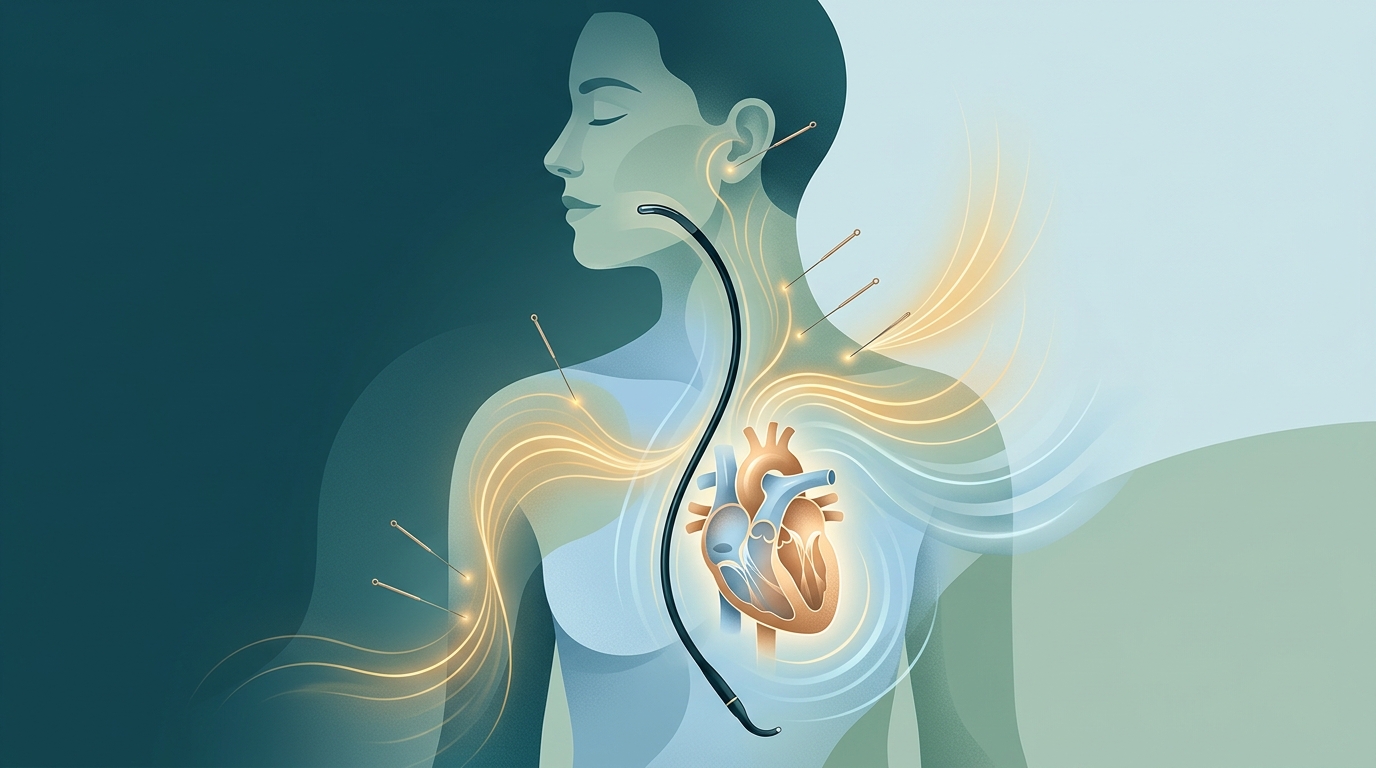
Randomisation took place immediately before the procedure using a computer-generated list concealed from both patients and the echocardiography practitioner. Only the physician providing the intervention knew the allocation. The acupuncture group received disposable indwelling needles: New Pyonex needles, 0.2 millimetres in diameter and 1.5 millimetres long, embedded in skin-coloured adhesive tape, placed bilaterally at the PC6 point on the inner forearm three to four centimetres above the wrist crease, plus Spinex needles, 0.14 millimetres by 6 millimetres, at CV24 in the mento-labial groove beneath the lower lip. A placebo device, self-adhesive tape without a needle, fixed the Spinex needle in place. The needles stayed in situ from before probe insertion until the transducer was withdrawn.
The placebo procedure was designed to mimic needle insertion convincingly. The acupuncturist used a neural pen, a device normally employed to locate skin areas of lower electrical resistance attributed to acupuncture points, to apply pressure that produces a pricking sensation. He then attached the New Pyonex placebo devices near, but not exactly at, the acupuncture points, telling patients the pen was being used to find the points. All patients first received three puffs, roughly thirty milligrams, of ten percent lidocaine pump spray, matching routine clinical standard. Blinding was later assessed by asking both patients and the examiner to guess the allocation; fifteen patients in each group believed they had received real acupuncture, and the examiner’s retrospective guesses were comparable between groups, suggesting the masking held.
The primary endpoint was the intensity of gagging on an eleven-point verbal rating scale from zero, meaning no gagging, to ten, meaning maximal discomfort. Patients in the acupuncture group reported a median intensity of four, with an interquartile range of two to eight, versus seven, with an interquartile range of five to eight, in the placebo group, a difference that did not reach statistical significance with a P value of 0.13. The TEE examiner’s own ratings showed a median of two, with an interquartile range of one to five, in the acupuncture arm versus four, with an interquartile range of two to nine, in the placebo arm, at P equal to 0.06. Twenty-four patients in the acupuncture group and twenty-seven in the placebo group experienced gagging at all, so the incidence was also statistically indistinguishable.
The clearest separation emerged in rescue medication. When gagging is so strong that the probe cannot be inserted, the protocol called for intravenous midazolam, one to three milligrams, as first-line rescue; if five milligrams failed, incremental twenty-milligram doses of propofol followed until insertion succeeded. Six patients in the acupuncture group required sedative rescue medication compared with fourteen in the placebo group, a difference the authors report as statistically significant at P equal to 0.03, with the figure legend giving P equal to 0.028 by Fisher’s exact test. All other measured endpoints, including nausea, vomiting, heart rate, oxygen saturation, patient satisfaction and side effects of needling, were comparable between the groups, and no unwanted side effects of needling were reported. No complications related to the echocardiography examinations occurred, and no examination exceeded fifteen minutes.
Statistically, the trial used both intention-to-treat and per-protocol analyses; two patients per group were excluded from the per-protocol set for reasons listed in a supplementary file, and those results did not differ from the intention-to-treat findings. Missing data remained below five percent. The sample size calculation drew on an earlier randomised study by Rösler and colleagues, in which stroke and transient ischaemic attack patients needled at CV24 reported a median gagging intensity of two on a visual analogue scale versus six under sham acupuncture or no intervention. Assuming a standard deviation of 2.5, the Greifswald team calculated that twenty-five patients per group would detect a thirty percent difference, two points on the rating scale, at a significance level of 0.05 and eighty percent power, inflated to thirty per group to allow for fifteen percent dropout.
That power calculation matters for interpreting the outcome. The observed differences in gagging intensity, four versus seven by patient report and two versus four by examiner assessment, point in the same direction as the Rösler data, yet fell short of significance. The authors attribute this partly to low statistical power, noting their sample was nearly triple the size of the earlier trial, and partly to the special character of that study population: patients examined within twenty-four hours of an ischaemic stroke or transient ischaemic attack, whose cognitive condition may have coloured their subjective intensity ratings. Their own ambulatory, neurologically intact participants, the authors argue, could rate gagging more precisely. They also speculate that needling CV24 and PC6 may simply have been too weak to override the strong mechanical irritation of the laryngopharynx during probe insertion, and they propose adding GV26, a point in the philtrum supplied by maxillary trigeminal afferents, in future protocols.
The reduction in rescue sedation is the finding the authors consider most worth replicating. Midazolam premedication is known to improve comfort during and after transoesophageal echocardiography, but benzodiazepines carry excess sedation, delayed recovery and prolonged observation before safe discharge, a real cost for ambulatory patients. A non-pharmacological method that lowers sedative requirements without prolonging the procedure would therefore be clinically attractive. The authors also argue that intradermal fixed needles are the right tool for this setting, because conventional long needles interfere with probe manipulation around the mouth, and that the New Pyonex placebo blinding procedure worked well enough to recommend for future studies. They add that the very low incidence of concomitant nausea in this cohort means the PC6 point, suggested by earlier work for nausea, is not justified for gagging relief in this procedure.
The authors conclude that acupuncture with indwelling fixed intradermal needles may reduce the need for sedative medication and could be a safe, easily applied method to avoid pharmacological sedation in patients scheduled for elective ambulatory transoesophageal echocardiography, while explicitly calling for larger trials with improved methodology to confirm the finding. The trial was prospectively approved by the Institutional Ethics Committee of University Medicine Greifswald, followed the CONSORT reporting guideline and the Declaration of Helsinki, and was registered as NCT03821428 on January 25, 2019, with the first patient enrolled on January 17, 2019 and the last on April 6, 2021. For now, the honest summary is a cautious one: the needles did not tame the gag reflex itself in this small single-centre study, but they appear to have spared a meaningful share of patients the sedatives otherwise needed to get the probe in.
Subject of Research: A randomised placebo-controlled trial of intradermal acupuncture at CV24 and PC6 for reducing gagging and sedative rescue medication during transoesophageal echocardiography.
Article Title: Acupuncture for relief of gagging in patients undergoing transoesophageal echocardiography—a randomised placebo-controlled trial
Article References: Usichenko, T. I., Müller-Kozarez, I., Busch, R., Knigge, S., & Busch, M. (2026). Acupuncture for relief of gagging in patients undergoing transoesophageal echocardiography—a randomised placebo-controlled trial. Clinical Research in Cardiology. https://doi.org/10.1007/s00392-026-03048-5
Image Credits: AI Generated
DOI: 10.1007/s00392-026-03048-5
Keywords: acupuncture, transoesophageal echocardiography, gag reflex, intradermal needles, placebo-controlled trial, midazolam, sedation, CV24, PC6, randomised trial, cardiology, patient blinding
News Source: Ophelia Keating. (November 4, 2026). Acupuncture May Cut Sedative Use During Swallow-Tube Heart Scans, Trial Finds. Scienmag.