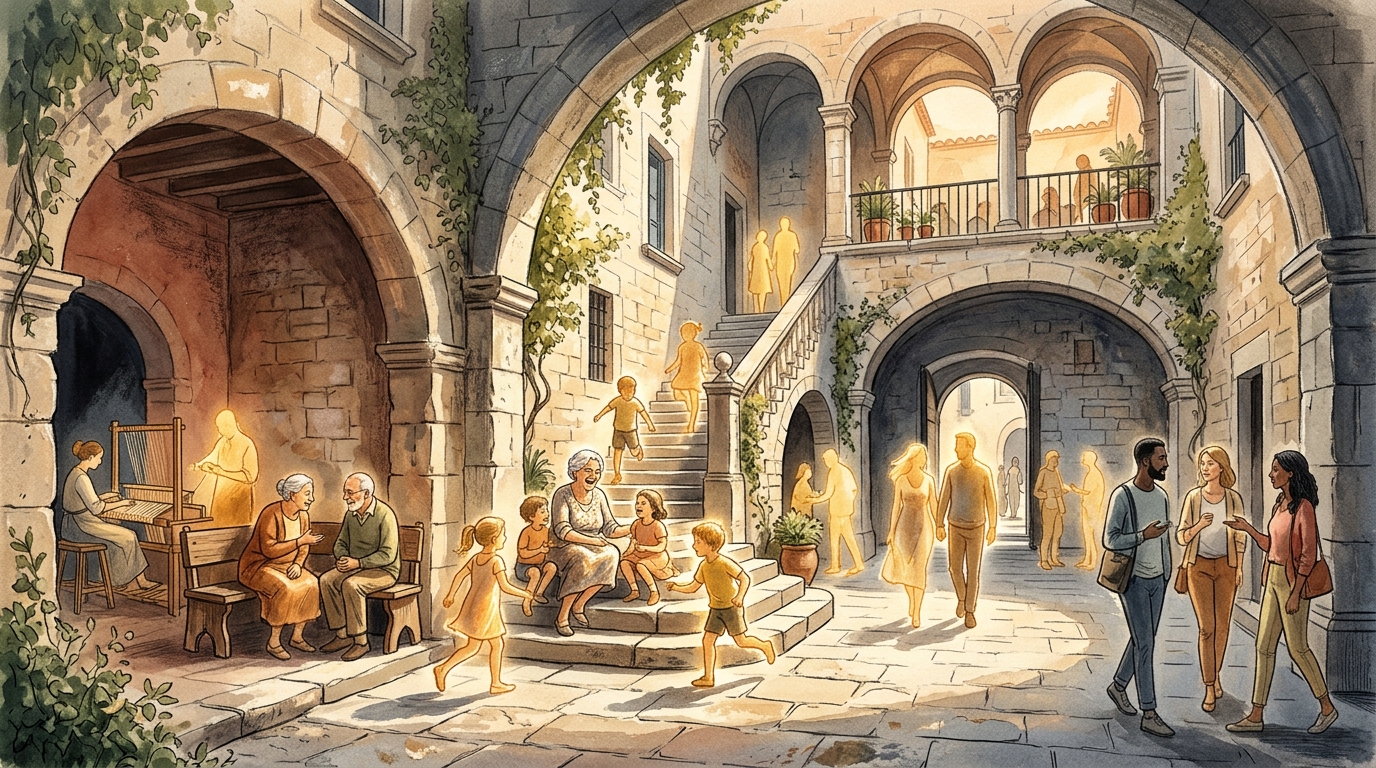
A new theoretical study argues that the conservation of architectural heritage should be grounded less in the preservation of physical form and more in the protection of lived experience. Published in the journal Architectural Research, the work by Tae-Ho Jeong and Seung-Hoon Han proposes an ontological distinction between two kinds of place: those a person inhabits and absorbs through the body, memory and emotion, and those a person knows only through images, texts and cultural narratives. The distinction, the authors contend, has direct consequences for how heritage sites should be understood, valued and safeguarded.
The study departs from conventional conservation frameworks, which have historically centered on historical evaluation and the maintenance of physical appearance. According to the authors, such approaches risk reducing heritage to a static object of preservation, potentially overlooking the accumulated memories, experiences, events and emotional attachments that sustain the continuity of communal identity. In recent decades, they note, the discourse on architectural heritage has undergone a notable epistemic shift from the preservation of material fabric toward perspectives that emphasize the lived, affective and identity-forming dimensions of place.
To build this argument, the researchers draw on a philosophical and architectural lineage. Martin Heidegger conceptualizes human existence as Being-in-the-world, viewing place not as a geometric container but as the existential site where human beings dwell and disclose their being; for Heidegger, place is an emergent clearing in which existence becomes manifest, a field of disclosure rather than a neutral coordinate. Christian Norberg-Schulz extends these insights into architectural theory through the concepts of existential space and Genius Loci, arguing that a place is defined not by physical form alone but by the layered interplay of meaning, memory, emotion, temporality and material presence, and that human identity forms when individuals are able to take root in a place. Yi-Fu Tuan adds an experiential perspective, suggesting that space becomes place as it is endowed with meaning through human perception, experience and emotional engagement.
From this theoretical base, the study introduces its central analytical construct. The existentially experienced place is defined as a place imbued with meaning through the direct experiences of a concrete subject, in which experiences, memories, emotions and sensory engagements become sedimented over time. The cognized place, by contrast, is a place known, imagined or mentally formed through indirect sources such as literature, mass media or maps, despite the subject having no direct experience of it. The authors also distinguish both from Norberg-Schulz’s broader notion of the existential place, producing a three-layered framework: the universal dimension of the existential place, the individually constituted existentially experienced place, and the indirectly formed cognized place.
The comparison between the two modes of place unfolds across several dimensions. In their mode of apprehension, existentially experienced places are perceived through bodily dwelling and experiential presence, whereas cognized places are understood through mediated information and imagery, reflecting whether memories are produced through material engagement or immaterial representation. In their relationship to identity, existentially experienced places constitute the primary basis through which individual and communal identities take shape, while cognized places perform a secondary or symbolic role, influencing perception but lacking the existential depth necessary for sustaining identity. Temporally, existentially experienced places accumulate memories through continuous lived encounters, generating multilayered temporal depth, whereas cognized places rely on discrete, externally supplied representations, resulting in episodic and fragmented temporalities. Finally, the density of place-ness differs: existentially experienced places possess a profound existential intensity derived from lived experience, while cognized places display a comparatively weaker density grounded in abstract associations and representational imagery.
The study illustrates these categories with concrete examples. A school playground repeatedly experienced during childhood may gradually become an existentially experienced place through the accumulation of memories, emotions, bodily activities and everyday experiences, functioning as an existential ground on which personal identity, familiarity and a sense of belonging are continuously formed and reproduced. Even after many years, revisiting such a place can evoke a strong sense of continuity and existential attachment by reconnecting individuals with layers of lived memory embedded within it. Yet when the place is demolished and reconstructed, the lived atmosphere, mnemonic continuity and existential depth accumulated through time may become difficult to recover, even if the physical site itself remains. Conversely, places associated with globally mediated events, such as the September 11 attacks, may function as cognized places for many individuals who never physically encountered them, generating powerful symbolic meanings and shared collective memories through media representations, historical narratives and collective discourse, though their experiential continuity and existential grounding may gradually weaken over time as direct historical connections and embodied memories diminish across generations.
The theoretical grounding for these claims draws partly on human geography. Kevin Lynch’s theory of cognitive maps, which examines how individuals remember, perceive and mentally structure urban environments, demonstrates that cognitive representations influence spatial behavior and contribute to a sense of orientation and identity. However, the authors argue, the cognized place remains grounded in representational knowledge rather than existential encounter, often lacking the experiential depth that characterizes places forged through dwelling. From the perspective of place attachment, emotional bonds with place are typically formed through direct and repeated experiences, contributing to a sense of belonging and personal meaning, whereas places known primarily through representation may not always generate the same degree of emotional attachment, as they lack sustained experiential engagement.
On this basis, the study identifies specific limitations of preserving places known only through representation. Because cognized places rely on information or imagery rather than lived experience, they lack emotional resonance and are not internalized within the life-world of individuals or communities, often remaining at the level of superficial recognition. They frequently intersect with commercial consumption or symbolic volatility, making it difficult for them to anchor local identity, as symbols and images shift rapidly and the continuity of meaning weakens. Moreover, when the preserved image of a cognized place does not correspond to the lived memories and experiences of the community, preservation risks devolving into a performative, display-oriented practice that may satisfy formal criteria or touristic expectations but fails to embody heritage as a lived foundation of identity.
In response, the authors propose an existentially oriented conservation framework with three priorities. First, oral histories and community narratives should be incorporated into preservation planning, so that collecting and interpreting residents’ stories, emotions and life events transmits memory into the preservation process and retains the experiential dimension of place. Second, participatory and community-based design approaches are necessary, aiming not merely to replicate past appearances but to recreate resonant environments that sustain both community memory and visitor engagement. Third, the preservation of experience, not only form, must be prioritized, with sensory traces, temporal layers and the embodied atmosphere of place actively integrated into design and conservation decisions, enabling heritage sites to function as ongoing settings that evoke existential experience. Such strategies, the study suggests, carry potential implications for policy development, participatory design and heritage interpretation, positioning architectural heritage not as a static relic of the past but as a dynamic context in which identity may be continually reproduced.
The authors are explicit about the scope of their claims. The research is conceptual and interpretive in nature, grounded in literature review and theoretical analysis rather than empirical case studies or user-based investigations, and does not aim to provide empirically verified conclusions. They acknowledge that the distinction between existentially experienced and cognized places is an analytical construct that may overlap or interact in real-world contexts, and that the study focuses primarily on specific theoretical traditions without fully engaging critical heritage studies, social constructivist approaches or postcolonial interpretations of place. Future research, they suggest, could test the framework through case analyses, interviews and participatory observations in diverse cultural and spatial contexts. Within those limits, the study offers a framework for rethinking heritage conservation as an endeavor that encompasses not only the conservation of form but also the safeguarding of experience and identity.
Subject of Research: A theoretical framework distinguishing existentially experienced places from cognized places and its implications for architectural heritage conservation and identity formation.
Article Title: An Ontological Distinction between Existentially Experienced and Cognized Places and the Role of Individual and Collective Identity in Architectural Heritage Conservation
Article References: Jeong, T.-H., & Han, S.-H. (2026). An Ontological Distinction between Existentially Experienced and Cognized Places and the Role of Individual and Collective Identity in Architectural Heritage Conservation. Architectural Research, 28(1), Article 9. https://doi.org/10.1007/s44515-026-00009-x
Image Credits: AI Generated
DOI: 10.1007/s44515-026-00009-x
Keywords: architectural heritage, place identity, place attachment, existential place, cognized place, heritage conservation, Heidegger, Norberg-Schulz, Yi-Fu Tuan, lived experience, collective identity, participatory design
News Source: Denise Maddox. (November 4, 2026). Lived Experience, Not Just Stone: Rethinking What Architectural Heritage Really Preserves. Scienmag.