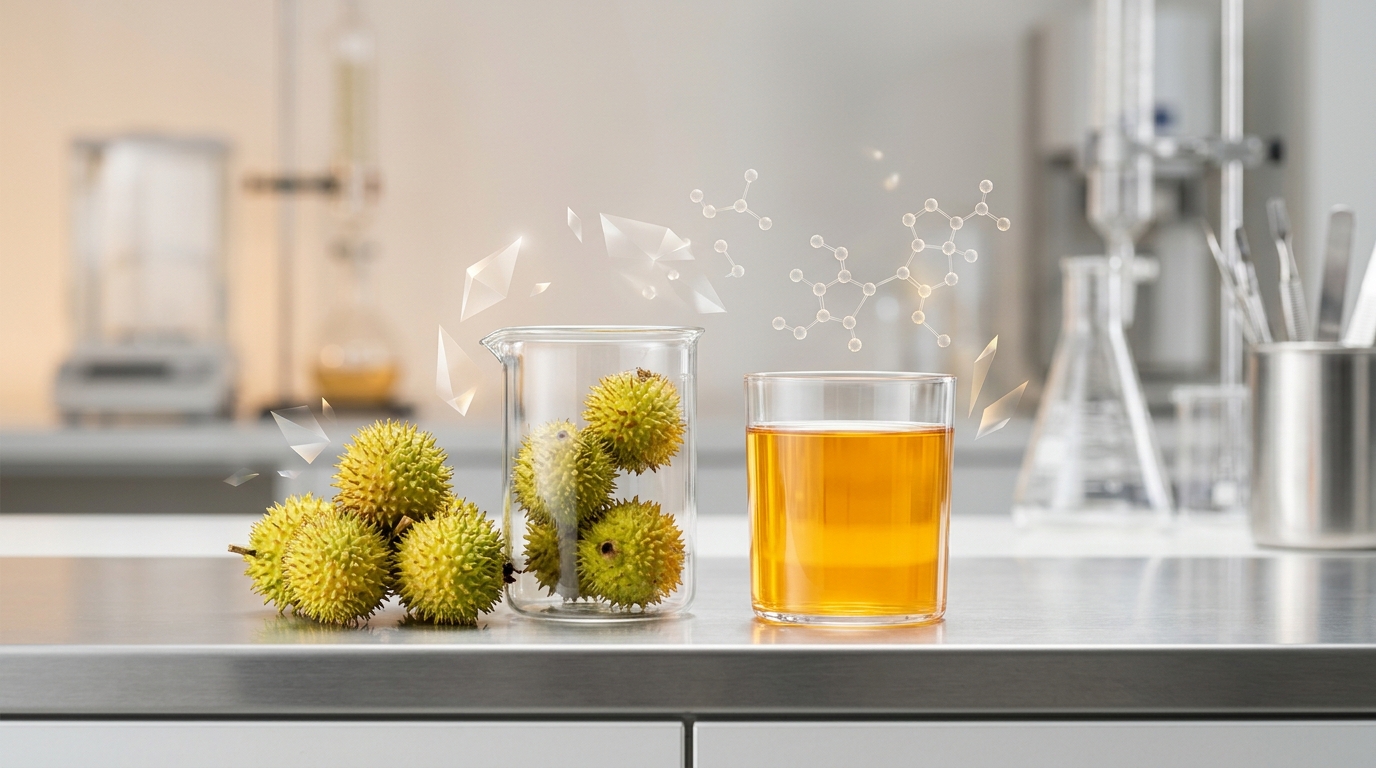
A new family of synthetic food preservatives has shown strong antimicrobial, antioxidant and antibrowning activity in roxburgh rose juice, according to a study published in npj Science of Food. Researchers isolated two spoilage fungi from deteriorated juice, synthesized a series of trifluoromethylpyrimidine derivatives bearing a thiosemicarbazide group, and identified one compound, labeled 5a, as the most promising candidate for extending the storage stability of this fruit beverage.
The investigation began with spoiled roxburgh rose (Rosa roxburghii Tratt) juice, from which the team isolated two predominant gas-generating spoilage fungi, designated CQ2 and CQ5. Molecular identification revealed them to be Pichia nanzhaoensis and Arxiozyma slooffiae, respectively. These yeasts were then used as target organisms for evaluating the biological activity of the newly synthesized compounds.
Compound 5a emerged as the standout performer in antimicrobial testing. It inhibited the isolated strains with EC50 values of 10.63 micrograms per milliliter against CQ2 and 8.24 micrograms per milliliter against CQ5. By comparison, potassium sorbate, a widely used commercial preservative, exceeded 100 micrograms per milliliter against both strains, indicating substantially weaker potency under the same assay conditions.
The compound also demonstrated considerable antioxidant capacity. In the DPPH assay, compound 5a achieved an IC50 value of 4.14 micrograms per milliliter, while the ABTS assay yielded an IC50 of 2.95 micrograms per milliliter. Both figures surpass the reference antioxidants vitamin C, at 6.38 micrograms per milliliter, and trolox, at 8.04 micrograms per milliliter, suggesting the molecule could help protect juice components from oxidative degradation during storage.
To probe how compound 5a might exert its effects at the molecular level, the researchers performed molecular docking and 100-nanosecond molecular dynamics simulations. These computational analyses validated stable binding of the compound to NADPH oxidase, with a binding free energy (ΔEMMPBSA) of −36.458 kilojoules per mole. The simulations support the plausibility of a specific interaction with this enzyme target rather than nonspecific association.
Safety considerations were addressed through ADMET analysis, which the authors report confirmed desirable biosafety properties for the compound. Such in silico profiling evaluates absorption, distribution, metabolism, excretion and toxicity indicators, and in this study it supported the candidacy of 5a as a food-grade preservative, though experimental toxicology would be required before any practical food application.
Beyond laboratory assays, application experiments tested the compound directly in roxburgh rose juice during storage. The results showed that compound 5a effectively suppressed browning, conserved nutrients, and optimized the flavor profile of the juice over the storage period. Browning and nutrient loss are major quality challenges for fruit beverages, and a single additive that addresses microbial spoilage, oxidation and enzymatic discoloration simultaneously would be commercially attractive.
The authors conclude that these results suggest compound 5a is a promising multifunctional preservative with integrated antimicrobial, antioxidant and antibrowning activities, suitable not only for roxburgh rose juice but potentially for other fruit beverages as well. Roxburgh rose juice is valued for its nutritional content but is prone to deterioration caused by gas-generating yeasts and oxidative reactions, making preservation a persistent industry concern.
The study, published open access on 30 October 2026, was carried out by Pei Li, Shijing Tang, Wenmin Pan, Lu Yu and colleagues. It represents an early-release, peer-reviewed accepted version that is citable under a permanent DOI, with the final version of record to follow. As with all laboratory and computational findings, further validation in real production settings and formal safety evaluation would be needed before such a compound could be adopted in commercial beverage preservation.
Subject of Research: Synthetic trifluoromethylpyrimidine-thiosemicarbazide preservatives for antimicrobial, antioxidant and antibrowning protection of roxburgh rose juice
Article Title: Trifluoromethylpyrimidine‑thiosemicarbazide derivatives as novel multifunctional food preservatives for enhancing storage stability of roxburgh rose juice
Article References: Li, P., Tang, S., Pan, W., & Yu, L. (2026). Trifluoromethylpyrimidine‑thiosemicarbazide derivatives as novel multifunctional food preservatives for enhancing storage stability of roxburgh rose juice. npj Science of Food. https://doi.org/10.1038/s41538-026-01213-8
Image Credits: AI Generated
DOI: 10.1038/s41538-026-01213-8
Keywords: food preservatives, roxburgh rose juice, trifluoromethylpyrimidine, thiosemicarbazide, antimicrobial activity, antioxidant, antibrowning, Pichia nanzhaoensis, Arxiozyma slooffiae, molecular docking, ADMET, food spoilage
News Source: Alan Morgan. (November 4, 2026). New trifluoromethylpyrimidine-thiosemicarbazide preservative outperforms potassium sorbate in roxburgh rose juice tests. Scienmag.