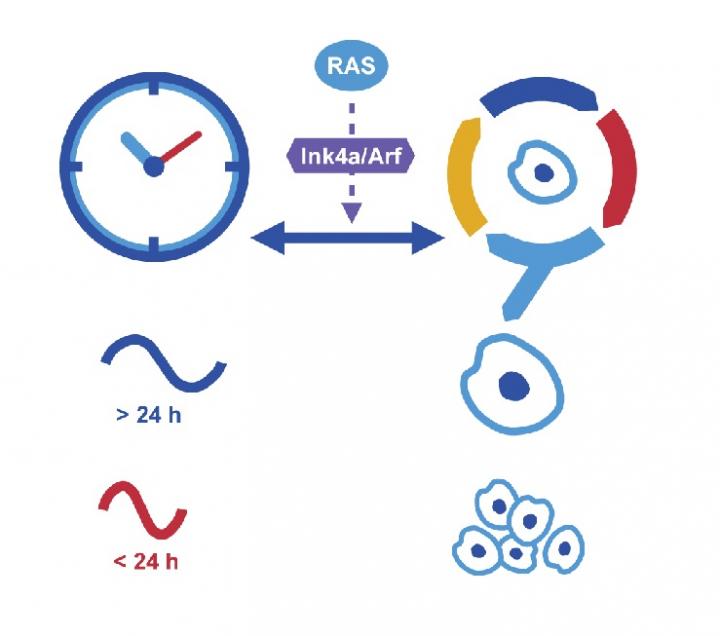
Credit: Angela Relógio, adapted by Roland Roberts.
Our body has an internal biological or "circadian" clock, which cycles daily and is synchronized with solar time. New research done in mice suggests that it can help suppress cancer. The study, publishing 7 December in the open access journal PLOS Biology by Dr Angela Relógio from the Charité-Medical University of Berlin, Germany and colleagues, hypothesised that given the range of molecular time-dependent processes that it regulates, including metabolism, DNA repair and the cell cycle, the circadian clock has the potential to act as a tumour suppressor.
The circadian clock runs in sync with environmental light-dark cycles and helps to orchestrate metabolic and behavioural patterns such as daily cycles of rest and activity. Many diseases including cancer can disrupt the clock, causing it to run amok. When cells in our body multiply, however, they follow a different schedule known as the cell cycle, in which two daughter cells are produced by cell division at the end of the cycle. Many cancers involve a dysfunctional or hyperactive cell cycle, which enables the tumor cells to multiply uncontrollably.
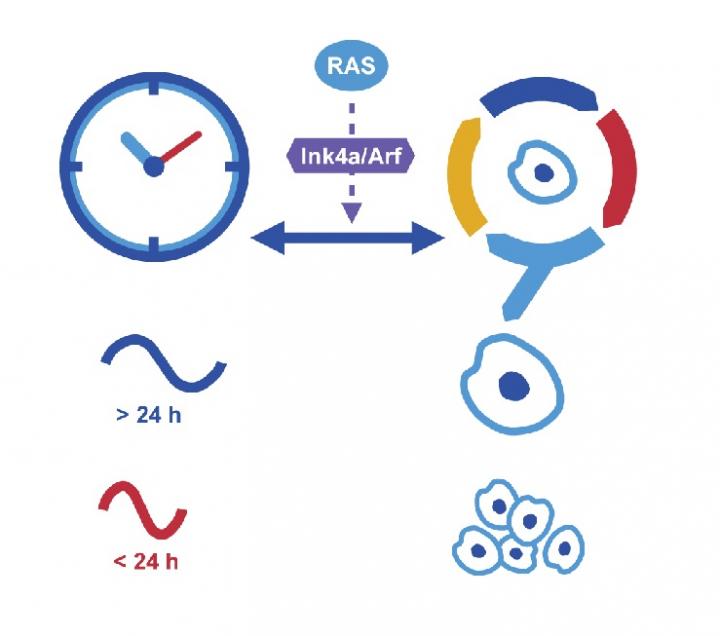
The research team found that when they perturbed a protein called RAS, which is inappropriately activated in about a quarter of all human tumors, and two proteins called INK4a and ARF, which can suppress cancer, they discovered a cross-talk between the circadian clock and the cell cycle. They show that RAS, which is known to control the cell cycle, also controls the circadian rhythms, and exerts its effect on the circadian clock via INK4A and ARF. Their work highlights the important role of the circadian clock as modulator of cell fate decisions and further reinforces the function of the circadian clock as a cancer-preventing mechanism.
Relógio, whose surname in Portuguese means "clock," says: "Based on our results, it seems to us that the clock is likely to act as a tumour suppressor, and that it is of advantage for cancer cells to circumvent circadian control. One cannot stop wondering whether disrupted circadian timing should be included as a next potential hallmark of cancer."
The findings of Relógio and colleagues reveal that a new layer of complexity – internal time -may be relevant for cancer treatment, and chime with recent studies that propose the use of chronotherapy, in which sleeping and waking times are adjusted in an attempt to reset the patient's biological clock. In the light of the new findings here described and the chronotherapy studies published so far, we might need to rethink cancer treatment, by including the internal time factor, to achieve optimal therapeutic effects.
###
In your coverage please use this URL to provide access to the freely available article in PLOS Biology: http://journals.plos.org/plosbiology/article?id=10.1371/journal.pbio.2002940
Citation: El-Athman R, Genov NN, Mazuch J, Zhang K, Yu Y, Fuhr L, et al. (2017) The Ink4a/Arf locus operates as a regulator of the circadian clock modulating RAS activity. PLoS Biol 15(12): e2002940. https://doi.org/10.1371/journal.pbio.2002940
Funding: Deutsche Krebshilfe https://www.krebshilfe.de/ (grant number 110678). funded the work in CS's laboratory. The funder had no role in study design, data collection and analysis, decision to publish, or preparation of the manuscript. German Federal Ministry of Education and Research (BMBF) https://www.bmbf.de/ (grant number eBio-CIRSPLICE – FKZ031A316). funded the work in AR's laboratory as well as RE, NG, JM, LF, YL and MA. The funder had no role in study design, data collection and analysis, decision to publish, or preparation of the manuscript. Berlin School of Integrative Oncology (BSIO) of the Charité – Universitätsmedizin Berlin http://www.bsio-cancerschool.de/ (grant number). provided additional funding to NG and LF. The funder had no role in study design, data collection and analysis, decision to publish, or preparation of the manuscript. Jinan Huaiyin Hospital of Shandong Province http://www.jnhyyy.com/ (grant number). provided additional funding to YL. The funder had no role in study design, data collection and analysis, decision to publish, or preparation of the manuscript. Deutsche Forschungsgemeinschaft http://www.dfg.de/ (grant number SFB740/D2 and TRR186/A17). funded the work in AK's laboratory. The funder had no role in study design, data collection and analysis, decision to publish, or preparation of the manuscript.
Competing Interests: The authors have declared that no competing interests exist.
Media Contact
Angela Relógio
[email protected]
Related Journal Article
http://dx.doi.org/10.1371/journal.pbio.2002940