


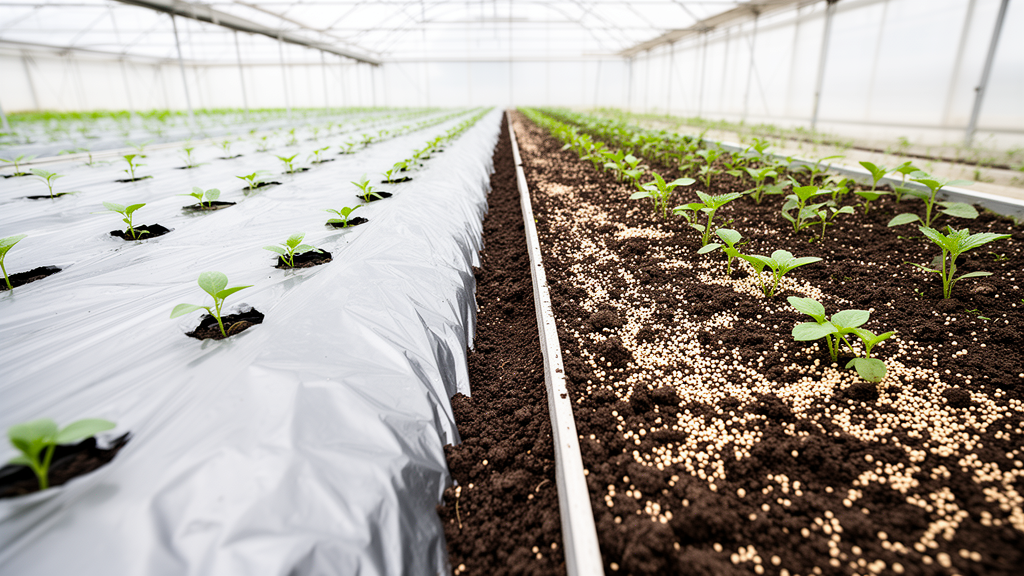
Plastic film laid over greenhouse soil during summer solar disinfection does not treat bacteria and fungi the same way, according to a field trial in Shandong Province, China. In a 32-day experiment on soil that had grown tomato and zucchini continuously for six years, researchers at Shandong University of Agricultural Engineering found that mulching cut bacterial richness and diversity while raising fungal diversity, and that the effects of adding microbial inoculants depended on whether film covered the soil. The work, published in Frontiers in Microbiology, is among the first to test several inoculant identities in a single factorial design during biological greenhouse solar disinfestation.
The trial took place in a 2,240-square-meter greenhouse in Zibo City from 14 July to 15 August 2024. The team set up ten treatments in a randomized design with three replicate plots each: four inoculants—Trichoderma harzianum, Bacillus subtilis, Saccharomyces cerevisiae, and a multi-strain compound dominated by Bacillus licheniformis—each applied with and without plastic film, plus two uninoculated controls, one mulched and one not. All plots received chicken manure at 75 tonnes per hectare and irrigation, and the mulched plots were sealed with 0.02-millimeter film for the entire period. After 32 days, the film was removed and soil was sampled from the top 20 centimeters of each plot.
Bacterial and fungal communities were profiled by amplicon sequencing of the 16S rRNA gene and the ITS region respectively. Sequencing coverage was high, with Good’s coverage above 0.99 in every library, and bacterial samples yielded roughly ten times more amplicon sequence variants than fungal ones—between about 1,598 and 2,694 bacterial ASVs versus 112 to 280 fungal ASVs per treatment. The researchers attribute that gap partly to the lower taxonomic resolution of ITS and the less complete fungal reference databases.
The clearest bacterial signal was a uniform decline under mulch. Chao1 richness fell by 23.39 percent on average, from a marginal mean of about 2,423 ASVs in unmulched soil to about 1,856 under film, a statistically robust effect (p = 0.0029). Shannon diversity dropped 8.50 percent (p = 0.011), and the reduction held across every inoculant group, indicating that the film imposed a strong, consistent selective pressure that overrode inoculant-specific effects on richness and evenness. The Simpson index, by contrast, showed no significant treatment effects and stayed near its maximum of about 0.995 to 0.996, meaning evenness among the remaining abundant bacteria stayed high even as rarer lineages disappeared.
Fungal communities moved the opposite way. Mulching raised fungal phylogenetic diversity by 46.48 percent (p = 0.0008), Shannon diversity by 44.13 percent (p < 0.001), and Simpson diversity by 9.68 percent (p < 0.001), with increases in every inoculant group. Fungal Chao1 richness, however, responded only to inoculant identity (p = 0.0070), not to mulching: Bacillus-plus-mulch plots had the highest mean richness at 279.67 ASVs, while yeast-plus-mulch plots had the lowest at 111.67. Significant mulching-by-inoculant interactions appeared for bacterial phylogenetic diversity and for fungal phylogenetic diversity, Shannon and Simpson indices (p ≤ 0.033), but not for fungal Chao1, meaning fungal richness depended on which inoculant was added while fungal phylogenetic breadth and evenness were jointly determined by both practices.
Taxonomic shifts mirrored these diversity patterns. Among bacteria, mulching reduced the relative abundance of Actinobacteriota—predominantly aerobic lineages—by 17.40 to 51.20 percent within mulched-unmulched pairs, significantly in three of five pairs, while Gemmatimonadota, which includes facultatively anaerobic members, rose by 54.82 to 131.98 percent under film in all five pairs. Among fungi, Ascomycota increased under both inoculation and mulching, whereas Mortierellomycota declined. The authors interpret the bacterial pattern as consistent with oxygen depletion beneath the sealed film, though they note that relative-abundance data alone cannot distinguish true numerical expansion of one group from contraction of others.
Community composition, measured as beta diversity, was structured by both factors in bacteria. Across four distance metrics, mulching explained 7.6 to 24.5 percent of variation and inoculant identity 15.5 to 29.6 percent, with a significant interaction under three metrics. Dispersion tests showed no heterogeneity among bacterial groups, so these effects reflect genuine shifts in community position rather than differences in within-group scatter. In fungi, both factors were also significant, but mulching markedly increased within-group dispersion (p = 0.0001 for both Bray–Curtis and Jaccard distances), meaning mulched plots were more dissimilar from one another than unmulched ones. Part of the apparent fungal mulching effect therefore reflects elevated spatial heterogeneity under the film rather than a uniform community shift.
An exploratory LEfSe biomarker analysis identified treatment-specific candidate taxa in nine of ten bacterial groups and six of ten fungal groups, each recruiting phylogenetically distinct lineages rather than converging on a common signature. Notably, Bacillus-plus-mulch plots were associated with enrichment of Fusarium and Alternaria. Because ITS sequencing cannot separate pathogenic from saprotrophic or endophytic strains within these genera, the authors stress this is a compositional signal only, not evidence of increased disease risk, and would require strain-specific qPCR, culture-based pathogenicity assays, or metagenomics to interpret.
The study has clear limits. It ran for one season at a single site with only three replicates per treatment, no plant performance measurements, no soil physicochemical data such as pH, electrical conductivity or oxygen levels, and a single sampling timepoint after film removal. One yeast-plus-mulch replicate showed anomalously low bacterial diversity that inflated within-group variance, so conclusions about that treatment are tentative. Environmental sensors deployed under the film failed, leaving gaps that prevent linking microbial responses to specific temperature or moisture dynamics. The authors frame the findings as preliminary and hypothesis-generating rather than as management recommendations.
Even so, the central result stands: plastic mulching imposes divergent selective pressures on soil bacteria and fungi during greenhouse solar disinfestation, and the value of any particular inoculant depends on whether film is present. Practices that suppress bacterial diversity may simultaneously elevate fungal diversity, which the authors note could matter for soilborne fungal disease if pathogens are among the taxa released from bacterial antagonism. They argue that inoculant-mulching combinations should not be assumed safe or effective based on single-practice performance alone, and that integrated microbial management—coupling amplicon surveys with functional assays, absolute quantification, and crop measurements—will be needed before these compositional baselines can translate into field guidance.
Subject of Research: Interactive effects of plastic-film mulching and microbial inoculants on soil bacterial and fungal communities during greenhouse solar disinfection
Article Title: Plastic-film mulching and microbial inoculant jointly shape soil microbial community assembly during biological greenhouse solar disinfection
Article References: Li, P., Li, S., Wang, L., Ji, L., Wang, X., & Jiang, L. (2026). Plastic-film mulching and microbial inoculant jointly shape soil microbial community assembly during biological greenhouse solar disinfection. Frontiers in Microbiology, 17, 1951686. https://doi.org/10.3389/fmicb.2026.1951686
Image Credits: AI Generated
DOI: 10.3389/fmicb.2026.1951686
Keywords: plastic-film mulching, soil microbiome, greenhouse solar disinfection, microbial inoculants, bacterial diversity, fungal diversity, amplicon sequencing, continuous cropping obstacles, soil disinfestation, Trichoderma, Bacillus subtilis, PERMANOVA
News Source: Morgan Morrow. (October 30, 2026). Plastic mulch and microbial inoculants steer greenhouse soil microbes in opposite directions. Scienmag.



