


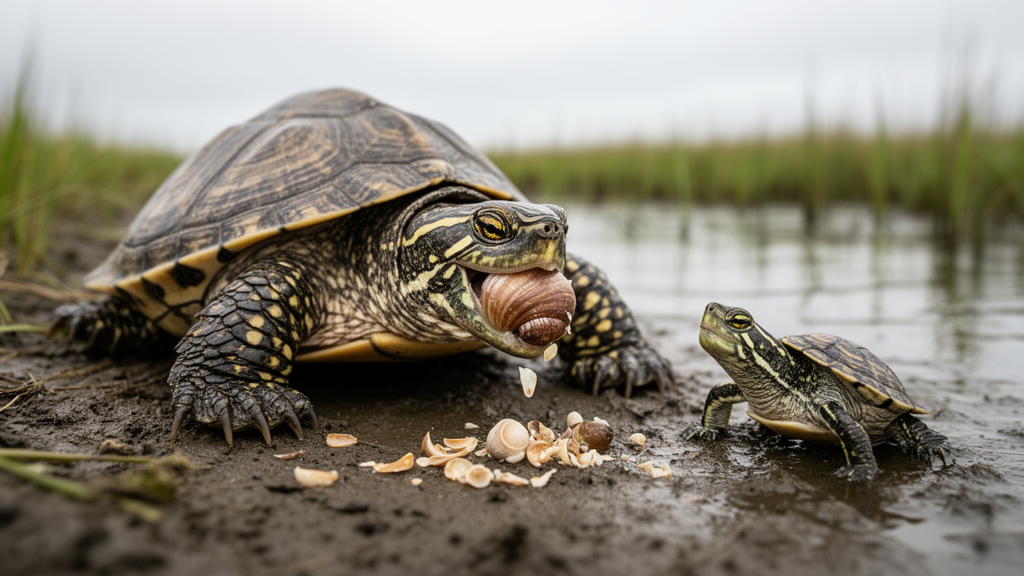
Diamondback terrapins are among the most sexually dimorphic turtles in North America, with adult females growing far larger than males, and a new study shows that this size gap translates directly into what each sex can eat. Researchers at McNeese State University used fecal DNA metabarcoding to reconstruct the diets of terrapins captured between February and August over a three-year period, and paired those dietary records with bite force measurements taken from the same animals. The results reveal a striking partitioning of food resources across demographic groups, driven jointly by body size, jaw performance and the energetic demands of reproduction.
The dietary analysis showed that adult females were the only group to consume gastropods, and they did so exclusively during the reproductive period. Males and subadult females, by contrast, relied primarily on algae and crustaceans. This pattern was not simply a matter of preference. Bite force in the terrapins scaled strongly with carapace length and head width, and only adult females generated enough force to crush the shells of periwinkle snails, a common intertidal prey. The authors describe this as a clear performance threshold: below a certain combination of head dimensions and jaw strength, the hard-shelled resource is physically inaccessible, regardless of its availability in the habitat.
That threshold has ecological consequences beyond individual meals. Periwinkles are calcium-rich, and the fact that only adult females exploited them, and only while gravid, suggests the prey item functions as a temporally restricted nutrient source tied to egg production. The study frames trophic ecology in this species as the product of interacting constraints: morphology sets the ceiling on what can be processed, performance capacity determines whether that ceiling is reached, and reproductive physiology shapes when particular resources are targeted. For males and juveniles, the soft and algal fractions of the marsh diet remain the accessible baseline.
One of the more unexpected findings concerned the early season. In the late winter and early spring captures, the diets of all demographic groups were dominated by marine algae containing floridean starch, a storage carbohydrate characteristic of red algae. The authors suggest this represents an important and previously underappreciated carbohydrate source for terrapins during the colder months, when animal prey may be less available or less active. Because the detection came from fecal DNA rather than direct observation, it also demonstrates the sensitivity of metabarcoding to plant and algal material that traditional gut-content studies can miss or underrepresent.
The methodological choice is itself notable. The authors report that this is the first use of fecal DNA metabarcoding to elucidate the diets of diamondback terrapins. Fecal sampling is non-invasive, which matters for a species of conservation concern, and it captures recently ingested items without requiring stomach lavage or sacrifice. Sequencing dietary DNA from droppings allows researchers to identify prey taxa that are visually unrecognizable once digested, and to do so across many individuals and months, building a seasonal picture that would be difficult to assemble by hand-sorting remains.
The integration of biomechanics with molecular diet data is what gives the study its explanatory power. Bite force is a direct measure of the mechanical performance an animal can deliver, and its strong scaling with carapace length and head width in this species means the sexes occupy measurably different positions on that performance curve. When the measured forces are compared against the force required to fail a periwinkle shell, the dietary records line up with the biomechanical prediction: females above the threshold eat snails, everyone below it does not. This concordance between an independent performance measurement and observed prey use is a clean example of how functional morphology shapes diet in the wild.
The temporal structure of the findings adds another layer. Because sampling spanned February through August across three years, the researchers could separate early-season algal feeding from the later reproductive-period exploitation of gastropods by females. The seasonal signal in the female diet, with snails appearing only during the reproductive window, implies that the largest and strongest individuals in the population shift their foraging toward a resource that supports a specific physiological demand, rather than simply eating the largest prey available at all times. That kind of context-dependent resource use is exactly what coarse observational diet studies tend to average away.
For a species that inhabits brackish marshes along the Atlantic and Gulf coasts, understanding which demographic groups use which prey has practical implications. The identification of a performance threshold also offers a measurable trait that can be tracked: if head width and bite force predict access to hard-shelled prey, then body-size distributions within a population carry direct information about which individuals can use which parts of the food web.
The study, published in Frontiers in Amphibian and Reptile Science, was conducted by Mark Merchant, Sarah Baker and Zhuang Li of McNeese State University in Lake Charles, Louisiana. Its combination of molecular diet reconstruction and performance testing on a dimorphic turtle offers a template for studying how sexual size dimorphism translates into ecological differentiation, and it establishes floridean starch-rich algae as a winter carbohydrate source in terrapin diets that had gone largely unnoticed until DNA sequencing of fecal samples made it visible.
Subject of Research: Sex- and size-dependent seasonal diets of diamondback terrapins revealed by fecal DNA metabarcoding and bite force measurements
Article Title: Fecal DNA metabarcoding reveals how sexual dimorphism and bite force influence seasonal changes in diets of diamondback terrapins (Malaclemys terrapin littoralis)
Article References: Merchant, M., Baker, S., & Li, Z. (2026). Fecal DNA metabarcoding reveals how sexual dimorphism and bite force influence seasonal changes in diets of diamondback terrapins (Malaclemys terrapin littoralis). Frontiers in Amphibian and Reptile Science, 4, 1953675. https://doi.org/10.3389/famrs.2026.1953675
Image Credits: AI Generated
DOI: 10.3389/famrs.2026.1953675
Keywords: diamondback terrapin, fecal DNA metabarcoding, sexual dimorphism, bite force, trophic ecology, periwinkle snails, seasonal diet, floridean starch, reproductive ecology, Malaclemys terrapin, Fecal, metabarcoding
News Source: Daisy Hatcher. (October 30, 2026). Bite force and fecal DNA reveal why only female diamondback terrapins crush snails. Scienmag.



