


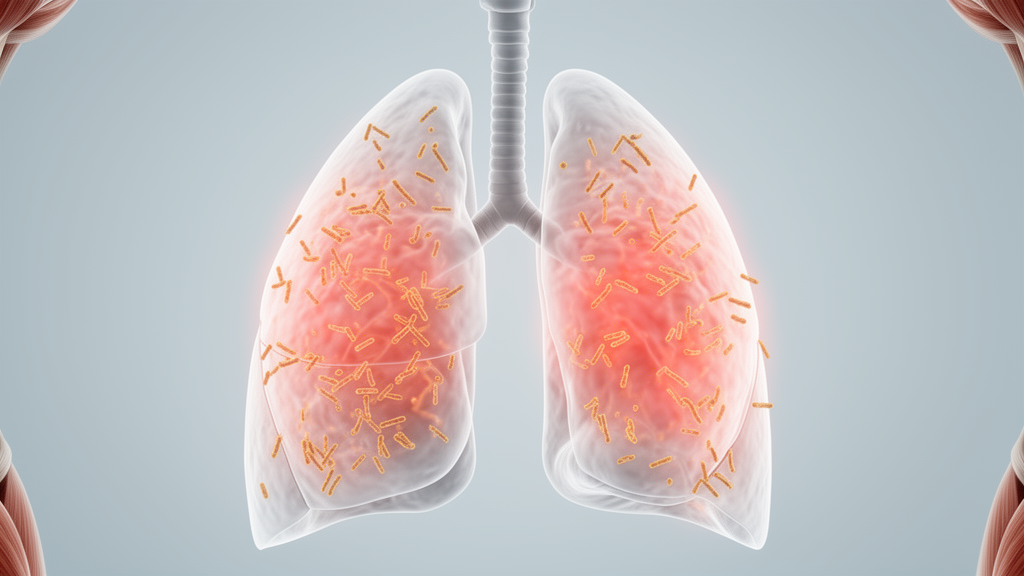
A 70-year-old woman admitted to hospital with fever and worsening breathlessness died 13 days later despite intensive treatment, according to a case report published in Frontiers in Medicine. Clinicians identified two life-threatening processes at once: Pneumocystis jirovecii pneumonia, an opportunistic fungal infection of the lungs, and rapidly progressive interstitial lung disease, a pattern of lung injury in which scarring and inflammation advance so quickly that oxygen exchange collapses within days. The patient also tested positive for anti-MDA5 antibodies, a marker associated with a particularly aggressive form of dermatomyositis in which the lungs, rather than the skin and muscles, often dominate the clinical picture.
The report, authored by researchers from People’s Hospital of Deyang City and Deyang People’s Hospital in Deyang, China, together with The Affiliated Hospital of Southwest Medical University in Luzhou, documents the diagnostic pathway in detail. Computed tomography of the chest showed scattered reticular opacities and ground-glass opacities in both lungs, patterns that reflect thickening of the lung’s supporting tissue and partial filling of the air spaces. To identify the infectious cause, the team performed bronchoalveolar lavage, washing a section of the deep lung with fluid, and analyzed the recovered material with metagenomic next-generation sequencing. This technique sequences genetic material directly from a clinical sample without needing to culture the organism first, and it detected Pneumocystis jirovecii in the bronchoalveolar lavage fluid.
Laboratory testing during hospitalization revealed positive anti-MDA5 antibodies. Melanoma differentiation-associated gene 5, or MDA5, is a cellular sensor involved in recognizing viral RNA, and antibodies directed against it define a subgroup of dermatomyositis strongly linked to rapidly progressive interstitial lung disease. The authors emphasize that some patients with this antibody never develop the characteristic rash of dermatomyositis, and in certain cases the lung disease is the first and only manifestation. For that reason, they argue, early screening for anti-MDA5 antibodies is essential in patients who present with unexplained early-stage rapidly progressive interstitial lung disease.
Treatment began on admission with high-flow oxygen therapy, which delivers warmed, humidified oxygen through a nasal interface at pressures that improve oxygenation, and with methylprednisolone, a potent corticosteroid intended to suppress the inflammatory lung injury. As the patient’s condition deteriorated, the team escalated care: mechanical ventilator support took over the work of breathing, and the antifungal combination trimethoprim-sulfamethoxazole was administered against Pneumocystis jirovecii. The patient also received plasma exchanges, a procedure that removes and replaces blood plasma to strip circulating antibodies, and immunoglobulin treatment, which provides pooled antibodies with immunomodulatory effects.
Despite this combination, the clinical course was unfavorable. The fever subsided, but respiratory failure and the interstitial lung disease continued to worsen. Follow-up imaging showed that ground-glass opacities, mixed ground-glass opacities, consolidations and reticular opacities had become significantly more pronounced than on admission, changes the authors interpret as rapidly progressive interstitial lung disease evolving after the start of treatment. The patient died after 13 days of treatment.
The authors frame the case as a warning about the combination of these two conditions. Pneumocystis jirovecii pneumonia combined with rapidly progressive interstitial lung disease in dermatomyositis has been reported only occasionally, they note, but patients with this combination experience rapid disease progression and high mortality rates. In their assessment, the case underscores the critical importance of identifying Pneumocystis infection early and starting anti-PJP treatment promptly, because delays allow the fungal burden and the underlying lung injury to compound each other.
The diagnostic details carry practical weight. Pneumocystis jirovecii cannot be reliably grown in standard culture, so detection depends on staining, polymerase chain reaction or sequencing methods applied to respiratory specimens. Metagenomic next-generation sequencing of bronchoalveolar lavage fluid, as used here, can identify the organism’s genetic signature directly, offering a route to diagnosis when conventional tests are inconclusive. In this patient, that approach confirmed the pathogen while the antibody test simultaneously revealed the autoimmune substrate driving the lung destruction.
The case also illustrates how difficult the management of anti-MDA5-positive dermatomyositis can be. The immunosuppression required to treat the autoimmune lung disease can predispose patients to opportunistic infections such as Pneumocystis, yet the infection itself and the rapidly progressive lung disease share overlapping symptoms, including fever, breathlessness and diffuse infiltrates on imaging. Disentangling infection from autoimmune injury matters because the treatments differ, and the authors’ account shows both processes progressing in the same patient within a two-week window.
As a single case report, the study cannot establish which treatment strategies improve survival in this combination, and the authors’ conclusions rest on one patient’s course. The report is published under the section of Respiratory Medicine, was received on 24 August 2026 and accepted on 20 October 2026, and carries the caveat standard to case reports: all claims expressed are those of the authors. Its central message, however, is unambiguous. In patients with unexplained rapidly progressive interstitial lung disease, the authors conclude, clinicians should consider Pneumocystis jirovecii pneumonia and screen early for anti-MDA5 antibodies, because recognizing both threats at once may offer the only realistic chance of intervening before the disease becomes fatal.
Subject of Research: A fatal case of Pneumocystis jirovecii pneumonia combined with rapidly progressive interstitial lung disease in anti-MDA5-positive dermatomyositis
Article Title: A fatal threat: Pneumocystis jirovecii pneumonia with rapidly progressive interstitial lung disease in anti-MDA5-positive dermatomyositis—a case report
Article References: Li, X., Xu, S., Feng, Y., Wang, R., & Wang, X. (2026). A Fatal Threat: Pneumocystis jirovecii pneumonia with Rapidly Progressive Interstitial Lung Disease in Anti-MDA5-Positive Dermatomyositis-A Case Report. Frontiers in Medicine, 13, 1977161. https://doi.org/10.3389/fmed.2026.1977161
Image Credits: AI Generated
DOI: 10.3389/fmed.2026.1977161
Keywords: Pneumocystis jirovecii pneumonia, dermatomyositis, anti-MDA5 antibodies, rapidly progressive interstitial lung disease, metagenomic next-generation sequencing, case report, respiratory failure, interstitial lung disease, opportunistic infection, bronchoalveolar lavage, fatal, threat
News Source: Ophelia Keating. (October 30, 2026). Fatal Pneumocystis pneumonia with rapidly progressive lung disease in anti-MDA5 dermatomyositis. Scienmag.



