


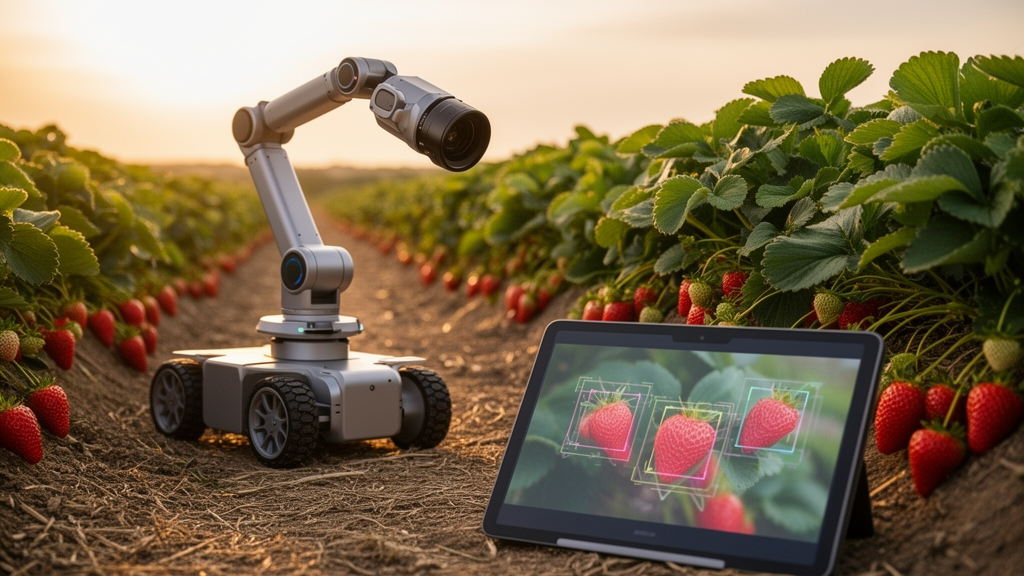
Deep learning has become the dominant approach for detecting strawberries, classifying their ripeness, and localizing picking points in automated harvesting systems, but a new systematic review warns that a large share of the published performance figures may be inflated by a common methodological flaw. The review, published in Artificial Intelligence Review, analyzed 60 peer-reviewed studies from 2023 to 2026 that use the YOLO family of object detection algorithms, versions 5 through 11, for strawberry fruit detection and ripeness estimation. Its authors conclude that while the field is advancing rapidly, reproducibility and evaluation practices lag behind the headline accuracy numbers.
The analysis found a clear concentration on a handful of architectures. YOLOv8 appeared in 28 of the 60 studies, or 46.7 percent, making it the most popular choice. YOLOv11 followed with 13 studies, or 21.7 percent. Hybrid models that combine convolutional neural networks with vision transformers are gaining attention, appearing in 8 studies, or 13.3 percent. The studies were examined across dataset characteristics, preprocessing and augmentation strategies, model architectures, and evaluation protocols.
The most consequential finding concerns data augmentation. In 21 of the 60 studies, or 35.0 percent, augmentation was applied before the dataset was split into training and test portions. That ordering allows transformed copies of the same images to appear on both sides of the split, a form of data leakage that can make a model appear more accurate than it would be in deployment. Only 13 studies, or 21.7 percent, followed the recommended split-then-augment protocol, and 8 studies, or 13.3 percent, applied online augmentation. The remaining 18 studies, or 30.0 percent, reported no augmentation at all.
To quantify the empirical impact of this flaw rather than merely flag it, the authors ran a controlled experiment on the StrawDI_Db1 dataset using YOLOv8, comparing four augmentation strategies. The results showed that the full leakage protocol overestimates test performance by 11.76 to 19.28 percentage points in mAP@0.5:0.95, and by 8.02 to 11.50 percentage points in mAP@0.50, compared with a clean split-then-augment pipeline. The underlying validation-test discrepancy reached up to 18.63 percentage points in mAP@0.5:0.95 and 13.81 percentage points in mAP@0.50. These numbers provide direct quantitative evidence that the metrics reported in the 35.0 percent of reviewed studies with pre-split augmentation may be substantially inflated.
Reproducibility emerged as a second major weakness. Code or trained weights were shared in only 2 of the 60 studies, or 3.3 percent, and datasets were made available in 8 studies, or 13.3 percent. Without access to code, weights, or data, independent researchers cannot verify reported results or build directly on prior work.
The review’s motivation rests on the practical demands of smart farming. Accurate detection of strawberry fruit, reliable ripeness estimation, and precise localization of the picking point are essential for automated harvesting and yield prediction. Real-world environments introduce significant challenges, including occlusion, illumination variability, and high visual similarity between ripeness stages. Deep learning-based object detection methods have become the dominant approach to addressing these issues.
The concentration on YOLOv8 and YOLOv11 suggests that the community has converged on a small set of architectures, but the review indicates that this convergence has not been matched by convergence on sound evaluation practice. The split-then-augment protocol is recommended because it keeps the test set free of transformed duplicates of training images. When augmentation is applied first, the same fruit photographed once can appear in the training set in its original form and in the test set in a flipped, rotated, or color-shifted form, allowing the model to score well on images it has effectively already seen.
The controlled experiment on StrawDI_Db1 moves the critique from anecdote to measurement. By holding the architecture and dataset constant and varying only the augmentation strategy, the authors isolated the effect of the leakage protocol itself. The magnitude of the overestimation, up to nearly 20 percentage points in the stricter mAP@0.5:0.95 metric, is large enough to change the ranking of competing methods and to make a flawed pipeline look superior to a correct one. For readers comparing published results across papers, differences of that size cannot be interpreted at face value when the augmentation order is unknown.
The authors frame the review as providing a structured overview of current approaches, a critical assessment of existing research practices, and actionable guidance for developing robust, deployment-ready deep learning solutions for precision agriculture. The guidance implied by the findings is straightforward: apply augmentation only after splitting the data, report the protocol explicitly, and release code, weights, and datasets so that results can be independently checked. As automated strawberry harvesting moves toward commercial fields, the gap between reported metrics and field performance will matter not only to researchers but to growers and equipment makers betting on these systems.
For now, the review stands as a caution against reading the strawberry detection literature optimistically. With more than a third of surveyed studies potentially reporting inflated numbers and almost none sharing the artifacts needed for verification, the true state of the art may be lower than the cumulative literature suggests. The quantitative demonstration that leakage can add up to 19.28 percentage points to a headline metric gives the field a concrete benchmark for how much of the reported progress may be methodological artifact rather than genuine sensing capability.
Subject of Research: A systematic review of deep learning methods for strawberry detection, ripeness classification, and picking point localization, quantifying how data leakage inflates reported performance.
Article Title: Deep learning for real-time strawberry detection, ripeness classification, and picking point localization: a review of architectures, field studies, and open challenges
Article References: Jelali, M., Gerz, F., Altan, O.-T., & Al-Shrouf, L. (2026). Deep learning for real-time strawberry detection, ripeness classification, and picking point localization: a review of architectures, field studies, and open challenges. Artificial Intelligence Review. https://doi.org/10.1007/s10462-026-11747-8
Image Credits: AI Generated
DOI: 10.1007/s10462-026-11747-8
Keywords: deep learning, strawberry detection, YOLOv8, YOLOv11, data augmentation, data leakage, precision agriculture, automated harvesting, ripeness classification, object detection, reproducibility, mAP
News Source: Blake Davidson. (October 30, 2026). Deep learning drives strawberry detection, but inflated metrics plague the field. Scienmag.



