


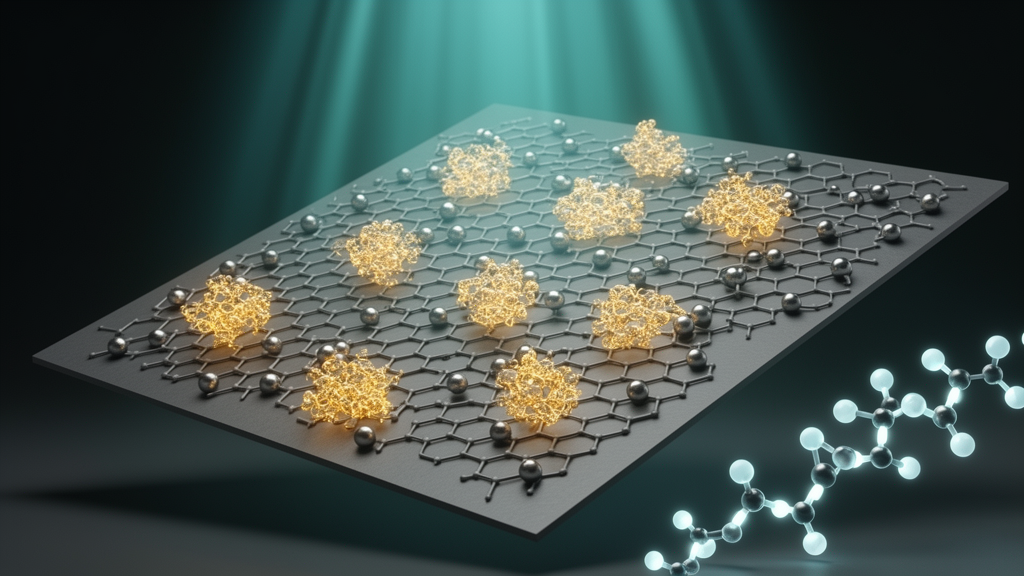
Chemists have long chased a way to marry the precision of biology with the brute synthetic power of metal catalysis, and a new study now reports a surprisingly simple recipe. Researchers combined commercial lipase enzymes with palladium and copper salts in water at room temperature, using few-layer graphene flakes as a landing pad for the proteins. The enzymes did not merely hold the metal in place; they actively induced the formation of tiny crystalline metal nanoparticles, producing heterogeneous catalysts that can forge carbon-carbon bonds in reactions central to pharmaceutical synthesis. The work, published in the journal Catal, describes a family of graphene-enzyme-metal hybrids built under single-enzyme, dual-enzyme and dual-metal configurations.
Each was immobilized on graphene by interfacial adsorption, a process that fixes the enzymes in their open conformation, spread homogeneously across the support surface. That detail matters because the protein scaffold is not a passive container. According to the authors, the enzyme acts as a reducing agent, with electrons drawn from the oxidation of amino acids surrounding aspartate, glutamate or histidine residues that serve as the first coordination points for the metal. The enzyme also shapes particle size and morphology, so the choice of protein is effectively a design parameter for the final catalyst.
Transmission electron microscopy revealed how strongly the enzymatic system influenced the outcome. The G/CALB@PdNPs hybrid contained very small spherical particles averaging 2.4 nanometers in diameter, with a minor fraction averaging 16.4 nanometers. G/TLL@PdNPs produced exclusively very small particles of about 2.2 nanometers. The bienzymatic G/TLL/CRL@PdNPs hybrid, in which CRL was immobilized on a G/TLL preparation, carried two distinct particle populations, one averaging 2.7 nanometers and another averaging 11.1 nanometers. X-ray diffraction confirmed metallic Pd(0) in these hybrids, while X-ray photoelectron spectroscopy showed mostly elemental palladium on the surface, with small amounts of PdO. The bienzymatic system, however, carried a higher surface concentration of PdO than its single-enzyme counterpart, a difference that later proved decisive in catalysis.
Adding a second metal rewrote the chemistry again. When copper sulfate was introduced to the G/TLL/CRL@PdNPs hybrid, X-ray diffraction showed peaks for Pd(0) and for Cu(II) in the form of copper phosphate, and infrared analysis confirmed phosphate in the sample. X-ray photoelectron spectra indicated mainly Pd(II) species on the surface in this bimetallic material. The palladium content fell from 2.2 percent by weight to 1.6 percent, which the authors interpret as some coordinated palladium being substituted by copper, while copper reached 16 percent by weight. Electron microscopy showed two size classes, particles averaging 4.2 nanometers and larger particles averaging 9.5 nanometers with varied shapes, including triangles, squares and spheres. A control hybrid prepared with copper alone demonstrated that the larger particles were Cu(II) species induced by CRL, and scanning transmission electron microscopy with energy-dispersive analysis indicated that the bimetallic hybrid contained mainly Cu/Pd alloy nanoparticles.
Controls reinforced the claim that the enzymes, not the graphene, drive nanoparticle formation. When the synthesis was attempted with graphene lacking immobilized protein, or with G/CALB coated in polyethyleneimine, a polymer that blocks the carboxylic groups that coordinate metal ions, negligible metal was detected by X-ray diffraction or inductively coupled plasma analysis. Metal loading in the functional hybrids remained modest, at 1.6 percent palladium by weight for G/CALB@PdNPs, 2.2 percent for G/TLL@PdNPs and 2.8 percent for the bienzymatic palladium hybrid, measured by ICP-OES. In the bienzymatic derivative, the researchers argue that CRL, with its greater number of vicinal aspartate and glutamate residues surrounded by hydrophobic groups, is the main agent of palladium nanoparticle formation, explaining the larger particles in that system.
The catalytic test case was a carbon-hydrogen activation reaction: the selective arylation of N-acetyl-L-tryptophan methyl ester using 4-methoxybenzenediazonium tetrafluoroborate as the aryl donor, run at room temperature. Free lipases and their graphene-immobilized versions did nothing. In a methanol-water mixture, G/TLL@PdNPs delivered 24 percent yield of the arylation product after two hours with selectivity above 99 percent, corresponding to a turnover frequency of 4.54 per hour. The bienzymatic G/TLL/CRL@PdNPs was less efficient under those conditions, but the authors attribute that to its mixed particle sizes. When they weighted the calculation by particle volume, the 2.7-nanometer particles showed a turnover frequency of 38.6 per hour, while the 11.1-nanometer particles managed only 2.2 per hour, meaning the small particles were 17 times more effective.
In pure methanol the hierarchy flipped dramatically. But G/TLL/CRL@PdNPs excelled, converting the substrate to the C-2 arylation product with more than 95 percent yield and greater than 99 percent selectivity in two hours, a turnover frequency of 14.26 per hour that made it 15 times more effective than the single-enzyme hybrid under identical conditions. The small 2.7-nanometer particles in that hybrid reached a turnover frequency of 244.5 per hour, and counting only the palladium atoms actually exposed on particle surfaces, the figure climbed to 5000 per hour. The authors link this performance to the PdO on the nanoparticle surfaces, citing recent studies suggesting that in water, Pd(0) nanoparticles are less stable because the metal must be reoxidized to Pd(II) with oxygen as the terminal oxidant, while the Pd(0) intermediate is prone to clustering into inactive species that deactivate the catalyst. The bimetallic Cu-containing hybrid, by contrast, lost more than 40-fold efficiency in pure methanol, a behavior the authors attribute to copper’s oxidative capacity, which facilitates regeneration of Pd(0) to Pd(II) and thereby reduces activity without water. In the aqueous methanol mixture, that same hybrid reached 70 percent conversion in six hours, though copper catalysis directly produced 20 percent of an unwanted anisole byproduct.
The Suzuki-Miyaura coupling, a workhorse reaction for building biaryl molecules, told a different story. Coupling bromobenzene with phenylboronic acid in water containing 20 percent acetonitrile at 45 degrees Celsius, G/TLL@PdNPs produced biphenyl in 65 percent yield after 20 hours as the sole product. The bienzymatic hybrid achieved higher overall conversion at 83 percent, but selectivity dropped: only 60 percent of the desired biaryl formed, alongside 23 percent phenol, which the authors attribute to surface PdO species oxidizing the aryl halide. Control catalysts, including palladium synthesized on enzyme-free graphene and commercial 5 percent palladium on carbon, produced no conversion at all. G/CALB@PdNPs consumed nearly all the phenylboronic acid but yielded no biphenyl; investigation showed its larger palladium particles promoted deboronation of the boronic acid under the strong basic conditions instead of the coupling reaction.
Durability was demonstrated with recycling experiments on G/TLL@PdNPs under the optimal Suzuki conditions. After the first reaction, the catalyst was washed with a 20 percent acetonitrile-water solution and reused twice more, retaining around 95 percent of its initial activity with high selectivity. They also emphasize practical scale: the enzyme-metal hybrids can be produced on multimilligram and even gram scales, and the three-dimensional structure of the enzyme is conserved with modifications during synthesis, which they describe as essential for proper nanoparticle formation.
The broader message is one of modular design. Depending on whether one enzyme, two enzymes or two metals are built into the graphene scaffold, the same simple aqueous, room-temperature protocol yields catalysts tuned for different reactions: the dual-enzyme palladium hybrid for C-H arylation, where selectivity for C-2 arylation was high and surface-accessible metal sites showed striking efficiency, and the predominantly Pd(0) single-enzyme hybrid for Suzuki coupling. For a field seeking greener routes to the carbon-carbon bonds that underpin pharmaceuticals, the study offers a template in which the enzyme is simultaneously scaffold, reducing agent and particle-size engineer, all assembled in one pot at room temperature.
Subject of Research: Enzyme-graphene hybrid catalysts with immobilized metal nanoparticles for carbon-carbon bond formation
Article Title: Biohybrid architectures featuring immobilized metallic nanoparticles for catalytic carbon-carbon bond formation
Article References: Losada-Garcia, N., Ortega-Nieto, C., & Palomo, J. M. (2026). Biohybrid architectures featuring immobilized metallic nanoparticles for catalytic carbon-carbon bond formation. Catal, 2(1), Article 1. https://doi.org/10.1007/s44422-025-00012-8
Image Credits: AI Generated
DOI: 10.1007/s44422-025-00012-8
Keywords: biohybrid catalysts, metal nanoparticles, lipases, graphene, palladium, copper, C-H activation, Suzuki-Miyaura coupling, carbon-carbon bond formation, artificial metalloenzymes, biocatalysis, heterogeneous catalysis
News Source: Bethany Barker. (October 30, 2026). Enzyme-Graphene Hybrids Forge Metal Nanoparticles for Greener Carbon-Carbon Bond Building. Scienmag.



