


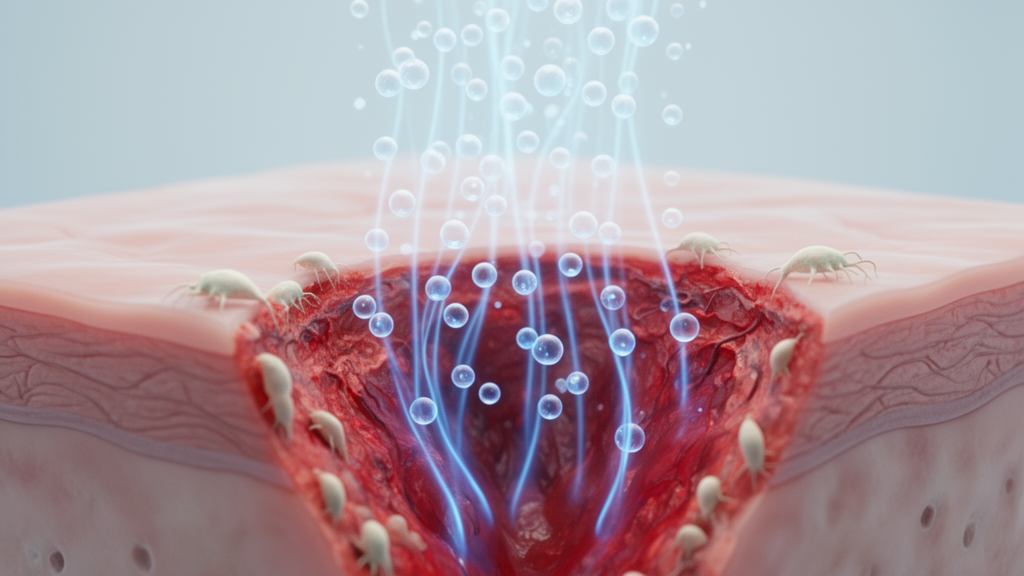
Chronic and complex wounds remain one of the most stubborn problems in modern medicine, and a new review in the Journal of Materials Science argues that the way forward lies in combining artificial intelligence with advanced biomaterials. The authors, led by Md Ali Mujtaba and Mohit Agrawal, describe how machine learning and related computational tools could transform wound management by predicting healing outcomes, optimizing formulations, and enabling real-time monitoring of wound biomarkers.
The core difficulty, according to the review, is that conventional wound care strategies mainly focus on infection control and moisture maintenance but often fail to dynamically regulate the wound microenvironment. Persistent inflammation, microbial infection, oxidative stress, and impaired angiogenesis all disrupt the coordinated biological events necessary for tissue regeneration, resulting in limited therapeutic efficacy. The review argues that conventional wound care strategies often fail to dynamically regulate the wound microenvironment, and it positions AI-integrated biomaterials as a potential route to personalized, adaptive, and precision-based wound therapy.
Artificial intelligence has emerged as a transformative tool in this space, the review notes, by enabling predictive modeling, automated wound assessment, and data-driven optimization of therapeutic interventions. The review describes AI as enabling predictive modeling, automated wound assessment, and data-driven optimization of therapeutic interventions, rather than relying solely on conventional wound care approaches. The authors emphasize that these computational methods have also accelerated the rational design of advanced biomaterials and drug delivery platforms.
Among the platforms highlighted are hydrogels, nanocarriers, microneedles, and bioactive scaffolds capable of controlled and stimuli-responsive therapeutic delivery. The review describes these platforms as capable of controlled and stimuli-responsive therapeutic delivery. The integration of AI with these systems, the authors suggest, points toward personalized, adaptive, and precision-based wound therapy.
The review also grounds its argument in molecular biology. Wound healing, it explains, is governed by signaling pathways such as VEGF/PI3K–Akt for angiogenesis, TGF-β/Smad for extracellular matrix remodeling, NF-κB for inflammation, and Nrf2/Keap1 for oxidative stress regulation. The review emphasizes linking AI technologies with these key molecular signaling pathways as part of its case for personalized, adaptive, and precision-based wound therapy.
The article appears in the journal’s Nano/Biomaterials for Targeted Therapy and Tissue Regeneration section and was published on 28 October 2026. It is positioned as a comprehensive overview of how AI-driven approaches can predict healing outcomes, optimize formulations, and enable real-time monitoring of wound biomarkers, rather than as a report of new experimental results. The review highlights the emerging integration of AI with advanced biomaterials for intelligent wound management.
Nanorobotics, mentioned in the review’s title, sits at the speculative edge of this vision. Nanorobotics is named in the review's title as one of the technologies to be integrated with advanced nanotherapeutics for wound healing. The review's stated scope covers the integration of AI, machine learning, and nanorobotics with advanced biomaterials including hydrogels, nanocarriers, microneedles, and bioactive scaffolds.
For clinicians and researchers, the significance of the review lies less in any single breakthrough than in the integration it describes. The review states that chronic and complex wounds remain a major clinical challenge due to persistent inflammation, microbial infection, oxidative stress, and impaired angiogenesis. The authors argue that AI can enable predictive modeling, automated wound assessment, and data-driven optimization of therapeutic interventions in wound management.
The review emphasizes the potential for personalized, adaptive, and precision-based wound therapy through the integration of AI with advanced biomaterials. As a review article, the work synthesizes existing literature rather than reporting new experimental results, and it is published in the Journal of Materials Science. The authors present the integration of AI with advanced biomaterials as a route toward intelligent wound management that links molecular signaling pathways with data-driven therapeutic design.
Subject of Research: Integration of artificial intelligence, machine learning, and nanorobotics with advanced biomaterials for wound healing
Article Title: Advanced nanotherapeutics for wound healing: integrating artificial intelligence, machine learning, and nanorobotics
Article References: Mujtaba, M. A., Shiekmydeen, J., Kumar, A., Kumar, D., Ali, S. S., Kumar, M., & Agrawal, M. (2026). Advanced nanotherapeutics for wound healing: integrating artificial intelligence, machine learning, and nanorobotics. Journal of Materials Science. https://doi.org/10.1007/s10853-026-13991-3
Image Credits: AI Generated
DOI: 10.1007/s10853-026-13991-3
Keywords: artificial intelligence, machine learning, nanotherapeutics, wound healing, hydrogels, nanocarriers, microneedles, bioactive scaffolds, drug delivery, biomaterials, nanorobotics, tissue regeneration
News Source: Blake Davidson. (October 30, 2026). AI-guided nanotherapeutics aim to reshape chronic wound care. Scienmag.



