


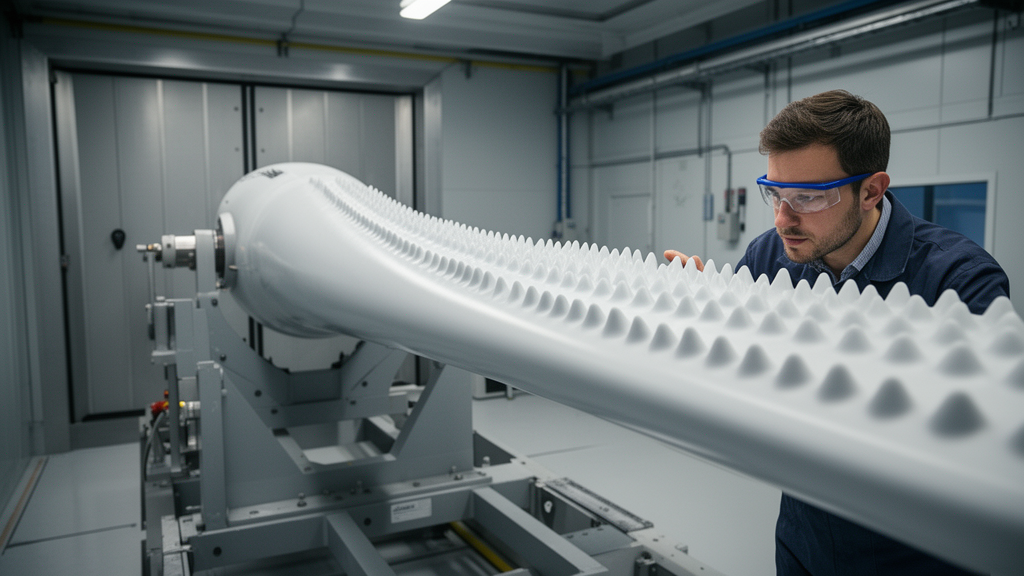
Wind turbine blades modeled on the bumpy flippers of humpback whales have delivered a striking double payoff in laboratory tests: they spun dramatically faster and generated far more power than conventional blades, while in some designs also cutting the noise radiated by the rotor. The findings come from an experimental campaign in which researchers at the Hong Kong University of Science and Technology fitted a small-scale wind turbine with four different serrated blade designs and measured their aerodynamic and acoustic behavior inside both a closed-vein wind tunnel and an anechoic chamber.
The study, published in the journal Advances in Aerodynamics, centered on a scaled-down version of a well-documented research turbine, the NREL Phase VI, developed by the U.S. National Renewable Energy Laboratory. The team modified the blade’s leading edge so that it undulated sinusoidally along the span, mimicking the tubercles, or protuberances, found on humpback whale flippers. The size of these serrations was controlled by two parameters: amplitude, the height of the undulation, and wavelength, the spacing between successive bumps. In this study, both parameters scaled with the local chord length of the blade, decreasing linearly toward the tip, a strategy the authors favored based on their earlier wind tunnel tests of serrated airfoil sections.
Four serration designs were selected to span a meaningful design space, labeled A4λ30, A4λ15, A4λ7.5, and A8λ30, where the numbers denote the amplitude and wavelength as fractions of the local chord. Each 3D-printed blade, made of hollow ABS resin reinforced with an internal mesh of ribs, was mounted on a 1.5-meter-diameter rotor equipped with torque sensors, a six-axis load cell, and a motor-brake system capable of controlling the spinning rate to within half a revolution per minute. The baseline rotor, with a straight leading edge, was tested alongside the serrated versions to validate the experimental protocol and provide a reference for comparison.
The aerodynamic results were unambiguous. When the rotors were left free to spin under a 5-meter-per-second inflow with a 3-degree tip pitch, the serrated rotors reached a tip-speed ratio of about 8.0, roughly 142 percent higher than the baseline rotor’s 5.6. Under a 7-meter-per-second inflow, the serrated blades spun freely at tip-speed ratios of 9.5 to 11.8 depending on pitch, again exceeding the baseline by more than 120 percent. When the rotors were deliberately slowed to an identical tip-speed ratio of about 5.3, the serrated rotors produced power coefficients around 0.28, roughly five times the baseline value of about 0.06. The authors note that none of the previous studies on serrated rotors reported such large increases in spinning rate, with earlier work typically showing gains of only a few percent in power coefficient and often penalties depending on the serration design.
Wake measurements taken one diameter downstream of the rotor helped explain where the extra energy was coming from. At the same rotational speed, all four serrated rotors produced wakes that were about 40 percent wider in area than the baseline wake, accompanied by noticeably larger velocity deficits, indicating greater extraction of energy from the wind. Crucially, the turbulence intensity in the serrated wakes remained similar to that of the baseline rotor, suggesting the aerodynamic gains did not come at the cost of increased turbulence, a factor that matters when turbines are deployed in wind farms where wake effects can reduce power delivery by as much as 45 percent.
The benefits proved robust across a range of operating conditions. When the turbine was yawed 30 degrees to the inflow, all rotors spun roughly 20 percent slower, but the serrated blades retained their advantage, spinning freely at tip-speed ratios about 145 percent higher than the baseline under a 3-degree pitch. Adding artificial turbulence to the inflow, generated by a static grid upstream of the model, lowered the maximum power coefficient of all rotors by about 35 percent, yet the serrated rotors still outperformed the baseline across the tested conditions. The authors caution that the wind tunnel’s blockage ratio of about 35 percent exceeds the commonly advised 10 percent threshold, but they argue that these confinement effects apply similarly across all rotors and therefore do not significantly bias the relative comparison between serrated and baseline designs.
The acoustic picture was more complicated. In the anechoic chamber, where the rotor was motor-driven at speeds from 0 to 800 rpm, the serrated blades produced noticeably lower sound pressure levels than the baseline at the blade passing frequency and its harmonics, but the pattern depended heavily on the serration design, the rotational regime, and the direction of measurement. At lower spinning rates, no consistent trend emerged across the designs. At the highest regime, 800 rpm, a clearer pattern appeared: the rotor with the smallest serrations, A4λ7.5, systematically radiated less noise than the baseline, while the rotor with the largest serrations, A8λ30, radiated more. When the results were A-weighted to reflect human hearing sensitivity, all serrated rotors were quieter than the baseline at 200 and 400 rpm, but the largest-serration designs became noisier than the baseline at 600 and 800 rpm.
Acoustic holography using a 112-microphone array upstream of the rotor confirmed the far-field observations. In the 630-hertz to 2000-hertz range, the A4λ7.5 design produced lower noise levels than the baseline, while the A8λ30 design produced higher levels, revealing an apparent proportionality between the magnitude of the serrations and their acoustic signature. The noise maps also showed that sound sources became more compact and concentrated over the blade tip region as frequency increased, consistent with the higher relative velocity at the outer span and the additional contribution of tip-vortex noise. The authors note that their findings are based on a small-scale rotor whose chord-based Reynolds numbers differ from those of a full-scale turbine, so the results should be taken as qualitative insights rather than direct predictions for real-world installations.
Overall, the study demonstrates that leading-edge serrations can serve as a passive flow-control solution that improves both the aerodynamic efficiency and, in some designs, the acoustic discretion of wind turbine blades. The authors attribute the aerodynamic gains to the ability of the leading-edge protuberances to mitigate stall and spanwise crossflow effects, mechanisms documented extensively in earlier airfoil studies. But the strong sensitivity of the acoustic outcomes to serration amplitude and wavelength, and the fact that larger serrations can actually increase noise at high rotational speeds, means that designers cannot simply scale up the bumps and expect uniform benefits. The team calls for future work combining refined full-scale serration design through numerical simulation with outdoor field tests on full-scale turbines, where higher Reynolds numbers, atmospheric turbulence, wind shear, and unsteady gusts would put the concept to a more demanding test. They also flag practical questions beyond fluid dynamics, including structural integrity, manufacturing complexity, retrofitting of existing turbines, and long-term issues such as dust accretion within the serrations.
Subject of Research: Experimental aerodynamic and acoustic testing of bio-inspired leading-edge serrated wind turbine blades on a small-scale rotor
Article Title: Experimental characterization of the aerodynamics and acoustics of bio-inspired, serrated wind turbine blades
Article References: Schmidt, T. G., & Redonnet, S. (2026). Experimental characterization of the aerodynamics and acoustics of bio-inspired, serrated wind turbine blades. Advances in Aerodynamics, 8(1), Article 12. https://doi.org/10.1186/s42774-025-00251-2
Image Credits: AI Generated
DOI: 10.1186/s42774-025-00251-2
Keywords: wind turbines, leading-edge serrations, humpback whale, bio-inspired design, aerodynamics, aeroacoustics, power coefficient, tip-speed ratio, anechoic chamber, wind tunnel testing, passive flow control, NREL Phase VI
News Source: Faith Mcneil. (October 30, 2026). Whale-inspired serrated blades spin faster and quieter in wind turbine tests. Scienmag.



