


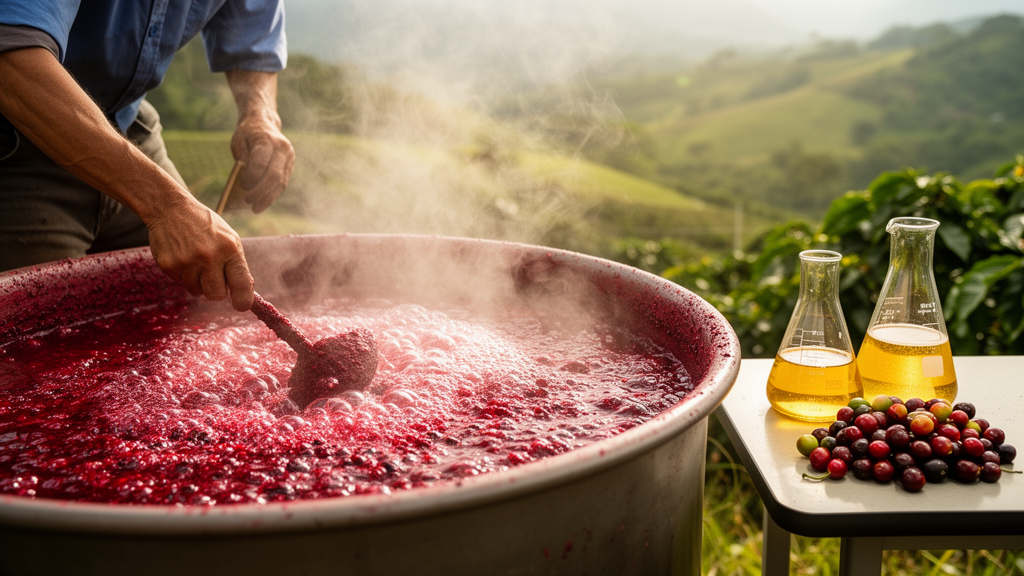
The work took place at Maestra Chela Farm in Volcancito, Boquete, in the Panamanian highlands at 1,575 meters above sea level. Mature Catuaí fruits were hand-picked, depulped mechanically with fresh water, and the beans were placed into five woven polypropylene bags of 17 kilograms each. They fermented for 30 hours following the local artisanal method, on a January day when the ambient temperature ranged between 17 and 20 degrees Celsius. Biomass temperature was tracked with a probe at different time points throughout the process.
Sixty samples of ten beans each were drawn from the five bags at three depths at four intervals: cherries before depulping, freshly depulped beans at time zero, and then at 8, 16, and 30 hours. Samples destined for DNA barcoding were frozen at minus 20 degrees Celsius, while those intended for live cultures were processed immediately. To select for thermotolerant strains, all isolation plates were incubated at 43 degrees Celsius, a temperature chosen from the literature and because it was the maximum at which yeast growth had been observed in the laboratory. Plates were monitored daily for eight weeks.
Three solid media were used: a YPD formulation, a yeast-malt medium, and Sabouraud dextrose agar, each supplemented with antibiotics to suppress bacteria. The choice of medium proved decisive. Fifty-one percent of isolates came from the yeast-malt medium, 39 percent from Sabouraud, and 10 percent from YPD despite equal sampling effort. The yeast-malt medium was by far the most diverse, yielding 26 unique operational taxonomic units and the only recoveries of Nakaseomyces, while Sabouraud alone produced Meyerozyma and several OTUs found nowhere else. YPD yielded a single OTU, Pichia kudriavzevii, which dominated all three media.
In total, 80 thermotolerant yeast morphotypes were obtained as axenic cultures, and sequencing of the nuclear ribosomal internal transcribed spacer region revealed 32 distinct OTUs, all within the phylum Ascomycota. BLAST analyses placed the strains in five clades corresponding to the genera Clavispora, Nakaseomyces, Meyerozyma, Candida, and Pichia. Maximum-likelihood phylogenetic analysis of full-length ITS sequences, using 87 reference sequences from GenBank and Yarrowia lipolytica as an outgroup, recovered the five clades with strong bootstrap support. Species names were assigned conservatively, and taxonomic placement below the genus level was deliberately withheld pending multilocus analyses.
Timing mattered as much as temperature. Clavispora and Meyerozyma were isolated from samples obtained at the beginning of the fermentation process, while Pichia was cultured after 8 hours and persisted as the main isolated genus until the end of the process. Pichia and Nakaseomyces were the most abundant isolates from samples obtained at 16 hours, and Pichia remained the dominant genus isolated at the end of the 30-hour fermentation process, with the genus Pichia representing 56 percent of the sequences of the class Pichiomycetes. The authors note that this temporal profile offers practical guidance: researchers seeking Pichia should sample late in fermentation, while those after Clavispora or Meyerozyma should sample early.
The diversity surprised the team. Previous studies of fermenting coffee in Africa found only eight species among 110 isolates, and a Brazilian study of dry-processed coffee recovered six species from 89 isolates. One plausible explanation is that yeast diversity rises with isolation temperature; the 43-degree incubation used here may have captured thermotolerant or thermophilic taxa that lower-temperature protocols missed. It may also explain why no basidiomycete yeasts were isolated. Even so, only three genera, Pichia, Nakaseomyces, and Candida, composed 86 percent of isolates, a pattern of many species-level taxa within few higher groups familiar from tropical fungal endophyte studies. The OTU count also implies that sampling was insufficient to reveal all taxa present.
Three strains advanced to starter-culture trials: two P. kudriavzevii isolates distinguished by their morphological differences and one Clavispora strain selected for its putative novelty, since its clade showed no high-identity matches to ex-type strains in curated GenBank references, hinting at a divergent lineage worth further investigation. Liquid starters were grown at 43 degrees Celsius for 12 hours with agitation, then 50 milliliters containing roughly 1.77 to 2.25 million cells per milliliter were used to inoculate 250 grams of depulped Catuaí. Coffee fermented for 18 hours, until the mucilage was fully consumed, then was washed and air-dried. Two negative controls, one with sterile medium and one with beans alone, ran alongside, and every sample and control was analyzed in triplicate by three testers, producing nine scores each.
Sensory evaluation followed Specialty Coffee Association standards, with a panel of three trained tasters holding Best of Panama National Judge certificates scoring ten attributes including fragrance, aroma, flavor, aftertaste, acidity, body, uniformity, cleanliness, sweetness, and balance, for a total out of 100. The authors report that the Clavispora strain and one P. kudriavzevii strain showed promise as starter cultures due to the characteristics given to the Catuaí coffee that increased its score in the SCA evaluation, noting that Clavispora can metabolize cellobiose, glucose, and xylose and tolerate various fermentation methods, while Pichia is a well-recognized genus with potential as a starter culture in coffee fermentation, capable of controlling the fermentation process and inhibiting the growth of unwanted fungi.
The findings carry practical weight for Panama, where small producers compete in a specialty market that accounts for 10 percent of global coffee trade and commands premium prices. The authors suggest that a temperature-adapted isolation protocol can reduce the cost and time needed to select starter cultures, and that the unexpectedly high species diversity encountered here implies earlier studies at lower temperatures overlooked a substantial number of thermotolerant taxa.
Subject of Research: Isolation of thermotolerant yeasts from Coffea arabica cv. Catuaí fermentation in Panama and their evaluation as starter cultures for specialty coffee quality
Article Title: Thermotolerant yeasts from fermentation of Coffea arabica L. cv. Catuaí from Panama and their effects on coffee quality
Article References: Montenegro G., A. I., Salazar C., J. R., Correa, K., González, A., Ruíz, M., Bayman, P., Raja, H. A., & Caballero-George, C. (2026). Thermotolerant yeasts from fermentation of Coffea arabica L. cv. Catuaí from Panama and their effects on coffee quality. Annals of Microbiology, 76(1), Article 41. https://doi.org/10.1186/s13213-026-01867-5
Image Credits: AI Generated
DOI: 10.1186/s13213-026-01867-5
Keywords: thermotolerant yeasts, coffee fermentation, Coffea arabica, Catuaí, Panama, Pichia kudriavzevii, Clavispora, starter cultures, SCA sensory score, microbial diversity, ITS barcoding, specialty coffee
News Source: Drew Townsend. (October 30, 2026). Heat-Loving Yeasts From Panamanian Coffee Fermentation Boost Specialty Scores. Scienmag.



