


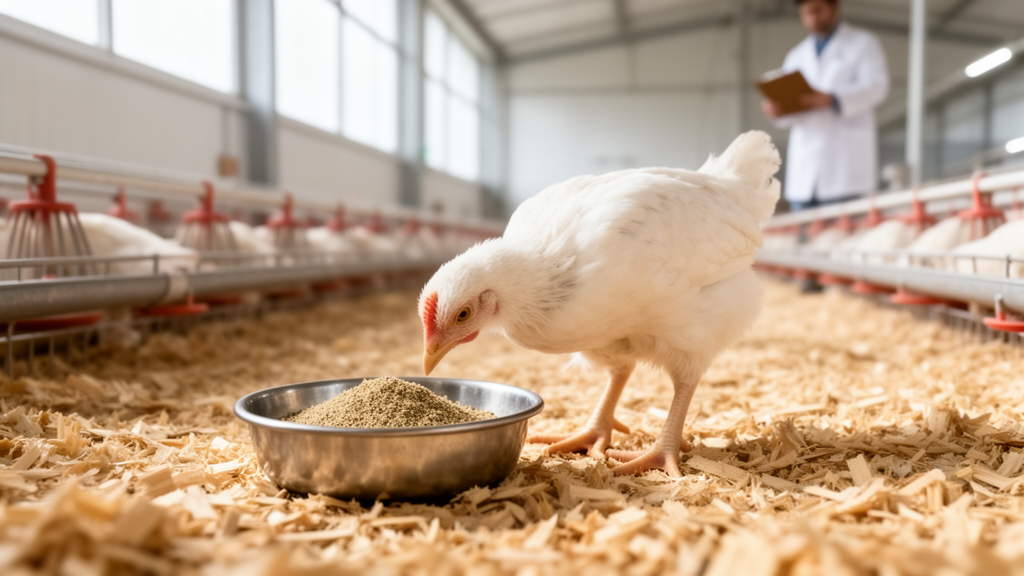
Broiler chickens fed a traditional Chinese medicinal herb for nearly two months showed measurable shifts in the bacteria and fungi living in their ceca, even though most standard blood chemistry readings stayed flat, according to a new study published in Annals of Microbiology. The research, led by Guiwen He, Lijun Cheng and colleagues with corresponding author Junsong Zhao, tested powdered Gastrodia elata, a plant long valued in East Asia as both a food and a medicine, as a dietary supplement in young broilers and tracked what happened inside their guts and bloodstreams.
The experiment began with sixty 21-day-old broilers, which the team randomly divided into four groups. One group served as the control and received no supplement, while the other three received low, medium and high doses of Gastrodia elata powder at 250, 500 and 750 milligrams per kilogram of feed, designated LDG, MDG and HDG respectively. Each group contained five replicates of three birds each. The birds were then fed these diets for 56 days, a substantial window for detecting dietary effects in fast-growing poultry.
At the end of the trial, the researchers drew blood to measure serum biochemical parameters and collected cecal contents for two kinds of DNA sequencing: 16S rRNA gene amplicon sequencing targeting the V3–V4 region to profile bacteria, and ITS gene amplicon sequencing to profile fungi.
The headline result was one of selective change rather than sweeping transformation. On the blood side, dietary supplementation with Gastrodia elata powder had no significant effect on serum biochemical parameters overall.
The bacterial story was more concrete. Supplementation modulated the overall structure of the intestinal bacterial community, and several specific genera shifted in abundance in a dose-dependent manner. The relative abundances of Oscillospira, Parasutterella and Negativibacillus significantly decreased in supplemented birds, while those of Ruminiclostridium, Erysipelatoclostridium and Enterorhabdus significantly increased.
The fungal community also responded. In the high-dose group, the Chao index, a measure of species richness that estimates how many distinct taxa are present, was significantly higher than in the control group. Fungal relative abundance patterns likewise shifted in response to the supplement.
The motivation behind the study adds an economic wrinkle. After Gastrodia elata was formally established as a source of both food and medicine, large-scale cultivation and extensive production and processing led to an increase in substandard products that fail to meet quality grades for direct sale. Rather than discarding these unqualified products, the researchers wanted to explore whether they could find high utilization value in livestock and poultry breeding, turning a waste stream from herbal medicine production into a potential feed ingredient.
Because the trial used an accepted, peer-reviewed manuscript shared early with a permanent DOI, the authors caution that the version is subject to further edits and will be replaced by the final Version of Record.
What the work does establish is a clear, dose-linked microbial signature. Broilers given Gastrodia elata powder carried significantly fewer Oscillospira, Parasutterella and Negativibacillus and significantly more Ruminiclostridium, Erysipelatoclostridium and Enterorhabdus in their ceca, along with richer fungal communities at the highest dose, while their serum biochemistry remained largely unchanged apart from tendencies in alkaline phosphatase and high-density lipoprotein. For researchers exploring whether substandard herbal products can be repurposed in animal feed, these results provide a microbial baseline and a reminder that changes in gut community structure do not automatically translate into changes in blood chemistry or, by extension, into measurable health or performance benefits.
Subject of Research: Effects of dietary Gastrodia elata powder supplementation on gut microbiota and serum biochemistry in broiler chickens
Article Title: Dietary supplementation with Gastrodia elata powder affected the gut microbiota and serum biochemical parameters in broilers
Article References: He, G., Cheng, L., Ruan, Y., Gao, X., Tian, H., She, M., Tan, D., Sheng, Y., Wang, X., Wang, J., & Zhao, J. (2026). Dietary supplementation with Gastrodia elata powder affected the gut microbiota and serum biochemical parameters in broilers. Annals of Microbiology. https://doi.org/10.1186/s13213-026-01868-4
Image Credits: AI Generated
DOI: 10.1186/s13213-026-01868-4
Keywords: Gastrodia elata, broilers, gut microbiota, cecal fungi, serum biochemistry, 16S rRNA sequencing, ITS amplicon sequencing, animal feed additive, Oscillospira, Ruminiclostridium, alkaline phosphatase, high-density lipoprotein
News Source: Bethany Barker. (October 30, 2026). Gastrodia elata Powder Reshapes Gut Microbes in Broilers, Leaves Blood Chemistry Largely Unchanged. Scienmag.



