


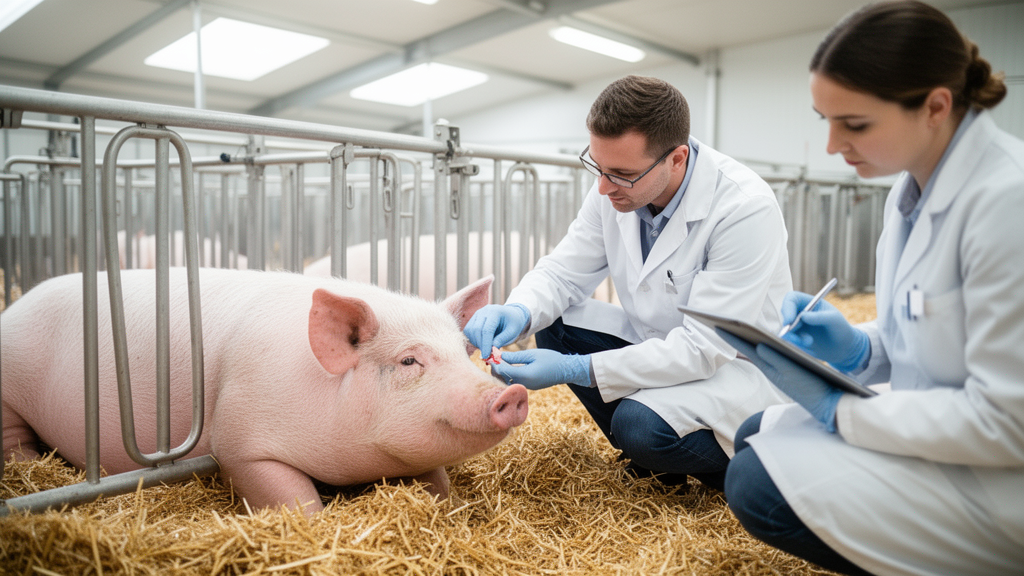
A genome-wide association study of 3263 sows has produced the first whole-genome-sequence-based map of the genetic architecture of labour dystocia in pigs, a common reproductive disorder in which farrowing stalls and obstetric help becomes necessary. The work, published in Genetics Selection Evolution, identified 250 associated SNPs in primiparous sows and 12 in multiparous sows, and fine-mapped two major QTL in primiparous Yorkshire sows to a 498.44 kb interval on chromosome 2 and a 779.85 kb interval on chromosome 9.
Labour dystocia, abbreviated LAD by the study team, was defined operationally as a piglet birth interval of more than 45 minutes, often requiring obstetric assistance, while normal delivery meant a sow expelled all foetuses and placentas without intervention. The condition matters economically because it lowers the number of piglets born alive and raises stillbirth rates. After decades of selection for larger litters, the authors note that delivery duration in domestic pigs has stretched from roughly two hours per 12 piglets to six hours and 40 minutes per 19 piglets born, with the reported incidence of dystocia rising from 0.25 percent to 5 percent and stillbirths climbing from 0.7 to 1.2 per litter.
The incidence of dystocia varied by parity and breed. Across the first four parities it ranged from 8.97 to 23.41 percent in Landrace sows and from 8.97 to 12.03 percent in Yorkshire sows, and first-parity sows had the highest rates in both breeds, at 23.41 percent for Landrace and 12.03 percent for Yorkshire. Over the four parities the overall incidence was 19.09 percent in Landrace and 10.70 percent in Yorkshire. After a first difficult birth, the probability of recurrence was 35.38 percent in Landrace and 19.69 percent in Yorkshire. Average piglet birth weight was 1.58 kg for Landrace litters and 1.33 kg for Yorkshire litters, a contrast the authors link to breed differences in dystocia risk, since larger piglets face more friction in the birth canal.
The association scan returned a striking asymmetry between breeds. In primiparous sows, one suggestive SNP was detected in Landrace animals, while Yorkshire sows yielded 249 associated SNPs, 90 of which reached genome-wide significance; 243 of these sat near 23 Mb on chromosome 2, marking that region as the major QTL for the trait. In multiparous sows the counts were one suggestive SNP in Landrace and 11 associated SNPs in Yorkshire, three of them genome-wide significant. The authors attribute this disparity largely to sample size, which ranged from 126 to 487 for Landrace and 857 to 2776 for Yorkshire, and note that no significant SNPs overlapped between the primiparous and multiparous analyses, suggesting the case-control ratio also shapes power. A meta-analysis combining the two breeds found fewer signals, consistent with genetic heterogeneity between the populations, although the chromosome 2 QTL was corroborated.
On chromosome 2, the region was first bounded by SNPs in strong linkage disequilibrium with the top SNP, 2_23327820, and refined by a 2-LOD drop-off method to a 498.44 kb interval spanning 23.18 to 23.68 Mb. The top SNP explained 4.50 percent of phenotypic variance, and genotype frequencies told a consistent story: sows with the AA genotype had a 5.37 percent incidence of dystocia, compared with 9.94 percent for AT and 12.27 percent for TT carriers, with the A allele at a frequency of 39 percent. FINEMAP rejected a single-causal-variant model outright and instead supported two independent causal signals, with a posterior probability of 0.645 for two variants, and a conditional analysis showed that all signals in the interval dropped below threshold once the top SNP was included as a covariate.
On chromosome 9, the QTL interval spanned 779.85 kb, from 43.34 to 44.12 Mb, and the top SNP, 9_43672208, explained 2.67 percent of phenotypic variance. Here the risk allele pattern ran the other way: sows carrying the CC genotype had a 24.68 percent incidence of dystocia, versus 15.04 percent for CG and 10.31 percent for GG, with the G allele at 83 percent frequency. Fine-mapping assigned a posterior probability of 0.56 to two causal variants and 0.406 to three, and identified two 95 percent credible sets led by 9_44119733 and 9_43680847. The potentially regulatory SNP 9_44119733 explained 2.76 percent of phenotypic variance, sat in moderate linkage with the top SNP at r² of 0.49, and showed a genotype gradient of 18.95 percent incidence for TT, 13.89 percent for TC, and 9.35 percent for CC sows, with the C allele at 71 percent.
The SNP 2_23340612 overlapped ATAC-seq peaks from muscle and brain tissues of Yorkshire, Enshi black pig, and Duroc breeds, and motif analysis placed its A and G alleles within two predicted transcription factor binding motifs that together recruit 27 transcription factors. Enrichment analysis of those factors pointed to oxytocin signalling, muscle contraction, and development of the female genitalia and embryo, and a STRING interaction network centred on the MEF2C transcription factor, which is highly expressed in brain tissue according to the PIGOME database. The authors suggest this variant may act as an MEF2C binding site influencing oxytocin synthesis and secretion in the hypothalamus and pituitary, but they caution that the low posterior inclusion probability of 2_23340612 in the fine-mapping means its causality remains uncertain and requires experimental testing.
The chromosome 9 variant 9_44119733 lies in an intron of BUD13 and upstream or downstream of ZPR1, APOA1, APOC3, APOA4, and APOA5, and overlaps ATAC-seq peaks in adipose, muscle, brain, heart, liver, and other tissues across Yorkshire, Duroc, Meishan, and Enshi black pig, indicating a conserved active regulatory region. Its C and T alleles fall within two motifs predicted to bind eight transcription factors, and STRING analysis predicted interactions among ZNF274, HMGA1, CTCF, and the six neighbouring genes, a network tied to transcriptional regulation, chromatin organization, and lipid-related processes. In total, eight promising candidate genes emerged: APOA1, APOC3, APOA4, APOA5, BUD13, ZPR1, ACAN, and HAPLN3, with enrichment in lipid metabolism, extracellular matrix organization, cell adhesion, and response to estrogen. The genomic heritability of dystocia was low to moderate, from 0.11 to 0.19, and genetic correlations with total number born and number born alive were strongly negative at −0.77 and −0.89. The authors stress that all variants and genes should be treated as candidate loci pending functional validation, while noting that because swine resemble humans in anatomy, physiology, and the delivery process, the findings may also inform labour dystocia research in both species.
Subject of Research: Genetic architecture of labour dystocia in pigs identified through imputed whole-genome sequence association in multi-breed sow populations
Article Title: Imputed whole genome sequence based association pinpoints genetic architecture of labour dystocia of pigs using multi-breed populations
Article References: Zhou, S., Han, J., Yuan, J., Qiao, C., Chao, Z., Duan, D., Li, M., Wang, Z., Tan, S., Li, X., & Xin, W. (2026). Imputed whole genome sequence based association pinpoints genetic architecture of labour dystocia of pigs using multi-breed populations. Genetics Selection Evolution, 58(1), Article 58. https://doi.org/10.1186/s12711-026-01076-3
Image Credits: AI Generated
DOI: 10.1186/s12711-026-01076-3
Keywords: labour dystocia, sows, GWAS, whole-genome sequence, imputation, QTL fine-mapping, candidate genes, lipid metabolism, oxytocin signalling, Landrace, Yorkshire, reproductive traits
News Source: Juliet Wilcox. (October 30, 2026). Genome-Wide Scan of 3263 Sows Pinpoints DNA Variants Tied to Difficult Labour in Pigs. Scienmag.



