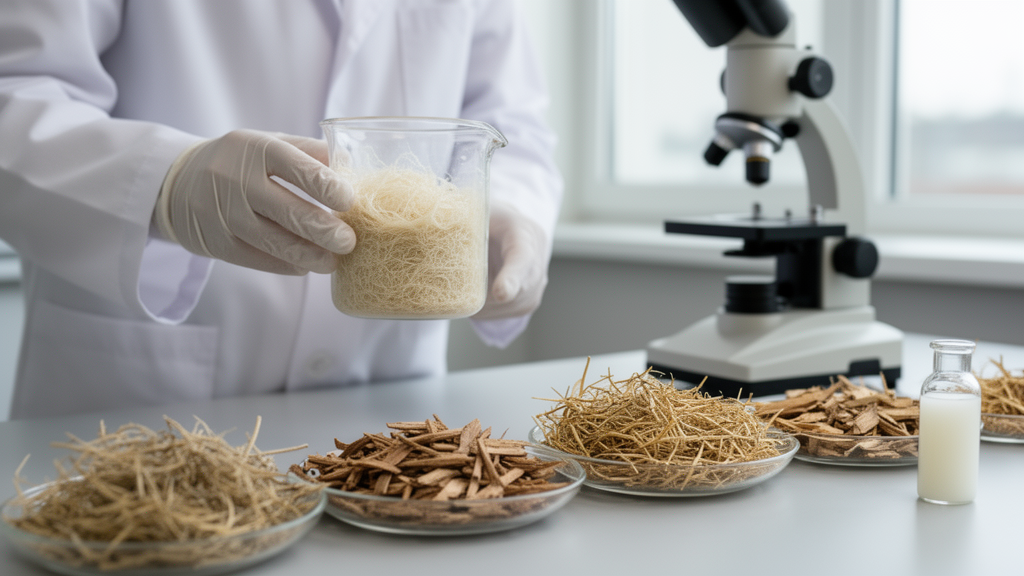
Lignocellulosic biomass, the most abundant renewable resource on Earth, is usually treated as a disposal problem: straw is burned in fields, forestry residues are landfilled, and the resulting pollution and greenhouse gas emissions are written off as the price of agriculture. A comprehensive review published in Discover Chemical Engineering argues that this waste stream could instead feed a high-value materials industry, and it maps in unusual detail the technical routes, economic barriers, and environmental caveats that stand between farm residue and nanoscale cellulose.
The review, led by Miao Liu and Ronghou Liu with colleagues across China, Malaysia, Poland, and Serbia, synthesizes recent advances in producing nanocellulose from lignocellulosic feedstocks. Nanocellulose refers to bio-based nanomaterials derived from natural cellulose with at least one dimension between 1 and 100 nanometers, and it comes in three main forms: cellulose nanocrystals (CNC), cellulose nanofibrils (CNF), and bacterial nanocellulose (BNC). The material has drawn intense interest because it combines remarkable mechanical strength, high specific surface area, biodegradability, and tunable surface chemistry, properties that open doors in composite reinforcement, flexible electronics, food packaging, biomedicine, and energy storage.
The economic logic is central to the authors’ argument. Converting lignocellulosic waste into biofuels, platform chemicals, or bioplastics has been studied extensively, but those routes demand extensive depolymerization, fermentation or polymerization, and downstream purification, and the products often earn only commodity-level margins. Nanocellulose production, by contrast, preserves the crystalline backbone of cellulose and therefore requires less severe chemical breakdown than biofuel synthesis, yet yields a premium nanomaterial with exceptional market value. The authors frame this as a more lucrative and technologically viable return on investment for biomass valorization, one that also reduces dependence on fossil-based polymers and expensive purified cellulose sources.
The structural science behind this proposition is well established. Lignocellulosic biomass is a hierarchical plant-cell-wall composite of cellulose, hemicellulose, and lignin. Cellulose microfibrils act as the load-bearing skeleton, hemicellulose serves as the matrix polysaccharide connecting the fibrils, and lignin forms a rigid aromatic network that shields the carbohydrates and makes the biomass recalcitrant. Cellulose itself is a linear homopolymer of β-D-glucopyranose units joined by β-1,4-glycosidic bonds, with parallel chains aggregating through dense hydrogen bonding and van der Waals interactions into microfibrils that mix highly ordered crystalline domains with less ordered amorphous regions. Those crystalline domains give the final nanomaterial its stiffness and strength, while the amorphous regions and interfibrillar hydrogen bonds are the preferential targets of hydrolysis, oxidation, enzymatic treatment, or mechanical fibrillation, allowing nanoscale cellulose to be liberated without complete molecular deconstruction.
Feedstock choice emerges as a decisive trade-off. Agricultural residues such as rice husks, wheat straw, corn stover, bagasse, and coir are abundant and nearly free, but their cellulose content is generally lower, often 30 to 45 percent, and their structural heterogeneity limits theoretical nanocellulose yield. Rice husks illustrate the trap: their substantial ash and silica content forces harsh, chemical-intensive pretreatments that inflate operating costs and diminish the yield of high-quality material. Bagasse sits at the favorable end of the agricultural spectrum, with cellulose content up to 55 percent and a loose fibrous structure that eases chemical or enzyme penetration and cuts the energy needed for deconstruction and lignin removal compared with dense wood. Hemp bast fibers are the standout, boasting 70 to 80 percent cellulose and remarkably low lignin levels of 3 to 6 percent, a yield potential that drastically surpasses wood and other agricultural residues, though at higher initial procurement cost.
A key clarification the review makes is that nanocellulose is not extracted directly from raw biomass. Production proceeds in two sequential stages. First, pretreatment or fractionation removes or loosens lignin, hemicellulose, pectin, waxes, ash, and other non-cellulosic components to obtain cellulose-rich pulp with improved accessibility. Second, the isolated cellulose is converted into nanocellulose through mechanical fibrillation, acid hydrolysis, TEMPO-mediated oxidation, enzymatic hydrolysis, or combined routes. The pretreatment toolbox spans chemical methods, including acidic, alkaline, and green-solvent systems; physical methods such as ball milling, high-pressure homogenization, steam explosion, liquid hot water, microwave irradiation, ultrasonication, and electron beam irradiation; and biological methods using microorganisms or enzymes, notably white-rot fungi whose lignin peroxidase, manganese peroxidase, and laccase selectively cleave lignin’s aromatic structures while sparing cellulose.
The energy economics of these routes differ dramatically, and the review quantifies them. Conventional mechanical grinding or milling can consume roughly 5 to 30 kilowatt-hours per kilogram, although optimized planetary ball milling has been reported to lower this to about 2.95 kilowatt-hours per kilogram. Purely mechanical homogenization of untreated fibers can require 20 to 70 kilowatt-hours per kilogram, making it one of the most energy-intensive nanofibrillation routes, but appropriate chemical, enzymatic, or thermal pretreatments can reduce that demand from roughly 60 kilowatt-hours per kilogram to below 10 under optimized conditions. Ultrasonication, effective at laboratory scale for producing fine and uniform nanocellulose, frequently reaches 40 to 48 kilowatt-hours per kilogram, a techno-economic bottleneck worsened by the rapid dissipation of ultrasonic energy in large liquid volumes. A recent example shows what pretreatment can achieve: superheated steam pretreatment of oil palm empty fruit bunch reduced the energy consumption of wet disc milling from 60.5 to 7.4 kilowatt-hours per kilogram while maintaining CNF widths of approximately 10 nanometers and crystallinity of 54 to 62 percent.
On the chemical side, sulfuric acid hydrolysis remains the mature route to CNC, typically using 58 to 65 weight percent acid at 40 to 50 degrees Celsius for 30 to 60 minutes, and it introduces negatively charged sulfate ester groups that stabilize colloidal dispersions. But it carries high acid consumption, equipment corrosion, heavy water demand for washing and neutralization, and acidic wastewater, and it inherently caps yields at roughly 30 to 50 percent because the amorphous regions are destroyed. TEMPO-mediated oxidation, which selectively converts the C6 primary hydroxyl groups on cellulose surfaces to carboxyl groups under mild alkaline conditions, routinely achieves mass recovery exceeding 70 to 90 percent and yields uniform, highly transparent CNF, yet the cost of the TEMPO catalyst and its co-oxidants substantially exceeds that of bulk mineral acids, and without efficient catalyst recovery the process is significantly more expensive and harder to scale. Green solvents, including deep eutectic solvents and ionic liquids, can combine delignification, swelling, and functionalization, but practical solvent recovery efficiency frequently drops to 75 to 85 percent after 3 to 5 continuous cycles as dissolved lignin and degradation products accumulate, and regeneration demands large volumes of anti-solvents whose separation by distillation or evaporation makes the recycling loop energy-intensive.
The techno-economic and life-cycle evidence the review compiles is sobering and nuanced. Early cradle-to-gate LCA work found that among four laboratory-scale chemical-mechanical routes, TEMPO oxidation followed by homogenization had the lowest cumulative energy demand and global warming potential, while sonication-dominated routes produced substantially higher impacts. A semi-continuous industrial design for carboxylated CNC based on HCl gas hydrolysis and TEMPO oxidation, with 8 kilotonnes annual capacity, estimated a minimum selling price of 4.3 euros per kilogram dry matter and a cradle-to-gate global warming potential of 1.705 kilograms CO2-equivalent per kilogram CNC, with pulp cost and plant capacity as the main economic drivers and sodium hypochlorite, pulp, NaOH, and electricity as the main GWP contributors. Scale effects are stark: laboratory-scale CNC from crop straw via periodate-chlorite oxidation showed a GWP of 3410 kilograms CO2-equivalent per kilogram, falling to 141 after industrial scale-up and to 22.7 when periodate recycling and ultrafiltration-based concentration were introduced. Recovering deep eutectic solvent in CNC production from oil palm empty fruit bunch cut production cost from 4.75 to 3.56 US dollars per kilogram and GWP from 64 to 18 kilograms CO2-equivalent per kilogram. Other estimates span a minimum selling price of 0.81 US dollars per gram for a recyclable 64 weight percent ionic liquid system, 16.03 US dollars per kilogram for CNC from sugar maple forest residues with a GWP of 28.60 kilograms CO2-equivalent per kilogram, and projected climate-change reductions of 15 to 27 percent by 2075 for sugar beet pulp valorization under learning effects.
The review’s conclusions are deliberately cautious. Significant gaps remain, including high chemical and energy consumption during scale-up, insufficient solvent and reagent recovery, the absence of standardized eco-friendly extraction protocols, and limited understanding of how extraction conditions determine nanocellulose morphology, surface chemistry, and application-specific performance. Translation into high-value applications is still constrained by inconsistent product quality, weak techno-economic validation, and insufficient life-cycle assessment, and the industry lacks unified international standards for particle size distribution, crystallinity, and surface chemistry. The authors also propose a paradigm shift: rather than pursuing absolute purity through extensive delignification, which drives chemical consumption and yield losses, the field should develop lignin-containing nanocellulose, retaining residual lignin as a natural compatibilizer that confers hydrophobicity, UV shielding, and antioxidant properties. Future work, they argue, should target low-viscosity and recyclable solvent systems, hybrid pretreatments, high-consistency processing, closed-loop biorefineries that co-valorize lignin, hemicellulose, and sugars, and evaluation protocols that report yield, energy consumption, chemical input, solvent recovery, wastewater, and product properties together, because the greenness of nanocellulose, they conclude, is process-dependent rather than intrinsic.
Subject of Research: Extraction of nanocellulose from lignocellulosic biomass
Article Title: Advances in nanocellulose extraction from lignocellulosic biomass
Article References: Liu, M., Tsui, T.-H., Zhang, L., Smoliński, A., Jurišić, V., & Liu, R. (2026). Advances in nanocellulose extraction from lignocellulosic biomass. Discover Chemical Engineering, 6(1), Article 30. https://doi.org/10.1007/s43938-026-00133-z
Image Credits: AI Generated
DOI: 10.1007/s43938-026-00133-z
Keywords: nanocellulose, lignocellulosic biomass, cellulose nanocrystals, cellulose nanofibrils, pretreatment, TEMPO oxidation, deep eutectic solvents, life cycle assessment, techno-economic analysis, biomass valorization, green solvents, sustainable materials
News Source: Denise Maddox. (October 30, 2026). Review maps how lignocellulosic waste can be turned into nanocellulose. Scienmag.