


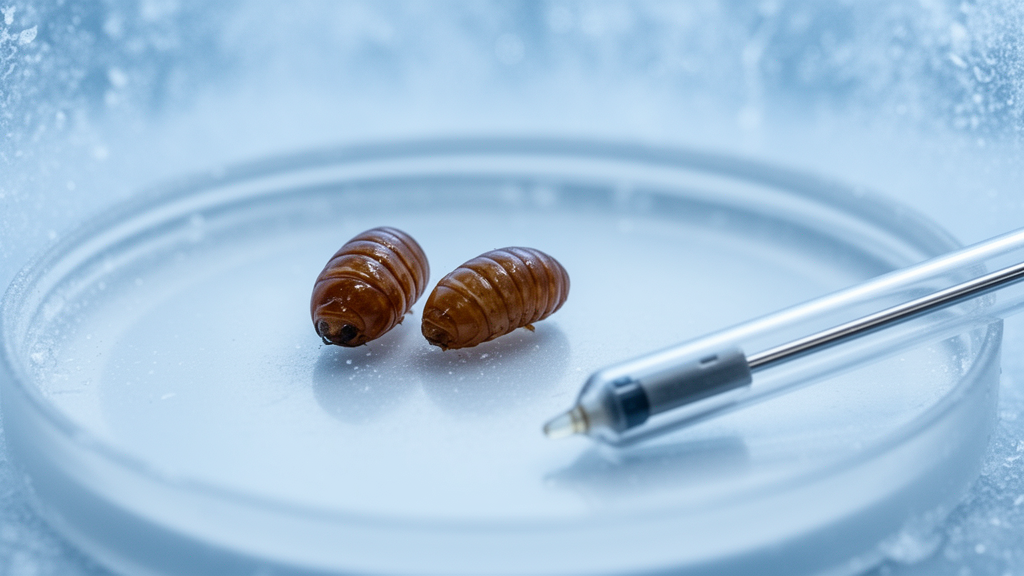
Two of the world’s most notorious invasive fruit flies may owe part of their success to a simple physiological trick: growing up cold. A new laboratory study published in BMC Ecology and Evolution reports that the temperature at which pupae of Bactrocera dorsalis and Bactrocera zonata develop before adult emergence measurably shapes how well the resulting adults cope with low temperatures. The findings, based on the invasive tephritid species Bactrocera dorsalis and Bactrocera zonata, suggest that cooler developmental conditions can prime adults for better cold performance, a plastic response that could influence where these tropical-origin pests manage to establish in temperate regions such as Europe.
Both species are considered important emerging pests of temperate regions, and their expanding ranges have raised concern among plant health authorities. Bactrocera dorsalis, the oriental fruit fly, and Bactrocera zonata, the peach fruit fly, are of tropical origin, yet both are currently pushing into cooler territory. Whether they can persist through winter is a central question for predicting their invasion potential, and the new research points to developmental plasticity as one mechanism that may facilitate establishment and persistence under cooler environmental conditions.
The experimental design was straightforward but revealing. Laboratory-reared pupae of both species were maintained under three constant temperatures: 15 °C, 20 °C, and 25 °C. Once adults emerged, the researchers assessed their cold tolerance using two standard metrics. The first was the Critical Thermal minimum, or CTmin, the temperature at which an insect loses the ability to remain active. The second was the Chill Coma Recovery Time, or CCRT, which measures how quickly an insect recovers movement after being immobilized by cold exposure. Together, these assays capture different dimensions of cold tolerance, from the threshold at which function fails to the speed of recovery afterward.
Lower developmental temperatures came at a cost for the immature stages. Pupal development took longer at cooler temperatures in both species, an expected trade-off of slower metabolism. Survival, however, told a different story for each species. Only Bactrocera dorsalis maintained high survival levels across all three developmental temperatures, while Bactrocera zonata fared worse in the immature stages. This difference in survival already hinted at distinct cold performance between the two species before adults were even tested.
When the adults were assessed, the results split neatly by metric. Overall, CTmin did not differ among developmental temperatures, species, or sex, meaning the temperature at which adults lost muscular control was essentially the same regardless of how cold their pupal environment had been. However, the interaction between temperature and species was significant, indicating that the two species responded differently to development at lower temperatures. In other words, the threshold metric stayed flat, but the underlying physiology was not identical across species and thermal histories.
The recovery metric told a more dynamic story. In both species, adults that had developed at 15 °C recovered faster from chill coma than those developed at 20 °C and 25 °C. This is the study’s clearest signal: cooler temperatures during pupal development and prior to adult emergence enhanced adult cold response primarily through improved chill coma recovery rather than through a shift in CTmin. The effect appeared in both species, but not to the same degree. Bactrocera dorsalis displayed stronger temperature-dependent variation and slower overall CCRT than Bactrocera zonata, yet both species converged in recovery performance when they had developed at 15 °C.
These interspecific differences point to distinct cold tolerance strategies. Bactrocera dorsalis exhibited higher developmental plasticity, bending its adult cold performance more substantially in response to the temperature it experienced as a pupa. Bactrocera zonata showed less developmental plasticity than its congener, maintaining a narrower range of responses across the thermal treatments. Such carry-over effects, in which conditions experienced before adult emergence shape adult stress tolerance, are a recognized form of phenotypic plasticity in insects and are thought to help prepare them for overwintering challenges.
For invasion biology, the implications are practical. The authors argue that temperature during development and before adult emergence acts as a key determinant of adult response to cold temperatures and may contribute to invasion potential in tephritids. Incorporating these plastic responses into bioclimatic and pest risk models, they suggest, will improve predictions of invasion success, establishment probability, and range of expansion by capturing the role of overwintering success in those species. Models that assume fixed cold tolerance across a species’ range may therefore underestimate or misplace the zones where these flies can survive winter, particularly at the cool edges of their distributions.
The study is a laboratory experiment using constant temperatures, so field validation across naturally fluctuating thermal conditions remains a logical next step. Still, the core message is clear and actionable: the thermal history of the immature stages matters for the adults that emerge from them. As Bactrocera dorsalis and Bactrocera zonata continue their push into temperate Europe, understanding that a cooler pupal environment can produce adults better equipped to recover from cold exposure adds a physiological dimension to forecasts of where these pests will take hold next. For growers and regulators tracking these emerging pests, the developmental temperature of the flies themselves may be as important as the climate data on the map.
Subject of Research: How temperature during pupal development modulates adult cold tolerance in two invasive tephritid fruit fly species
Article Title: Temperature experienced prior to adult emergence modulates adult cold tolerance of the invasive Tephritidae species Bactrocera dorsalis and Bactrocera zonata
Article References: Rodovitis, V. G., Pereira, R., Aguilar, J. S., & Papadopoulos, N. T. (2026). Temperature experienced prior to adult emergence modulates adult cold tolerance of the invasive Tephritidae species Bactrocera dorsalis and Bactrocera zonata. BMC Ecology and Evolution. https://doi.org/10.1186/s12862-026-02587-9
Image Credits: AI Generated
DOI: 10.1186/s12862-026-02587-9
Keywords: Bactrocera dorsalis, Bactrocera zonata, cold tolerance, phenotypic plasticity, chill coma recovery, CTmin, invasive species, tephritid fruit flies, pupal development, temperature, pest risk modelling, overwintering
News Source: Drew Townsend. (October 30, 2026). Cooler Pupae, Tougher Adults: Developmental Temperature Shapes Cold Tolerance in Two Invasive Fruit Flies. Scienmag.



