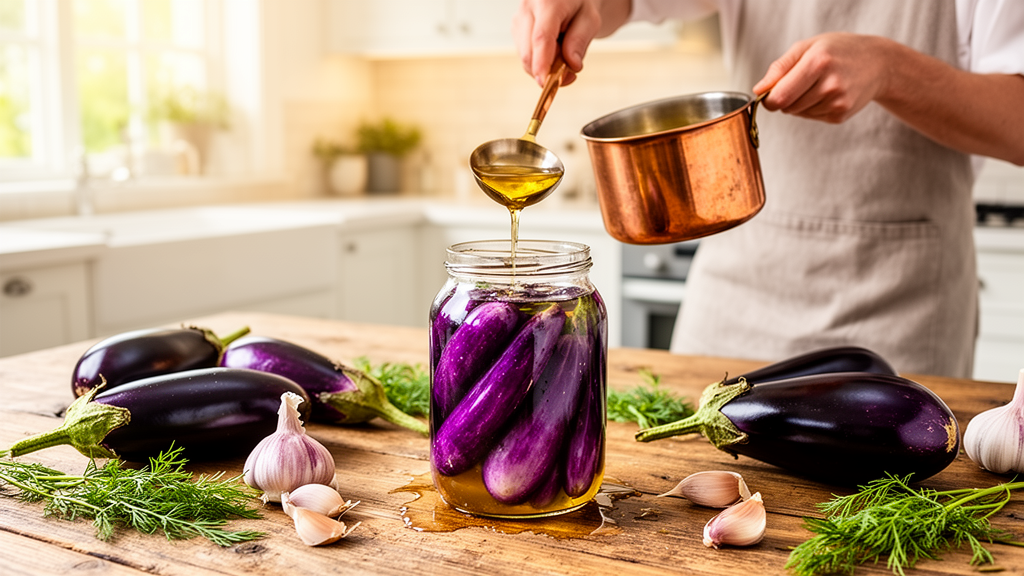
A pickle that once sat on Ottoman tables has been rebuilt for modern kitchens. In a study published in Discover Food, Halime Bozkuş and Osman Güldemir describe how they standardized the production of traditional Ottoman eggplant pickles, calculated their energy and nutrient composition per serving, and tested how acceptable the finished product is to human tasters. The work appears as an open access research article, published on 15 October 2026, and is part of a broader effort to keep historical recipes alive by translating them into formats that contemporary food producers can actually follow.
The starting point was not a laboratory but an archive. The researchers first examined Ottoman pickle varieties through document analysis, treating written records of the era’s food culture as a map of what was once made and eaten. From the varieties they identified, eggplant pickles were selected for the study on the basis of expert opinions. That choice matters, because eggplant occupies a central place in Turkish cuisine, and a pickled version of it carries both culinary and cultural weight. Rather than treating the historical recipe as a fixed artifact, the team used the historical food adaptation model, a framework for carrying heritage foods across time, to reformulate the product in line with modern production and hygiene standards.
Standardization is the quiet backbone of any traditional food that hopes to survive outside a home kitchen. A grandmother’s recipe can tolerate ambiguity, but a commercial process cannot. By defining the production steps precisely, the researchers turned a heritage preparation into something reproducible: the same raw materials, the same sequence, the same conditions, yielding a consistent product batch after batch. This is what allows a traditional food to move from family tables into gastronomy, product development and, potentially, sustainable local food systems, without losing the identity that made it worth preserving in the first place.
Once the standardized product existed, the team quantified what it delivers nutritionally. Energy and nutrient composition were calculated per serving using BeBiS, the Nutrition Information System, a software package widely used in Turkey for dietary analysis. This nutritional modeling step converts a cultural artifact into hard numbers: how much energy a serving provides and which nutrients it contributes. For heritage foods, which are often dismissed as nostalgic rather than nourishing, such data are essential. They let nutritionists, food technologists and consumers place the product within an actual diet instead of guessing at its value from tradition alone.
The sensory half of the study asked a more human question: does the modernized pickle still taste like something people want to eat? Twenty-five semitrained panelists, tasters with some training in sensory evaluation but not professionals, scored the product on a 9-point hedonic scale, the standard instrument for measuring liking. They rated five attributes: color, odor, taste, texture and overall acceptability. The pickle received an average score of approximately 6.31 across these characteristics, a result the authors interpret as showing that the product is acceptable.
A score of about 6.31 on a 9-point scale sits in the upper-middle range of liking, above the scale’s midpoint but short of enthusiastic approval. For a reformulated heritage product, that is a meaningful result. It suggests the adaptation did not strip the pickle of its character. The panelists found the color, smell, taste and texture coherent enough to rate the overall experience positively, which is exactly the outcome a standardization project needs before a traditional food can be proposed for wider production.
The study also demonstrates a method, not just a result. Document analysis identifies candidate dishes, expert opinion narrows the field, the historical food adaptation model governs the reformulation, software-based analysis captures the nutrition, and a hedonic panel tests whether the outcome still pleases. That pipeline could be applied to other Ottoman-era preparations, and the authors frame their findings as evidence that traditional Ottoman pickles can be successfully reinterpreted in modern gastronomy, contributing to product development, cultural heritage preservation and sustainability.
There are limits worth noting. The sensory panel consisted of 25 semitrained panelists rather than a large consumer sample, so the scores describe a controlled evaluation rather than market-wide acceptance. The nutritional values were calculated per serving through analysis software rather than measured by laboratory analysis of the finished pickles. And the study, published as an early-access open access article subject to further edits, examines a single product. Even so, the core finding stands: a pickle with centuries of history behind it can be standardized, quantified and judged acceptable by modern tasters, which is how culinary heritage earns a place in the present.
Subject of Research: Standardization, nutritional modeling and sensory evaluation of a traditional Ottoman eggplant pickle adapted to modern production conditions
Article Title: Standardization and nutritional modeling of traditional Ottoman eggplant pickles with sensory evaluation
Article References: Bozkuş, H., & Güldemir, O. (2026). Standardization and nutritional modeling of traditional Ottoman eggplant pickles with sensory evaluation. Discover Food. https://doi.org/10.1007/s44187-026-01267-3
Image Credits: AI Generated
DOI: 10.1007/s44187-026-01267-3
Keywords: Ottoman cuisine, eggplant pickle, food heritage, recipe standardization, nutritional analysis, sensory evaluation, hedonic scale, Turkish cuisine, gastronomy, food adaptation, Standardization, nutritional
News Source: Daisy Hatcher. (October 30, 2026). Ottoman eggplant pickle recipe standardized for modern kitchens. Scienmag.