


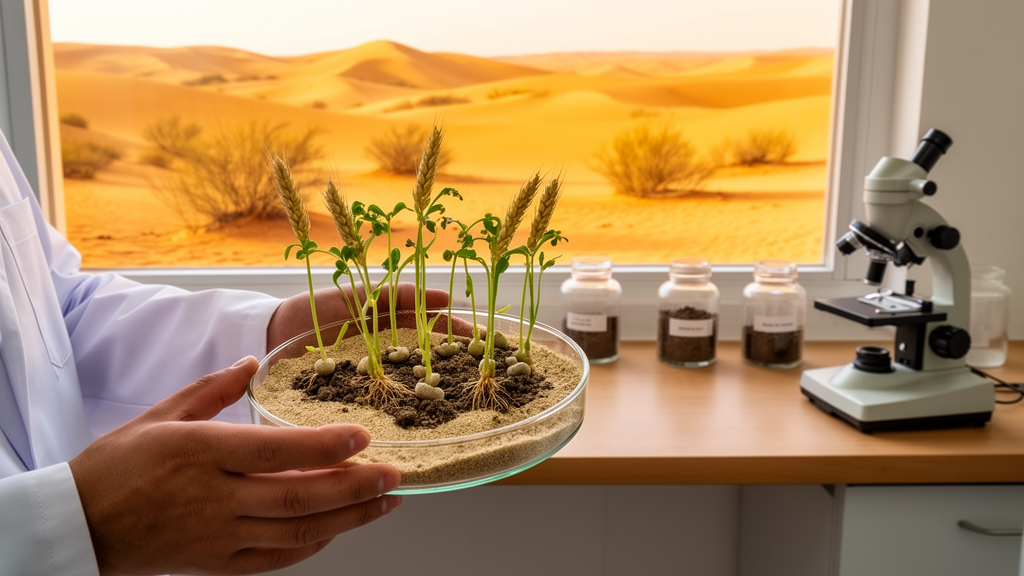
Bacteria pulled from the root nodules of three wild legumes growing in some of Algeria’s harshest landscapes can withstand drought-like conditions in the laboratory and, when applied to crop seeds, markedly improve germination under water stress. A research team isolated rhizobia from goat-thorn (Astragalus gombo), Sahara broom (Genista saharae), and narrowest ononis (Ononis angustissima) at two saline sites, Bou Saâda and Biskra, and screened the collection for stress tolerance and plant growth-promoting traits. From an initial set of 50 rhizospheric bacteria, 17 strains were selected for detailed morphological, biochemical, and molecular characterization. Four of them, designated GSB16, GSB9, GSB3, and OS2, stood out for their combined resilience to salinity, drought, extreme pH, and high temperature, and for carrying multiple traits associated with plant growth promotion.
The sampling sites reflect the extremes these microbes face in nature. Both locations have a Mediterranean climate with low, irregular rainfall, high temperatures, and long dry periods, and their soils are predominantly sandy, low in organic matter, and alkaline, with pH values between 8.4 and 8.9. Nodules were extracted from the roots of the three Fabaceae species, surface-disinfected, and crushed to release the bacteria, which were then cultured on yeast extract mannitol agar. Isolates were coded by host plant and location: OS and AS prefixes mark strains from Ononis angustissima and Astragalus gombo, while GS and GSB denote Genista saharae isolates from Bou Saâda and Biskra respectively. All selected isolates appeared as circular, whitish to creamy colonies with a mucous, opaque, or translucent appearance, and microscopic examination revealed Gram-negative bacilli consistent with Rhizobium.
A battery of confirmatory tests supported that classification. The isolates absorbed little or no Congo red dye, produced no keto-lactose, failed to grow on glucose-peptone agar, and could not grow on Hofer’s alkaline medium at pH 11, all characteristics that distinguish Rhizobium from related genera such as Agrobacterium. Biochemical profiling showed that every isolate tested positive for catalase, oxidase, and motility. Fifteen strains produced cellulase, 17 produced chitinase, seven showed protease activity, and 12 hydrolyzed urease; 16 reduced nitrate to nitrite, two utilized citrate, and only GS49 hydrolyzed starch. These enzymatic repertoires are relevant beyond taxonomy, because cellulase and chitinase can degrade fungal cell walls, pointing to potential biocontrol capacity against soil-borne pathogens.
The plant growth-promoting screening reinforced that picture. All isolates produced ammonia and grew on nitrogen-free Jensen’s agar, an indication of potential nitrogen fixation, and every isolate produced the phytohormone indole-3-acetic acid, with values ranging from 0.380 micrograms per milliliter in OSB4 up to 67.333 micrograms per milliliter in GSB3. Phosphate solubilization in liquid medium ranged from 10 to 169.265 micrograms per milliliter, observed in OS4 and GSB16 respectively, and four isolates exceeded 100 micrograms per milliliter. Siderophore production varied from 18.45 percent in AS10 to 51.58 percent in GSB9. Only four isolates, GSB16, GSB3, OS2, and GSB9, produced hydrogen cyanide, a compound implicated in suppressing soil pathogens.
Antifungal assays against a panel of phytopathogenic fungi showed selective but meaningful inhibition. All tested isolates inhibited Fusarium algeriense, with inhibition percentages between 14.1 and 43.8 percent, and inhibition against Fusarium incarnatum-equiseti ranged from 30.83 to 63.5 percent. Activity against Fusarium oxysporum was recorded only for GSB9 and GSB16, at 63.55 and 32.6 percent respectively. None of the strains inhibited Fusarium culmorum, Aspergillus niger, Rhizopus sp., or Alternaria alternata, underscoring that the antagonistic spectrum is pathogen-specific rather than broad.
Stress tolerance testing was central to the study’s premise. Growth was measured as optical density at 600 nanometers across temperatures from 20 to 45 degrees Celsius, pH values from 4 to 10, sodium chloride concentrations from 0.5 to 5 percent, and polyethylene glycol 6000 concentrations of 5, 10, 15, and 20 percent used to simulate osmotic drought. Most strains grew strongly at moderate temperatures, with peak growth at 28 degrees Celsius and reduced growth at 37 degrees, while OS2, GSB16, and GSB9 maintained moderate growth and only OS2 and GSB16 grew notably at 40 to 45 degrees. Growth was highest between pH 6 and 9, and only OS2 and GSB16 sustained growth at pH 10. Most isolates tolerated 1 to 2 percent NaCl, but only OS2, GSB3, and GSB16 kept moderate to detectable growth at 3 to 5 percent, and OS2 alone tolerated 5 percent. Under PEG-induced osmotic stress, OS2, GSB16, GSB9, and GSB3 retained the strongest growth at the highest concentrations of 15 to 20 percent.
The four standout strains were then tested directly on crop seeds. Durum wheat (Triticum durum, cv. Bousselam) and cultivated pea (Pisum sativum, cv. Latcha) seeds were soaked in bacterial suspensions of 1 x 10^8 colony-forming units per milliliter and germinated on filter paper moistened with sterile water or with 10 or 20 percent PEG 6000 solutions. The experiment comprised five treatment groups with three replicates each, totaling 900 wheat seeds and 225 pea seeds, and germination parameters, including final germination percentage, germination rate index, and seedling length and weight vigor indices, were scored over 11 days. Statistical analysis used one-way ANOVA with Tukey’s post hoc test where data were normal and Kruskal-Wallis tests with Conover-Iman pairwise comparisons where they were not.
The in planta results were striking, though they remain laboratory petri-dish findings rather than field demonstrations. For wheat, osmotic stress at 20 percent PEG sharply reduced final germination in uninoculated controls, but every rhizobial treatment improved it. OS2 achieved 100 percent germination at 10 percent PEG and 90 percent at 20 percent PEG, compared with 80 and 50 percent in the respective controls, and it also showed the strongest effects on germination rate, seedling length, and seedling weight. The abstract reports germination improvements of up to 80 percent for OS2 in wheat and up to 175 percent for GSB16 and GSB3 in pea relative to uninoculated controls. In pea, the uninoculated control germinated at only 26.66 percent under 20 percent PEG, while GSB16 reached 93.33 percent under 10 percent PEG and 73.33 percent under 20 percent PEG, with all isolates improving germination rate, seedling length, and seedling biomass.
Molecular identification by 16S rRNA gene sequencing placed all four selected strains in the genus Rhizobium. A maximum likelihood phylogenetic tree built from 732 aligned nucleotide positions showed GSB3 and GSB16 clustering with Rhizobium pakistanense, a species originally isolated from semi-arid regions of Pakistan, with 89 percent bootstrap support, while GSB9 and OS2 formed a distinct, fully supported subclade within the Rhizobium leguminosarum group, potentially representing novel genotypic variants. The authors suggest that the ecological origin of these strains in water-limited environments may contribute to their osmotic tolerance, although the molecular mechanisms by which they mitigate water stress, including possible roles of ACC deaminase, auxin biosynthesis, and exopolysaccharide production, remain to be confirmed by transcriptomic, proteomic, or mutagenesis studies.
The authors are careful to frame this work as a preliminary screening. The germination benefits were observed only at the earliest developmental stages under artificially induced osmotic stress in vitro, and the study did not test nodulation, yield, or performance in real soils. Pot and field experiments, along with assessments of repeated inoculation effects on plant performance and soil health, are needed to validate long-term effectiveness and practical use. Even so, the findings add to a growing body of evidence that locally adapted microbial biodiversity, here drawn from wild legumes surviving on the edge of the Sahara, can be a source of cost-effective microbial inoculants. If the promise holds beyond the laboratory, stress-tolerant native rhizobia could offer a sustainable tool for improving crop establishment in arid and semi-arid farming systems where water scarcity increasingly constrains both cereals and legumes.
Subject of Research: Drought-tolerant native Rhizobium strains from Algerian arid soils that enhance crop seed germination under water stress
Article Title: Native rhizobia from arid and semi-arid regions of Algeria exhibit drought tolerance
Article References: Attig, I., Ghadbane, M., Farda, B., Djebaili, R., Dassi, S., Harzallah, D., & Pellegrini, M. (2026). Native rhizobia from arid and semi-arid regions of Algeria exhibit drought tolerance. Discover Life, 56(1), Article 30. https://doi.org/10.1007/s11084-026-09752-6
Image Credits: AI Generated
DOI: 10.1007/s11084-026-09752-6
Keywords: rhizobia, Rhizobium, drought tolerance, Algeria, durum wheat, pea, seed germination, plant growth-promoting rhizobacteria, biofertilizer, arid agriculture, PEG osmotic stress, 16S rRNA
News Source: Alan Morgan. (October 30, 2026). Algerian Desert Rhizobia Show Drought Tolerance and Boost Wheat and Pea Germination. Scienmag.



