


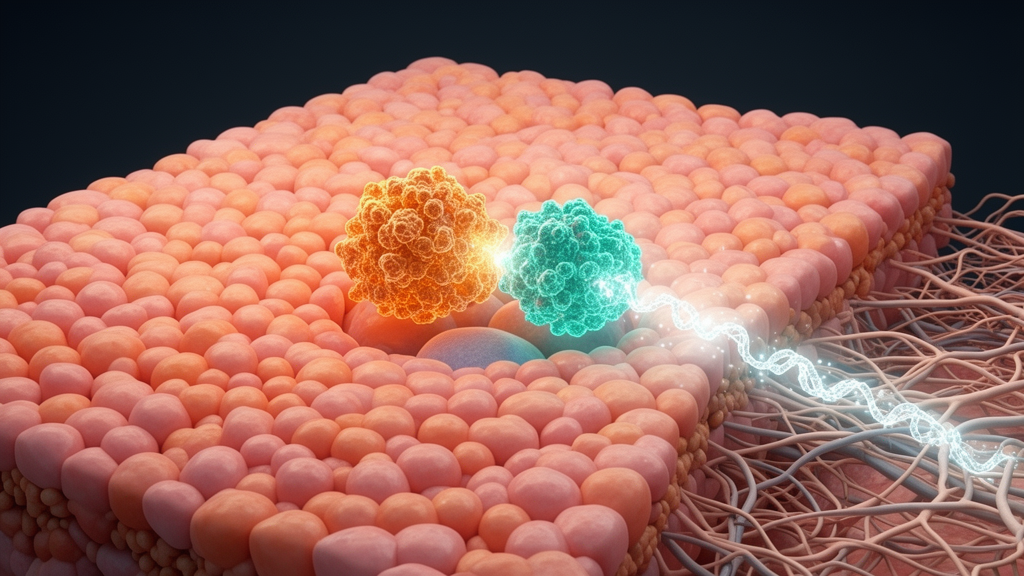
Two transcription factors, SIX1 and TEAD1, appear to work together to fuel colorectal cancer growth by converging on a shared target gene, CTGF, according to a study published in BMC Medical Genomics. The findings, based on human tissue samples, a mouse xenograft model and promoter-binding assays, suggest that the pair act synergistically rather than independently.
All three proteins were significantly upregulated in the cancer samples compared with controls, pointing to a consistent expression pattern across the three molecules in tumor tissue.
Tumors with combined knockdown of the two transcription factors showed a synergistic inhibition of growth, an effect the authors confirmed using Bliss independence analysis, a standard statistical test for drug or genetic interaction synergy.
Analysis of the xenograft tissues by Western blot, quantitative PCR and immunohistochemistry revealed that CTGF expression dropped at both the protein and mRNA levels when the two factors were removed together. This placed CTGF downstream of the SIX1–TEAD1 pair and linked the transcriptional cooperation to the observed suppression of tumor growth.
Mechanistically, dual-luciferase reporter assays and ChIP-qPCR demonstrated that both SIX1 and TEAD1 bind directly to the CTGF promoter. The convergent regulation of a single promoter by two transcription factors offers a plausible explanation for the synergistic effect: removing either factor alone leaves partial CTGF drive intact, while removing both collapses it.
The study also drew on the TCGA database for bioinformatic confirmation. Across that patient dataset, SIX1, TEAD1 and CTGF showed significant differential expression between tumor and normal tissue, and their expression levels correlated positively with one another, consistent with the experimental findings from tissues and xenografts.
The authors conclude that combined targeting of SIX1 and TEAD1 may represent a potential therapeutic strategy for colorectal cancer. That framing is appropriately cautious: the therapeutic evidence here comes from a preclinical xenograft model with genetically knocked-down cells, not from drugs or patients, and no combined inhibitor regimen has been tested. Still, the convergence of human tissue data, TCGA correlations, synergy statistics and direct promoter-binding evidence makes the SIX1–TEAD1–CTGF axis a coherent and testable new lead for the field.
Subject of Research: Synergistic regulation of CTGF by the transcription factors SIX1 and TEAD1 in colorectal cancer tumor growth
Article Title: Expression of SIX1 and TEAD1 in colorectal cancer and their synergistic effect on tumor growth via CTGF expression
Article References: Liang, Z., Chen, W., Zhang, N., Liu, X., & Yao, X. (2026). Expression of SIX1 and TEAD1 in colorectal cancer and their synergistic effect on tumor growth via CTGF expression. BMC Medical Genomics. https://doi.org/10.1186/s12920-026-02489-1
Image Credits: AI Generated
DOI: 10.1186/s12920-026-02489-1
Keywords: colorectal cancer, SIX1, TEAD1, CTGF, transcription factors, xenograft model, Bliss independence, TCGA, ChIP-qPCR, tumor growth, gene regulation, oncology
News Source: Nathaniel Bowman. (October 30, 2026). SIX1 and TEAD1 Team Up to Drive Colorectal Tumor Growth via CTGF. Scienmag.



