


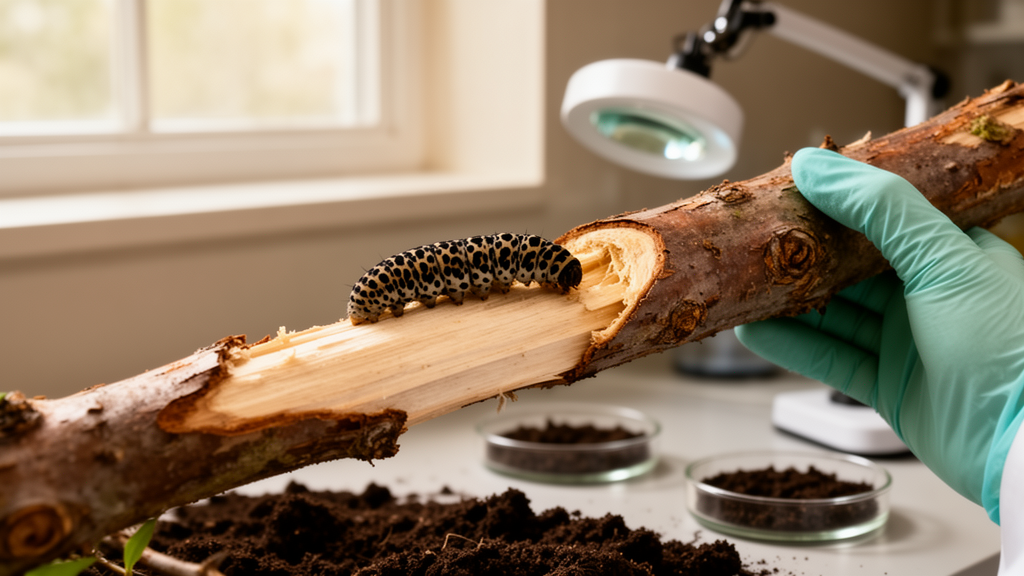
A single injection of entomopathogenic nematodes into the active galleries of willow trees killed more than three quarters of the leopard moth larvae hiding inside them, according to a field and laboratory study conducted in El-Fayoum governorate in the north-west of Egypt. The work, published as an open access research article in the Egyptian Journal of Biological Pest Control on 31 March 2026, tested four native nematode strains isolated from Egyptian soil against Zeuzera pyrina, the wood-boring caterpillar also known as the apple stem borer or leopard moth, which tunnels through the trunks and branches of willows and many fruit trees.
The four strains belonged to two species of entomopathogenic nematodes: two isolates of Heterorhabditis indica, labelled EGAZ2 and EGAZ3, and two isolates of Steinernema carpocapsae, labelled EGAZ9 and EGAZ10. All four had been isolated from soil samples in Egypt in 2017 by researchers at the Plant Protection Research Institute of the Agricultural Research Centre in Giza, and were reared on the greater wax moth Galleria mellonella before being stored in darkness at 10 to 12 degrees Celsius. Because the larvae of Z. pyrina live protected inside their tunnels, conventional insecticide sprays work only when directed at the tree while adult moths are active and laying eggs, a limitation that motivated the search for biological alternatives.
In the field phase, carried out during the spring of 2023, the researchers selected willow trees heavily infested with Z. pyrina and injected water suspensions of the nematodes directly into the larval galleries. Each tree received 5 millilitres of suspension per gallery, delivered with a 50 cubic centimetre syringe at one of three concentrations: 300, 400 or 500 infective juveniles per millilitre. The injection was performed only once, and all treatments were completed before sunset to avoid ultraviolet light and excessive evaporation. Control trees received water alone. Each strain was tested at each concentration on five trees, with the whole set of treatments replicated three times.
Mortality was assessed weekly by examining the galleries: tunnels with freshly expelled frass were scored as active, meaning the larva inside was judged still alive, and a knife and a flexible wire roughly 50 centimetres long were used to inspect randomly selected tunnels in the main branches and trunk. Mortality rates were calculated as the number of dead larvae divided by the total of dead plus living larvae, multiplied by 100. Across the field trials, mortality rose with nematode concentration for every strain. The EGAZ2 strain produced mortality between 42.9 and 53.9 percent, EGAZ9 between 55.9 and 74.6 percent, EGAZ10 between 50.4 and 76.8 percent, and EGAZ3 between 46.4 and 62.2 percent.
The highest mean larval mortality in the field, 76.8 percent, was recorded for the S. carpocapsae strain EGAZ10 at the highest concentration of 500 infective juveniles per millilitre. A two-way analysis of variance showed that both nematode species and concentration significantly affected field mortality, with species yielding F = 4.2, P = 0.015 and concentration F = 8.79, P = 0.001, while the interaction between the two factors was not significant. The authors conclude from these results that the four native strains, and EGAZ10 in particular, could serve as components of integrated pest management programmes against this borer under field conditions.
The laboratory phase examined how susceptible different larval ages were. Willow trunks infested with Z. pyrina were collected from El-Fayoum and brought into rearing cages, where eighty larvae were sorted into third, fourth, fifth and sixth instars. Larvae of each instar were divided into four replicates of five individuals, placed on filter paper in Petri dishes, and exposed to 300 infective juveniles per larva in 1.5 millilitres of sterile distilled water; controls received water only. The dishes were kept at 25 plus or minus 2 degrees Celsius and inspected daily for 72 hours, with mortality data corrected using Abbott’s formula.
Under these laboratory conditions, mortality was far higher than in the field, ranging from 91 to 100 percent across the strains and instars. The EGAZ10 strain of S. carpocapsae killed 100 percent of third instars, 99.7 percent of fourth instars, 99 percent of fifth instars and 96 percent of sixth instars, while H. indica EGAZ3 produced the lowest mortality. Statistical analysis found significant differences between nematode species (F = 28.9, P < 0.001) and between larval instars (F = 3.57, P = 0.018), but the interaction between species and instar was not significant.
The study also measured how many infective juveniles each strain could produce inside Z. pyrina larvae. Dead larvae were rinsed, placed into modified White traps, and the juveniles emerging over 11 to 13 days were counted. Reproduction generally increased with larval age, which the authors attribute to the sheer size of sixth instar larvae, which reach 50 to 55 millimetres and offer space and resources for several nematode generations, whereas smaller larvae may support only one incomplete generation. The highest yield came from sixth instar larvae infected with H. indica EGAZ2, at 840,055.6 infective juveniles per larva, followed by EGAZ9, EGAZ3 and EGAZ10 at 610,388.9, 683,888.9 and 550,611.1 respectively. The lowest yield, 316,750 juveniles per larva for EGAZ10, came from third instar larvae. Both species (F = 6.9, P < 0.001) and instar (F = 27.3, P < 0.001) significantly affected reproduction, with a non-significant interaction.
A separate biochemical experiment probed what infection does to the host’s metabolism. Thirty fifth instar larvae were infected with 300 infective juveniles of EGAZ10, and after 24 hours the surviving larvae were homogenised and analysed for total protein, total lipid, total carbohydrate and the activity of the detoxifying enzyme glutathione S-transferase, with three replicates per analysis. Total protein fell to 20.72 milligrams per gram in infected larvae compared with 24.491 milligrams per gram in controls. Total lipid rose sharply to 64.242 milligrams per gram from 9.298 milligrams per gram in controls, a difference the authors report as statistically significant (F = 10.5, P = 0.001). Total carbohydrate increased only slightly, to 19.575 from 18.875 milligrams per gram, and mean GST activity climbed to 60.439 units per gram from 34.119 units per gram in controls.
The authors interpret these shifts as evidence that the nematodes and their symbiotic bacteria disrupt the intermediary metabolism of the host, inducing physiological stress: protein catabolism in the fat body, a possible conversion of proteins into lipids, and an enhanced detoxification response reflected in elevated GST activity. They frame the four native strains, and especially S. carpocapsae EGAZ10, as candidate biological control agents for integrated pest management of Z. pyrina on willows, a tree of economic importance in pharmaceutical production, and call for future work on optimising application methods, understanding the differential susceptibility of larval stages and assessing effects on non-target organisms. As with any single-season field trial at one site, broader conclusions about long-term pest suppression across regions will require further testing.
Subject of Research: Field and laboratory evaluation of four native entomopathogenic nematode strains against the leopard moth Zeuzera pyrina in willow trees in Egypt.
Article Title: Biocontrol potential of four native entomopathogenic nematodes against Zeuzera pyrina L.(Lepidoptera: Cossidae) in the Willow trees (Salix spp.)
Article References: Ali, H. R., Azazy, A. M., Ellakwah, S. F., & Batt, M. A. E.-G. (2026). Biocontrol potential of four native entomopathogenic nematodes against Zeuzera pyrina L.(Lepidoptera: Cossidae) in the Willow trees (Salix spp.). Egyptian Journal of Biological Pest Control, 36(1), Article 17. https://doi.org/10.1186/s41938-025-00881-0
Image Credits: AI Generated
DOI: 10.1186/s41938-025-00881-0
Keywords: entomopathogenic nematodes, Zeuzera pyrina, biological control, willow trees, Steinernema carpocapsae, Heterorhabditis indica, larval mortality, integrated pest management, GST activity, Egypt, El-Fayoum, insect metabolism
News Source: Drew Townsend. (October 30, 2026). Native Nematode Strains Show Promise Against Willow-Boring Leopard Moth Larvae. Scienmag.



