


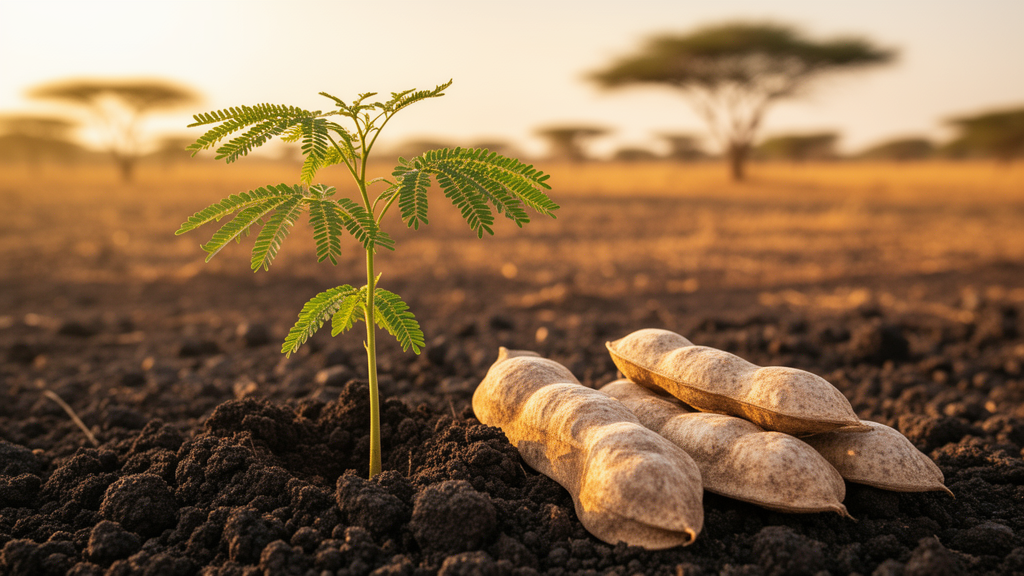
Seed size and soil choice together determine how well Faidherbia albida, a key agroforestry tree of Africa’s drylands, regenerates from seed, according to a new study conducted in Burkina Faso. The research, published in BMC Plant Biology, tested how two substrates and three seed size classes influenced germination and early seedling growth of the species, whose natural populations have declined significantly, primarily due to poor seed regeneration and limited adoption by local communities.
Faidherbia albida holds considerable socio-economic importance in arid and semi-arid regions of Africa, but its regeneration is hindered by physical seed dormancy and slow growth. The study team, led by Innocent Charles Emmanuel Traoré, set out to quantify how substrate type and seed caliber interact to shape the species’ early establishment, a critical bottleneck for reforestation efforts across the Sahel and similar zones.
For the experiment, seeds were sorted into three diameter classes: large seeds measuring 4.5 millimeters or more, medium seeds between 4.0 and 4.49 millimeters, and small seeds below 4.0 millimeters. Before sowing, all seeds received a pretreatment with concentrated sulfuric acid at 98 percent for five minutes to break physical dormancy. The seeds were then sown one per pot in containers 40 centimeters tall and 12 centimeters in diameter, arranged in a randomized complete block design.
The experimental layout compared two substrates, desert sand and topsoil, across five replicates with 10 seeds per replicate. The researchers analyzed the outcomes using Generalized Linear Models with quasibinomial, gaussian, and quasipoisson error structures, allowing them to test germination percentages, germination timing, and seedling growth traits separately.
The clearest result concerned seed size. Germination varied significantly according to seed size, with a p-value below 0.001. Large seeds achieved a germination success of 96 percent, with a standard deviation of 6.7 percent, while small seeds reached only 32 percent, with a standard deviation of 9.9 percent. That gap of roughly 64 percentage points underscores how strongly seed caliber alone can constrain regeneration in this species.
Germination kinetics were also strictly size-dependent, again with p below 0.001. Large seeds exhibited near-instantaneous emergence, with a latency of just one day, and showed high vigor indices. Small seeds, by contrast, displayed significant delays, with a four-day latency before emergence, and a protracted mean germination time. In practical nursery terms, this means large seeds not only germinate more often but also get seedlings established days earlier.
Substrate type told a different story. It did not significantly affect the final germination percentage, with a p-value of 0.1097, meaning seeds sprouted at similar rates on sand and topsoil once dormancy was broken. However, the substrate strongly influenced subsequent seedling development, shaping how young plants grew after emergence rather than whether they emerged at all.
Seedlings from large seeds grown on topsoil reached the highest collar diameter, at 0.23 centimeters with a standard deviation of 0.05 centimeters, the greatest height, at 22.29 centimeters with a standard deviation of 7.67 centimeters, and the highest number of ramifications, at 1.61 with a standard deviation of 2.15. Desert sand limited growth regardless of seed caliber, indicating that even the best seeds cannot compensate for a poor growing medium during early development.
The authors conclude that optimized regeneration of Faidherbia albida relies on a synergy between seed size and substrate quality. Utilizing large seeds in topsoil provides the highest vigor and growth prospects, offering what the study describes as a strategic pathway for successful reforestation and sustainable agroforestry management in arid and semi-arid zones.
For nursery managers and restoration practitioners in the Sahel, the findings point to a simple, low-cost intervention: sort seeds by diameter before sowing, favor the largest class, and use quality topsoil rather than desert sand in propagation containers. Because the study measured early growth under controlled pot conditions, the results speak to the nursery stage of regeneration rather than to long-term field performance, but they identify a concrete starting point for improving the establishment of this ecologically and economically valuable species.
Subject of Research: The effects of substrate type and seed size on germination and early seedling growth of Faidherbia albida in Burkina Faso.
Article Title: Effect of substrate and seed size on the germination and seedling growth of Faidherbia albida (Delile) A. Chev. in Burkina Faso
Article References: Traoré, I. C. E., Hien, B. S., Kabré, B., Kaboré, L. M., Sanou, M., & Ouédraogo, O. (2026). Effect of substrate and seed size on the germination and seedling growth of Faidherbia albida (Delile) A. Chev. in Burkina Faso. BMC Plant Biology. https://doi.org/10.1186/s12870-026-10280-8
Image Credits: AI Generated
DOI: 10.1186/s12870-026-10280-8
Keywords: Faidherbia albida, seed germination, seed size, substrate, topsoil, agroforestry, Burkina Faso, reforestation, seed dormancy, seedling growth, Sahel, Effect
News Source: Drew Townsend. (October 30, 2026). Large Seeds and Rich Topsoil Give Faidherbia albida Seedlings a Strong Start in Burkina Faso. Scienmag.



