


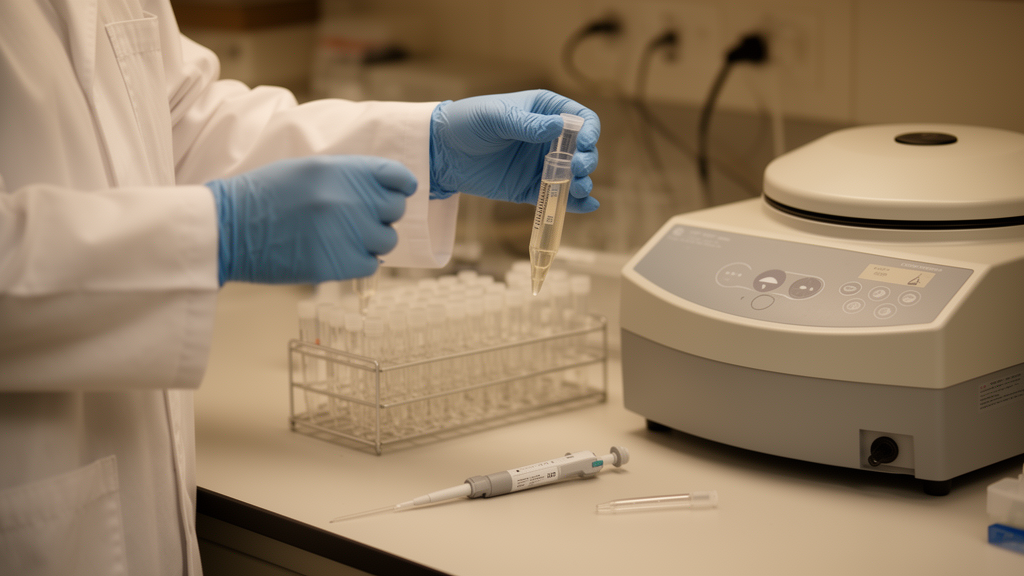
A simplified laboratory protocol can extract usable RNA from both Gram-positive and Gram-negative bacteria in roughly 35 minutes at room temperature, without phenol, DNase, lysozyme, chloroform, or refrigerated centrifugation, according to a methodology study published in the Springer Nature journal Discover Bacteria. The method, adapted from an existing RNA extraction procedure developed for SARS-CoV-2, produced an average RNA concentration of about 5 micrograms per milliliter from bacterial cultures with an optical density at 600 nanometers of roughly 0.8 to 1.0, accompanied by purity ratios and ribosomal RNA band patterns that the author reports as indicative of intact, high-quality RNA.
The protocol was developed and evaluated by Abdulhadi Albaser using four bacterial strains obtained from the Central Medical Laboratory in Sebha, Libya: two Gram-positive species, Staphylococcus aureus and Enterococcus spp., and two Gram-negative species, Escherichia coli and Pseudomonas spp. The cells were cultured aerobically overnight in 5 milliliters of Tryptic Soy Broth at 37 degrees Celsius before extraction. This small panel of organisms defines the scope of the validation, and the author notes that additional quantitative studies across a wider range of bacterial strains would be needed to confirm how broadly the findings extend.
The chemistry underlying the method rests on a simple principle: under acidic conditions, at pH 5.0 in this protocol, RNA remains differentially soluble while DNA and many cellular proteins precipitate or stay insoluble, owing to differences in polarity and solubility. The lysis buffer combines sodium dodecyl sulfate, sodium citrate dihydrate, anhydrous citric acid, and EDTA. Cells harvested from 500 microliters of culture are resuspended in water, mixed with this buffer, and then boiled at 100 degrees Celsius for two minutes, a step introduced specifically to disrupt the thick, robust cell walls of Gram-positive bacteria.
After lysis, a high-salt precipitation buffer containing sodium citrate, citric acid, and 4 molar sodium chloride is added, and the mixture is chilled on ice and centrifuged briefly to remove debris. The decisive innovation is the next step: the supernatant is transferred to a tube containing 0.5 molar calcium chloride and incubated for ten minutes at room temperature. Calcium chloride selectively precipitates RNA from high-salt solutions, a trick borrowed from plasmid DNA purification, where the same reagent is normally used to discard RNA as an impurity. Here the principle is reversed, so the RNA becomes the product while genomic and plasmid DNA are minimized through co-precipitation avoidance. The RNA pellet is then washed with 70 percent ice-cold ethanol, dried, and resuspended in 50 microliters of water, with every centrifugation step performed at ambient temperature.
Quality assessment combined spectrophotometry with gel-based analysis. Across all tested species, the A260/280 ratio, a standard measure of protein and chemical contamination, averaged 1.95 plus or minus 0.05, close to the value expected for clean nucleic acid. The A260/230 ratio, which flags co-purified carbohydrates, salts, or organic solvents, averaged 2.10 plus or minus 0.1. On one percent non-denatured agarose gels, densitometric analysis with ImageJ showed a consistent 2:1 ratio of 23S to 16S ribosomal RNA bands across all samples, a pattern the author interprets as evidence of intact, non-degraded RNA. Some lanes appeared overloaded, which the author attributes to very high RNA concentration rather than poor integrity.
The study is candid about one caveat. A faint upper band occasionally observed on the agarose gels could potentially indicate residual genomic DNA contamination. While the calcium chloride precipitation step is designed to reduce DNA co-precipitation, the author states that definitive verification would require DNase treatment followed by gel re-analysis, or quantitative PCR to detect DNA directly, and recommends such validation in future refinements of the protocol. This means the purity claims, while supported by the spectrophotometric ratios, are not yet backed by direct experimental confirmation of DNA absence.
The boiling step also shows species-dependent behavior. It was empirically observed to be crucial for effective lysis of the Gram-positive Staphylococcus aureus and Enterococcus spp., whereas its impact on the Gram-negative E. coli and Pseudomonas spp. was less pronounced, although it often produced slightly higher RNA yields for those Gram-negative organisms. The author suggests the boiling step could be optimized or adjusted depending on the bacterial species being studied, an area flagged for further quantitative work on yield and integrity.
Compared with established non-commercial bacterial RNA extraction methods using similar starting biomass, the reported yields were comparable to or exceeded those of prior approaches, as summarized in a comparison table in the study. The practical advantages, however, may matter as much as the yield numbers. Conventional RNA extraction frequently depends on phenol and chloroform, both hazardous, along with enzymatic treatments and cold centrifugation that add cost, time, and equipment requirements. By removing these elements, the 35-minute, room-temperature workflow lowers both the safety risks and the financial barriers to routine RNA work.
That accessibility angle is central to the motivation of the study. The author argues that isolating RNA poses a considerable challenge for researchers in developing nations, primarily because commercial extraction kits are prohibitively expensive and hazardous reagents complicate laboratory handling. The protocol requires little beyond basic laboratory tools: a heat source for boiling, a standard centrifuge, a UV spectrophotometer for quantification, and agarose gel equipment for integrity checks. Such simplification, if reproduced by other laboratories, could make gene expression analysis and sequencing workflows more feasible in resource-constrained settings.
As with any single-author methodology paper validated on four strains, independent replication will be the real test. The author himself lists quantitative comparisons with a broader array of commercial and non-commercial methods, and further experimental validation of DNA and protein removal, as future work needed to fully characterize the purity of the extracted RNA. For now, the study offers a detailed, open-access recipe: acidic lysis at pH 5.0, a two-minute boil, calcium chloride precipitation, and an ethanol wash, all completed in about half an hour, promising high-yield bacterial RNA without a fume hood, a cold room, or a single drop of phenol.
Subject of Research: A simplified 35-minute acidic lysis protocol for RNA extraction from Gram-positive and Gram-negative bacteria at room temperature without toxic chemicals.
Article Title: 35-minute protocol for high-yield RNA extraction from gram-positive & gram-negative bacteria at room temperature without toxic chemicals
Article References: Albaser, A. (2026). 35-minute protocol for high-yield RNA extraction from gram-positive & gram-negative bacteria at room temperature without toxic chemicals. Discover Bacteria, 3(1), Article 6. https://doi.org/10.1007/s44351-025-00040-8
Image Credits: AI Generated
DOI: 10.1007/s44351-025-00040-8
Keywords: RNA extraction, bacteria, Gram-positive, Gram-negative, acidic lysis, calcium chloride, phenol-free, molecular biology, laboratory protocol, Staphylococcus aureus, Escherichia coli, resource-limited settings
News Source: Drew Townsend. (October 30, 2026). Research report: 35-minute protocol for high-yield RNA extraction from gram-positive & gram-negative bacteria at room temperature without toxic chemicals. Scienmag.



