


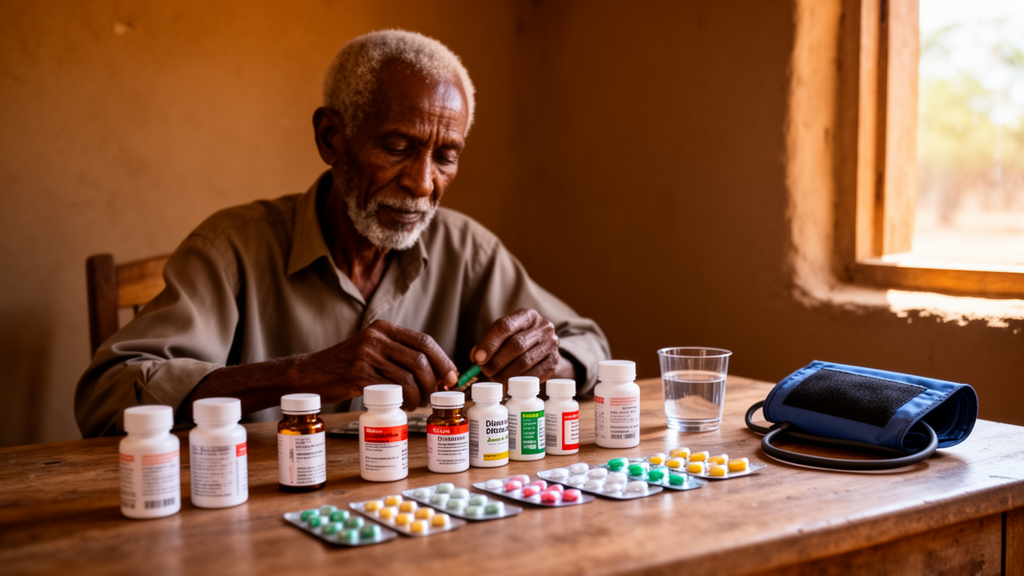
Nearly eight out of ten patients living with both type 2 diabetes and high blood pressure at a specialized hospital in southwest Ethiopia experienced at least one form of medication suboptimization, according to a prospective observational study published in Discover Endocrinology and Metabolism. The study, conducted at Mattu Karl Comprehensive Specialized Hospital between May 1 and October 30, 2024, found that 79.2 percent of the 168 participants studied had a medication-related problem that interfered with the goals of their therapy. The most common issue was a need for additional drug therapy, identified in 57.4 percent of cases, followed by non-adherence at 35.5 percent and doses that were too low at 12.5 percent.
Medication suboptimization, as defined in the study, covers a range of drug therapy problems: unnecessary medication, a need for additional therapy, ineffective treatment, doses set too low, adverse drug reactions, and non-adherence. Each of these can prevent patients from reaching the desired outcomes of treatment and requires professional judgment to resolve. The researchers argue that such problems carry serious consequences, including poor clinical outcomes, increased healthcare costs, longer hospital stays, reduced quality of life, morbidity, and mortality among patients managing both conditions at once.
The study population consisted of adults with confirmed type 2 diabetes and hypertension who were taking both anti-diabetic and anti-hypertensive drugs and attending regular follow-up at the hospital’s ambulatory care clinic. Patients who declined to participate, who were mentally ill, or whose medical records were incomplete were excluded. Using a single population proportion formula with a 50 percent assumed prevalence, a 95 percent confidence level, and a 5 percent margin of error, and applying a correction formula because the source population numbered about 300 patients, the team arrived at a final sample of 168 participants selected by consecutive sampling.
Data collection combined three approaches: review of medical records covering medications, medical conditions, and laboratory tests; patient interviews using a semi-structured questionnaire adapted from validated scales and translated into Amharic and Afan Oromo and back into English to ensure consistency; and direct observation. The questionnaire and abstraction format were pre-tested on 5 percent of the sample, equivalent to eight patients at a general hospital, before the main data collection began. Data were entered into EpiData Version 4.6 and analyzed in SPSS Version 26, with model fit checked using the Hosmer-Lemeshow test.
The participants were predominantly male, with 93 of 168, or 55.4 percent, being men. Their mean age was 47.38 years, with a standard deviation of 13.609 years. Most, 125 participants or 74.4 percent, were married, and 121, or 72 percent, reported no addiction. Only 32 participants, about 19 percent, had no formal education. The mean duration of coexisting diabetes and hypertension was 4.26 years, and 123 participants, or 73.2 percent, had been on treatment for five years or less. Clinically, the picture was concerning: more than half of the participants had uncontrolled hypertension, defined as systolic blood pressure of at least 140 mm Hg or diastolic pressure of at least 90 mm Hg, and 122 participants, or 72 percent, had uncontrolled type 2 diabetes, defined as repeated fasting blood sugar above 130 mg/dl.
Prescription patterns reflected standard combination management of the two conditions. Patients took a mean of 2.89 medications each. Most, 79.2 percent, received oral hypoglycemic agents alone, with metformin monotherapy prescribed for 49.4 percent and a metformin plus glibenclamide combination for 30.4 percent. Among antihypertensives, angiotensin converting enzyme inhibitors alone accounted for 50.6 percent of prescriptions, with combined antihypertensive classes at 28.6 percent. Statins were prescribed to 12.5 percent of patients and aspirin to 5.4 percent for cardiovascular risk prevention, and 79.8 percent of participants were taking three or fewer medications.
In total, the researchers identified 183 medication suboptimizations across the 168 participants, averaging 1.38 suboptimal medications per patient. Digging into the specific causes, the leading driver was a medical condition requiring additional pharmacotherapy to achieve synergistic or additive effects, accounting for 90 cases or 49.2 percent, while patients forgetting to take their medications accounted for 45 cases, or 24.6 percent. This pattern closely resembled findings previously reported at Mizan Tapi Teaching Hospital and Madda Walabu Referral Hospital in Ethiopia, although a study by Yimama and colleagues reported a lower need for additional drug therapy at 29.35 percent, a discrepancy the authors attribute to differences in sample size, study participants, and setting.
The multivariable logistic regression analysis identified four independent determinants. Patients with a history of alcohol drinking, defined as self-reported consumption of any alcoholic beverage in the past, were 6.013 times more likely to experience medication suboptimization than those without such history, with a 95 percent confidence interval of 1.013 to 35.682. Uncontrolled hypertension was the strongest predictor: patients with blood pressure at or above 140/90 mm Hg were 10.608 times more likely to have suboptimized medication than those with controlled blood pressure, with a confidence interval of 3.173 to 35.465 and a p-value below 0.001. Poorly controlled diabetes also mattered, with uncontrolled fasting blood sugar associated with 3.268 times higher odds, at a confidence interval of 1.033 to 10.334. In contrast, secondary education appeared protective: participants with secondary schooling were 0.056 times as likely to have medication suboptimization compared with those who had no formal education, with a wide confidence interval of 0.005 to 0.669, reflecting limited precision. The authors suggest that higher education improves health literacy, making it easier to understand and follow treatment instructions, while alcohol may impair adherence directly through cognitive effects and reduced motivation, or indirectly by creating circumstances that complicate taking medications as prescribed.
The 79.2 percent prevalence sits within the range of previous Ethiopian studies reporting 79.3 to 82 percent, but it was lower than figures from other Ethiopian research and from a Kenyan study reporting 93.8 percent, and higher than studies in Ethiopia reporting 42.3 to 73.5 percent, Uganda at 61.8 percent, Hong Kong at 62.8 percent, and Indonesia at 45.8 percent. The authors attribute these disagreements to differences in study design, participants, and settings. The broader context underscores the stakes: the International Diabetes Federation estimated that more than half a billion people worldwide had diabetes in 2022, a prevalence that has risen 12.9 percent since 2019, and the World Health Organization reported in 2023 that roughly four out of five people with hypertension are inadequately treated. Coexisting diabetes and hypertension share underlying mechanisms, including endothelial dysfunction, vascular inflammation, arterial remodeling, atherosclerosis, dyslipidemia, and obesity, and their combination increases mortality, morbidity, and drug therapy problems worldwide, with greater risk in developing countries.
The study has important limitations that the authors acknowledge. It was conducted at a single center, which may limit generalization to other populations and locations, and the sample size of 168 was small, particularly given the wide confidence intervals around the estimates for education and alcohol use. The study also did not address potential residual confounding from variables such as diet, income, and the quantity of alcohol consumed. The authors call for multi-center studies with larger samples to confirm the findings. Even so, they argue that identifying medication suboptimization early allows healthcare providers to intervene before acute and chronic complications develop, and provides information for policymakers to design strategies built on adherence to evidence-based treatment guidelines, regular medication reviews, and patient education and counseling to improve adherence.
Subject of Research: Determinants of medication suboptimization among patients with comorbid type 2 diabetes and hypertension in Ethiopia
Article Title: Determinants of medication suboptimization among patients with comorbid type 2 diabetes and hypertension in a tertiary hospital, Southwest Oromia, Ethiopia
Article References: Ararame, G. G., & Garoma, O. (2025). Determinants of medication suboptimization among patients with comorbid type 2 diabetes and hypertension in a tertiary hospital, Southwest Oromia, Ethiopia. Discover Endocrinology and Metabolism, 1(1), Article 11. https://doi.org/10.1007/s44417-025-00011-2
Image Credits: AI Generated
DOI: 10.1007/s44417-025-00011-2
Keywords: type 2 diabetes, hypertension, medication suboptimization, drug therapy problems, Ethiopia, non-adherence, logistic regression, patient education, health literacy, observational study, blood pressure control, blood glucose control
News Source: Ophelia Keating. (October 30, 2026). Medication Problems Affect Most Diabetes-Hypertension Patients in Southwest Ethiopia, Study Finds. Scienmag.



