


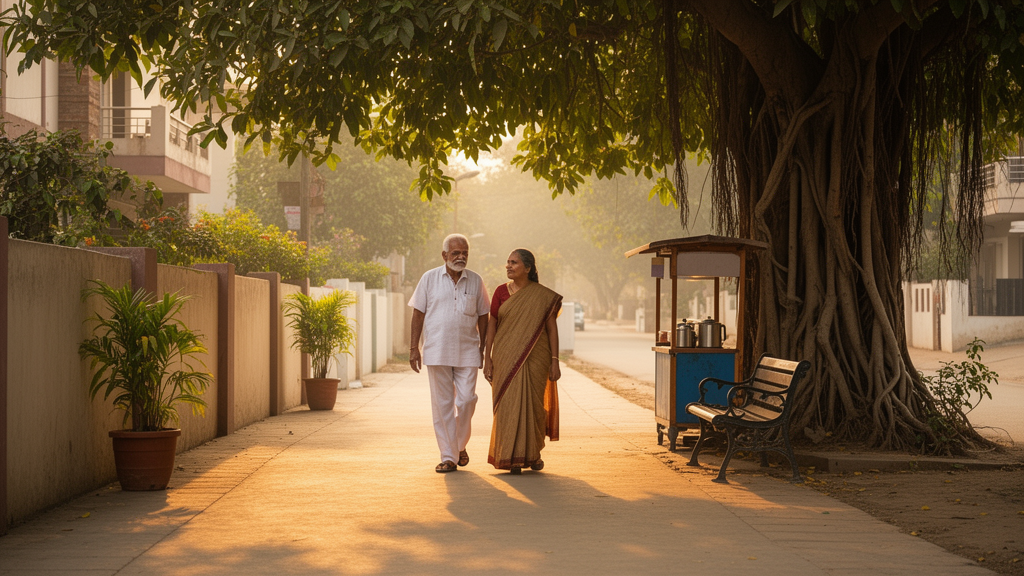
A cross-sectional study of 333 older adults in Udupi District, India, has produced a validated structural model linking how seniors perceive their neighbourhoods to how active, social, and satisfied with life they report being. The research, published open access in the journal City, Territory and Architecture on 16 August 2026, was conducted by Akshatha Rao and Nandineni Rama Devi and addresses a persistent gap: most evidence on walkability and ageing comes from Western, high-income settings, while empirical work on perception-based dimensions of the built environment in developing-country contexts has remained limited.
The study focused on adults aged 60 years and above, a population group whose rapid growth underscores the need for urban environments that support mobility, independence, and well-being. Participants completed a structured, self-administered questionnaire assessing five perceptual dimensions of their surroundings: safety, security, comfort, convenience, and aesthetics, along with their involvement in community engagement programs.
Methodologically, the researchers adopted a positivist paradigm and used Structural Equation Modelling in SmartPLS 4 to test an unusually dense web of relationships: 33 direct hypotheses and three mediating effects. This approach allowed them to examine not only whether each perceptual dimension predicted outcomes such as physical activity, socialization, and quality of life, but also whether those dimensions carried the influence of community engagement programs through to the final outcomes.
The results revealed a differentiated pattern rather than a uniform effect. Community engagement programs significantly enhanced perceived security, comfort, convenience, and aesthetics, but not safety. In other words, participation in local programs appeared to reshape how older adults experienced several qualities of their environment, while their sense of safety remained unaffected.
Comfort emerged as a particularly influential dimension. It positively influenced both increased physical activity levels and increased socialization, and it mediated the relationship between community engagement programs and these two outcomes. This suggests that comfortable streets and public spaces may be one pathway through which community-level initiatives translate into more active and socially connected lives for older residents.
Convenience showed a distinct role: it had a significant positive effect on quality of life and mediated the relationship between community engagement programs and quality of life. Aesthetics, meanwhile, positively affected both increased physical activity levels and increased socialization, indicating that visually appealing surroundings may encourage seniors to walk more and interact more with others.
Safety followed its own trajectory. It did not respond to community engagement programs in this sample, but it did show a significant positive relationship with increased socialization. The separation between safety and security in the model is notable, as the two dimensions behaved differently across the tested pathways, a distinction the authors’ five-factor framework was designed to capture.
The authors present the result as a validated, perception-driven structural model explaining walkability outcomes for older adults. Because the data are cross-sectional and drawn from a single district, the findings are context specific, and the authors themselves describe them as such while arguing that they offer transferable theoretical and practical insights.
The study arrives amid a broader wave of research on age-friendly walkability, including recent work on falls prevention in outdoor public spaces and on how attribute performance relates to pedestrian satisfaction among older adults. As the older adult population grows, models like this one aim to give planners measurable, perception-based targets for building cities where ageing residents can remain mobile, independent, and well.
Subject of Research: How older adults' perceptions of neighbourhood walkability relate to their physical activity, socialization, and quality of life in India
Article Title: Walkability and well-being among older adults: a perception-driven structural model for age-friendly urban planning in India
Article References: Rao, A., & Devi, N. R. (2026). Walkability and well-being among older adults: a perception-driven structural model for age-friendly urban planning in India. City, Territory and Architecture. https://doi.org/10.1186/s40410-026-00322-x
Image Credits: AI Generated
DOI: 10.1186/s40410-026-00322-x
Keywords: walkability, older adults, well-being, urban planning, India, structural equation modelling, age-friendly cities, built environment, quality of life, community engagement, physical activity, socialization
News Source: Denise Maddox. (October 30, 2026). Perceptions of Walkability Shape Well-Being in Older Adults in India. Scienmag.



