


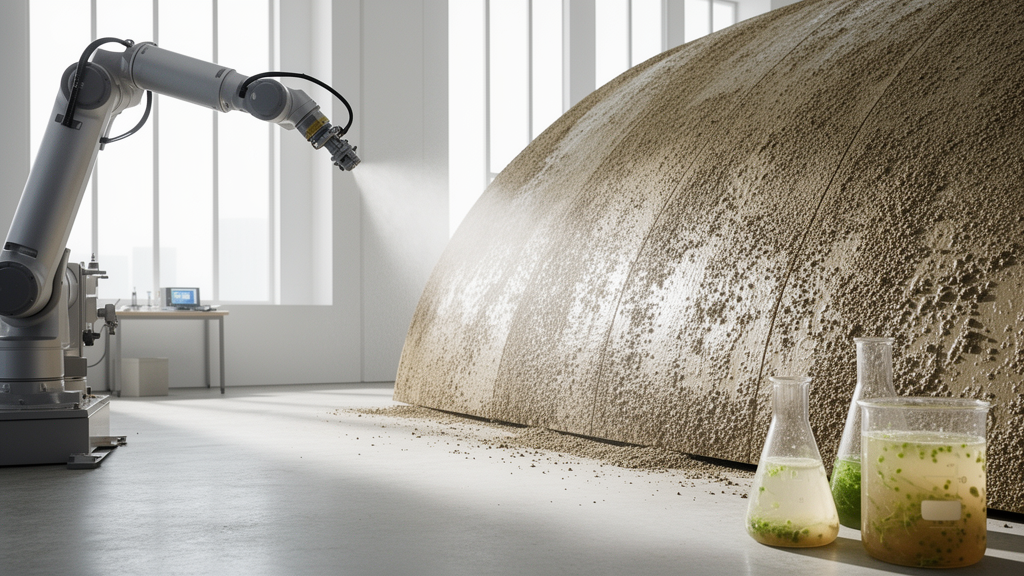
Researchers have developed a robotic fabrication method that sprays living bacteria, cementation solution and sand onto surfaces to grow biocemented architectural material layer by layer. The technique, called Robotic Biocementation Spraying (RBS), was presented in a research article published in the journal Architectural Intelligence on 21 May 2026, and was demonstrated at full scale during the Venice Biennale Architettura 2025, where the system operated autonomously for six months.
The method builds on microbially induced calcium carbonate precipitation, or MICP, a process in which bacteria trigger the formation of calcium carbonate minerals under ambient conditions. In MICP, carbonate ions generated by microbial metabolism react with calcium ions in the surrounding medium, producing mineral that binds loose particles into cohesive solids. The workhorse organism in the study was Sporosarcina pasteurii, a well-studied ureolytic bacterium that induces mineralization through the enzymatic hydrolysis of urea. According to the authors, MICP offers a less energy-intensive alternative to conventionally manufactured binders, and prior research cited in the article estimates that it can reduce the global warming potential of Portland cement by up to 37 percent. The researchers are careful to note that MICP is not inherently zero-carbon and does not match the mechanical performance of conventional concrete, which is why its architectural relevance lies primarily in non-structural applications.
What distinguishes the new work is the coupling of this biological process with robotic precision. The team, led by Karen Antorveza Paez and Benjamin Dillenburger among others, built a custom fabrication platform around a six-axis Universal Robots UR10 arm with a 10-kilogram payload and a 1.3-meter reach. A custom dual-spray end-effector delivers two separate fluid streams: one dispenses the cementation solution, containing 0.5 M calcium chloride and 0.5 M urea supplemented with 0.3 percent xanthan gum, while the other dispenses the bacterial suspension of S. pasteurii. A motorized helical screw feeder supplies sand granules of 0.1 to 0.2 millimeters. Both sprays delivered their solutions at roughly 15 grams per minute, a rate determined through iterative calibration, while the aggregate feed ran at 2 grams per minute. Solenoid valves connected to the robot’s digital output ports synchronized spraying and feeding with the motion of the arm.
The sequencing of the process is inspired by stromatolites, laminated rock structures formed through microbial activity and counted among the earliest examples of life on Earth. Stromatolites grow through successive cycles of carbonate precipitation on decaying microbial mats, in which extracellular polymers create adhesive microenvironments that capture sediments and initiate mineralization. The researchers abstracted this formation logic into a fabrication cycle that alternates between spraying bacterial and cementation agents, depositing and distributing granular material, and allowing a subsequent biocementation phase induced by microbial activity. Through this cyclical sequence, mineral layers gradually accumulate into a cohesive biogenic material.
To characterize the material, the team ran mineral precipitation assays mixing bacterial cells with cementation or xanthan-containing solutions at varying ratios. Mineral mass increased progressively over time, with a pronounced acceleration between 2 and 24 hours, indicating sustained ureolytic activity. Thermogravimetric analysis of the 24-hour precipitates identified two major weight-loss events: one between roughly 150 and 500 degrees Celsius corresponding to organic decomposition, and one between 550 and 800 degrees Celsius associated with carbon dioxide release from calcium carbonate dissociation. Carbon dioxide loss values ranged from 33.85 to 37.86 percent, corresponding to calcium carbonate contents between 76.9 and 86.0 percent. The highest carbonate yield, 86.05 percent, came from a bacterial-to-xanthan solution ratio of 1:3, which was the formulation selected for the large-scale demonstrator. Notably, the differences among the tested ratios remained minimal, suggesting that precipitation efficiency is robust to moderate changes in formulation and that ratio selection can be guided by practical considerations such as reagent cost.
Spatial analysis of sprayed samples showed that robotic deposition logic shapes where the mineral forms. Sampling positions across a representative sprayed geometry, including outer edges, the top crest, inner edges and the base, revealed uniform carbonate deposition with spatial variation within plus or minus 10 to 15 percent, excluding the base accumulation. Slightly higher calcium carbonate contents appeared at the outer and upper regions, attributed to direct spray exposure and atmospheric oxygen, while lower ratios in inner regions reflected reduced spray accessibility caused by geometric complexity. Elevated mineral concentration at the base suggested that flat, horizontal surfaces favor greater deposition through improved liquid retention. According to the authors, this indicates a process-level capacity for encoding mineral gradients through controlled variations in exposure and sequencing.
Mesoscale calibration experiments clarified how fabrication parameters govern geometry. Varying the programmed layer height from 0.4 to 0.8 millimeters produced noticeable differences in slope angle, surface geometry and vertical buildup, with lower layer heights yielding steeper and narrower walls because the wet deposited material consolidated more effectively. Tests with line spacings from 0.5 to 7.5 millimeters showed a clear transition: closely spaced trajectories promoted vertical accumulation into continuous ridges, while wider spacing produced broader, flatter profiles. Interestingly, the programmed total height corresponded most closely to the fabricated geometry at a spacing of 7.5 millimeters. Prototype experiments using toolpaths generated by a differential growth algorithm showed that moderate spacing between 1 and 10 millimeters preserves geometric clarity, whereas excessive pattern density below 0.5 millimeters can blur the intended form as accumulating material partially covers the programmed pattern.
The full-scale demonstrator, exhibited at the Venice Biennale Architettura 2025, measured 1.2 by 0.5 meters and was mounted horizontally on a steel frame inside a closed environment at 22 to 26 degrees Celsius and 45 to 70 percent relative humidity. Toolpaths were generated with a differential growth algorithm implemented in Grasshopper and Kangaroo Physics, producing continuous trajectories with locally varying spacing and curvature. Over roughly six months, the system operated about six hours per day, six days per week, depositing approximately 100 kilograms of sand, 80 liters of cementation solution and 50 liters of bacterial suspension. It produced a growth rate of about 4 centimeters per month, reached a maximum vertical buildup of 24 centimeters in peak regions, and fabricated more than one cubic meter of biocemented material. The demonstrator maintained geometric integrity without failure or cracking, and no visible contamination by other microorganisms was observed, which the authors attribute to the alkaline conditions associated with MICP. The fabrication hardware likewise operated without component replacement or failure. The researchers note that comparable geometries could be achieved under accelerated parameters within approximately two weeks; the extended duration was a curatorial decision highlighting the gradual formation of the material.
The study also documents constraints that only emerged during prolonged operation. Granular feedstock supply was limited by container capacity, pointing to a need for continuous or modular feeding strategies. Prolonged exposure to calcium-rich cementation solutions caused corrosion and wear in metal hardware components, and biopolymer solutions proved susceptible to biological contamination over extended periods, motivating improved storage, filtration or sterilization approaches. Because deposition currently relies primarily on gravity for particle placement, achieving vertical or overhead surfaces will require alternative bonding strategies such as higher-viscosity carriers, modified particle size distributions or increased spray pressure. Long-term bonding strength between biocemented layers and substrate surfaces was not quantified and requires further investigation, and the structural performance of the differentiated surface features was not evaluated in this study.
The authors frame RBS as a programmable biofabrication framework in which microbial mineralization is coordinated through robotic sequencing, extending MICP beyond laboratory and geotechnical contexts toward scalable biogenic surface fabrication. Compared with injection-based MICP, which delivers reagents into soil matrices and generates excess effluent, RBS deposits reagents directly onto surfaces through atomized spraying, where solutions are absorbed locally without liquid runoff. Compared with conventional shotcrete, which delivers a single premixed cementitious material, RBS separates deposition into three independent streams, allowing sequential activation and controlled biomineralization. Future work, the team writes, will focus on linking fabrication parameters to measurable performance indicators including adhesion strength, permeability reduction and durability, extending the system toward vertical and in situ fabrication, and conducting life-cycle assessments to evaluate the ecological performance of RBS relative to conventional binders.
Subject of Research: Robotic spray-based microbial biocementation for fabricating architectural surfaces
Article Title: Robotic biocementation spraying: a bioinspired fabrication method for architectural surfaces
Article References: Antorveza Paez, K., Kindler, R. O., Terzis, D., Lin, C., Coulter, F. B., & Dillenburger, B. (2026). Robotic biocementation spraying: a bioinspired fabrication method for architectural surfaces. Architectural Intelligence, 5(1), Article 11. https://doi.org/10.1007/s44223-026-00120-y
Image Credits: AI Generated
DOI: 10.1007/s44223-026-00120-y
Keywords: MICP, biocementation, robotic fabrication, Sporosarcina pasteurii, calcium carbonate, digital fabrication, architecture, bioinspired design, stromatolites, Venice Biennale, sustainable materials, 3D spraying
News Source: Denise Maddox. (October 30, 2026). Robots spray living bacteria to grow biocemented architectural surfaces. Scienmag.



