


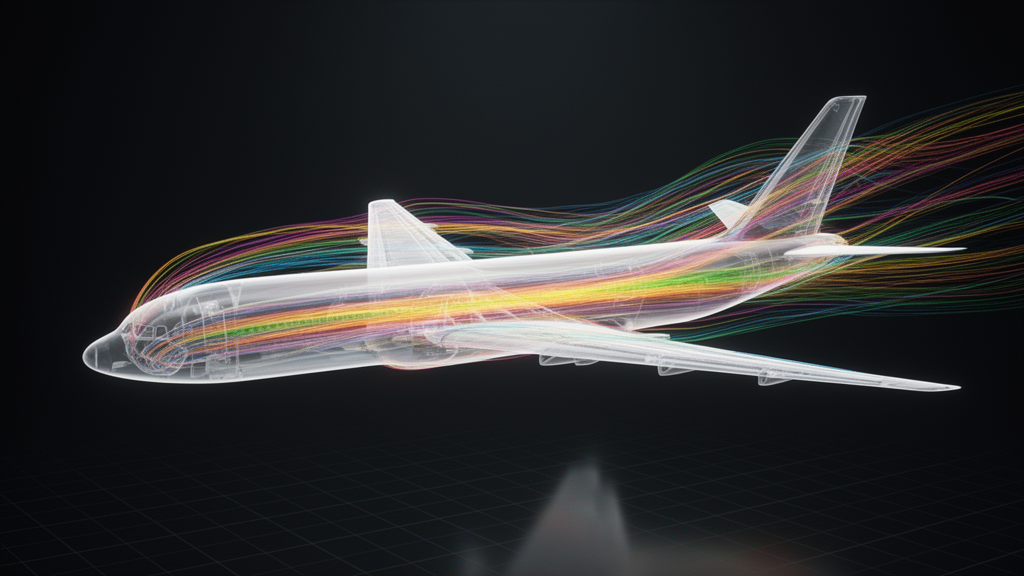
Aircraft wings are shaped by a relentless trade-off between lift, drag and structural stress, and evaluating that trade-off traditionally means running computationally expensive fluid and structural simulations for every design variant. A new open-access study published in Advances in Aerodynamics on 6 May 2026 presents a machine learning framework that replaces much of that burden, predicting both aerodynamic pressure distributions and structural stress fields for varied wing planforms in a fraction of a second.
The study, led by Mehedi Hasan and Zhongmin Deng with Azad Khandoker, uses the ONERA M6 wing as a baseline geometry. Rather than varying flight conditions alone, the researchers varied six planform parameters — sweep, dihedral, twist, and thickness-to-chord ratio at both root and tip — creating a design space in which the wing’s shape itself changes substantially from sample to sample. This focus on geometric variation is what the authors identify as a gap in earlier surrogate modeling work, which mostly addressed changing Mach numbers and angles of attack on a fixed wing shape.
To generate training data, the team parameterized wing geometries using the Class and Shape Transformation method, fitting the baseline ONERA M6 airfoil, a variant of the NACA 0012, with a 12th-order Bernstein polynomial. Latin Hypercube Sampling produced the design samples, and automated Python scripts ran Reynolds-Averaged Navier–Stokes simulations with the SST turbulence model at Mach 0.84 and 3.06 degrees angle of attack, alongside finite element analyses in which the wing was modeled as a solid aluminum body under one-way fluid-structure interaction loads.
A key preprocessing innovation is a parametric mapping grid with 49 spanwise slices and 91 chordwise points, onto which all computational results are interpolated. This standardization means every training sample shares identical spatial locations, so the machine learning models need only learn how loads vary with shape parameters, not how to handle inconsistent meshes. The approach also makes the method independent of the element types used in the underlying simulations.
The framework builds two reduced-order surrogate models from the same shape parameters. For aerodynamic pressure coefficients, Proper Orthogonal Decomposition applied via singular value decomposition captures the dominant modes; the first ten modes were found to represent 99 percent of the total energy in the pressure data. An eXtreme Gradient Boosting regressor chain then learns to predict these modal coefficients from the shape inputs, and inverse decomposition reconstructs the full pressure field. For structural stress, which exhibits complex, nonlinear behavior that defeats a single linear decomposition, the data is first grouped with K-means clustering, and decomposition is applied within each cluster.
The regressor chains are deliberately kept independent for each of the 49 spanwise airfoil slices. The authors explain this choice as a safeguard against cascade error propagation: if one slice’s prediction goes wrong, the error stays isolated rather than amplifying through subsequent slices. They also suggest that single neural network models linking all airfoils may be inherently data-hungry for this reason, though they note this hypothesis requires rigorous testing.
Performance figures are concrete. The pressure coefficient models achieved a maximum mean squared error of 0.05 using only 1,000 training samples, notably fewer than conventional neural network approaches would demand. Stress field predictions reached a maximum mean squared error of 0.10. For lift and drag coefficients, a separate regressor chain kept errors within roughly plus or minus 3 percent for lift and plus or minus 4 percent for drag across randomly selected test samples with varied planforms. Predicted modal shapes for the first four vibration modes matched finite element results with a maximum error of 10 percent.
The comparison between the two reduced-order strategies yielded a clear split. The decomposition-based model outperformed the clustering-based one for aerodynamic pressure prediction, while the clustering-based K-means model handled stress fields better, capturing localized stress concentrations that the linear decomposition missed. Both approaches struggled in the pressure recovery zone, where pressure coefficients change abruptly, and near the outer wing sections — limitations the authors attribute to the difficulty of resolving sharp transitions and fine-grained variations.
Computational savings are the headline benefit. The trained models predict a full pressure distribution in roughly 0.40 seconds and stress plus mode shapes in about 0.15 seconds, placing the approach in the sub-second range alongside other recent surrogate methods while covering a broader range of geometric variation than predecessors limited to fixed shapes or single-parameter changes. The authors caution that the framework does not replace practical testing and evaluation, and that a two-way coupled model accounting for structural deformation during flow simulation remains future work. Still, for preliminary design iterations, where hundreds of candidate wings must be screened quickly, the hybrid decomposition-and-clustering framework offers a demonstrably faster route through the design space.
Subject of Research: Machine learning surrogate models for predicting aerodynamic and structural responses of wing planform shapes.
Article Title: Aero-structural characterization of wing planforms using machine learning
Article References: Hasan, M., Deng, Z., & Khandoker, A. (2026). Aero-structural characterization of wing planforms using machine learning. Advances in Aerodynamics, 8(1), Article 14. https://doi.org/10.1186/s42774-025-00217-4
Image Credits: AI Generated
DOI: 10.1186/s42774-025-00217-4
Keywords: machine learning, wing planform, aerodynamics, structural analysis, CFD, FEA, surrogate models, proper orthogonal decomposition, K-means clustering, ONERA M6, XGBoost, reduced-order modeling
News Source: Blake Davidson. (October 30, 2026). Machine Learning Surrogates Predict Wing Aerodynamics and Stress in Seconds. Scienmag.



