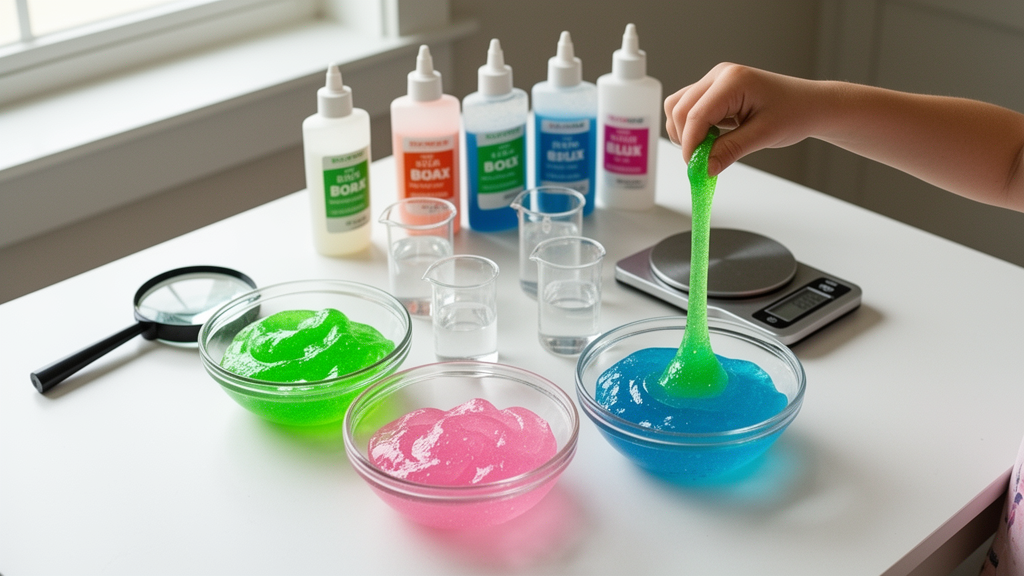
Hydrogel slime toys have quietly become one of the most popular polymer products on the market, spawning start-up companies and entire YouTube channels devoted to the squishy material. But does a twenty-dollar tub of slime actually contain better chemistry than a one-dollar version from a discount store? A new open-access study in Discover Polymers set out to answer that question with laboratory instruments rather than marketing claims, and the results reveal a striking divide between price tiers.
Researchers Stephanie Moreno, Osvaldo Bustamante and David A. Roberson purchased commercially available slime toys at three price points: low-cost products around one dollar, mid-cost products around five dollars, and high-cost products around twenty dollars. The high-cost slimes, De-stress Dough and Pearl Diver, came from PeachyBbies Slime LLC of Texas. The mid-cost slimes, Crystal Clearz and Sugar Cookie, were bought at a local Walmart, while the low-cost slimes, Flarp! and Silly Sludge, came from a Dollar General. The team deliberately chose slimes without additives such as Styrofoam beads so that the base materials could be compared cleanly.
As control materials, the researchers fabricated their own bespoke slimes following a commonly used recipe. White Elmer’s glue, based mainly on polyvinyl acetate (PVA), and clear Elmer’s glue, based mainly on polyvinyl alcohol (PVAOH), were each crosslinked with 20 Mule Team Borax dissolved in water. Two additional versions incorporated one milliliter of glycerol, a plasticizer, making up 1.25 percent by volume of the mixture. This gave the team four known-composition hydrogels against which the commercial products could be benchmarked.
The analytical toolkit combined four techniques. Dynamic mechanical analysis (DMA) in compression mode, run from minus 40 degrees Celsius to 30 degrees Celsius with liquid nitrogen, probed the viscoelastic behavior and glass transition temperatures of the gels. Fourier-transform infrared spectroscopy in attenuated total reflectance mode (FTIR-ATR) identified chemical functional groups. A reverse swelling test, in which samples were dried for 48 hours at 50 degrees Celsius, quantified water content. Finally, sessile drop contact angle measurements with water and glycerol, analyzed according to the ASTM D7490 standard, yielded surface energy values.
The water content results immediately undermined any simple price-based narrative. The bespoke PVAOH hydrogel held the most water of all samples tested. Among the commercial slimes, the low-cost Silly Sludge actually possessed the highest water content at 92.65 percent, with a swelling value of 13.6, while the mid-cost Sugar Cookie had the lowest at 63.0 percent and a swelling value of 2.7. The two high-cost slimes were similar to each other, with Pearl Diver at 82.1 percent and De-Stress Dough at 80.0 percent water. The authors explicitly note that the swelling analysis did not reveal a discernible trend between price point and water content.
The chemistry told a clearer story. FTIR-ATR analysis of dehydrated specimens, processed with a custom Python peak-detection script, showed that the high-cost slimes closely matched the bespoke controls. Pearl Diver aligned with PVA, sharing characteristic peaks including a carbon-oxygen double bond stretch at 1733 per centimeter, while De-stress Dough matched PVAOH and displayed peaks consistent with the inclusion of glycerol as a plasticizer. In other words, the premium products appear to be formulated much like well-made homemade slime from glue and Borax.
As the price dropped, the chemistry diverged. Mid-cost Crystal Clearz shared many peaks with PVAOH, but lacked the carbon-oxygen stretching peaks between 1715 and 1735 per centimeter, suggesting that a crosslinking agent other than Borax was used. Sugar Cookie showed essentially no matching peaks with PVA or PVAOH; software identification indicated it is composed of polyethylene glycol stearate, making it a non-olefinic material. The low-cost slimes, Flarp! and Silly Sludge, were also found to be non-olefinic. In their hydrated state, both were identified as chemically similar to a glycerin-based personal lubricant made from water, glycerin and hydroxyethylcellulose, the same class of material used in products such as K-Y Jelly.
The mechanical measurements added further differentiation. Sugar Cookie was the standout outlier, exhibiting the highest dampening capacity with a maximum tan delta of 3.5 and the only glass transition temperature above freezing, measured at 22.1 degrees Celsius via storage modulus decline. Every other slime’s glass transition fell below the freezing point of water, with Crystal Clearz showing the lowest at minus 21.4 degrees Celsius. Pearl Diver and Flarp! had the lowest dampening ability among the commercial slimes, with maximum tan delta values of 0.8 and 0.9 respectively. The authors caution that the sticky, low-viscosity nature of the hydrogels made DMA testing difficult and the curves noisy, though key parameters remained interpretable.
Surface energy measurements produced some of the most unexpected findings. All hydrogels showed contact angles below 90 degrees, confirming hydrophilicity. De-stress Dough registered the highest total and most polar surface energy at 157.23 millinewtons per meter, and was anecdotally the stickiest toy tested, while Crystal Clearz had a nearly negligible dispersive component of 0.01 millinewtons per meter. For the most part, slimes with higher surface energy had lower water content, and the authors infer that other ingredients, particularly additives, can dominate the surface energy of the material system, especially when water content is low. They also note a methodological caveat: published polar and dispersive components for the test liquids vary within accepted ranges, and using an alternative set raised the calculated surface energy of De-Stress Dough to 192.47 millinewtons per meter, highlighting how sensitive such measurements can be.
Taken together, the study shows that price in the slime market tracks chemical sophistication in a directional but imperfect way. High-cost slimes closely resemble bespoke glue-and-Borax hydrogels, mid-cost products diverge with alternative crosslinkers or entirely different polymer bases, and low-cost slimes abandon olefinic chemistry altogether in favor of a lubricant-like formulation. The authors emphasize that knowledge of these compositions is of growing importance as attention to the safety of hydrogel slime toys increases, and they acknowledge limitations of their scope, noting that factors such as packaging quality or toy accessories were not considered. What the instruments reveal, however, is that the humble tub of slime is a genuinely varied family of polymer materials, and the label price is only a rough guide to what is actually inside.
Subject of Research: Comparative materials characterization of commercial and homemade hydrogel slime toys
Article Title: Comparative materials characterization of commercially available and bespoke hydrogel slime toys
Article References: Moreno, S., Bustamante, O., & Roberson, D. A. (2026). Comparative materials characterization of commercially available and bespoke hydrogel slime toys. Discover Polymers, 3(1), Article 14. https://doi.org/10.1007/s44347-026-00053-9
Image Credits: AI Generated
DOI: 10.1007/s44347-026-00053-9
Keywords: hydrogel, slime toys, polyvinyl alcohol, polyvinyl acetate, FTIR spectroscopy, dynamic mechanical analysis, surface energy, water content, polymers, Borax crosslinking, materials characterization, consumer products
News Source: Bethany Barker. (October 30, 2026). Slime Toys Decoded: Chemistry and Mechanics Reveal What Price Really Buys. Scienmag.