


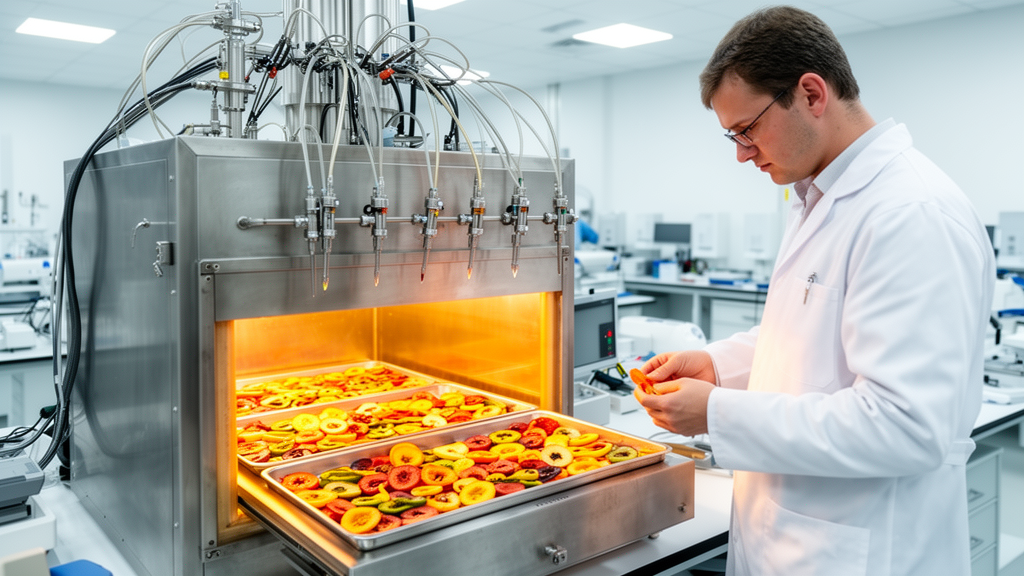
Drying is one of humanity’s oldest food preservation techniques, yet it remains one of the most demanding. Removing water slows the microbial and enzymatic reactions that spoil food, but the method used determines how much of a product’s original quality survives the process. Low-temperature approaches such as freeze-drying preserve delicate compounds but take a long time, while high-temperature drying is faster yet can degrade vitamins, pigments and antioxidants. A review published in Discover Chemical Engineering argues that a technology better known from pasteurization and sterilization—ohmic heating—could help the food industry escape this trade-off by treating foods with electricity before they ever enter a dryer.
Ohmic heating works on a deceptively simple principle. The food itself is placed between two electrodes and acts as an electrical resistor. When an alternating current passes through the material, the food’s intrinsic resistance generates heat through the Joule effect, described by the relationship Q = I²Rt, where Q is the heat produced, I the current, R the electrical resistance and t the duration of application. Because heat is generated volumetrically inside the matrix rather than conducted inward from a hot surface, the food warms rapidly and uniformly. The underlying dynamics follow Ohm’s law, V = IR, linking voltage, current and resistance. The authors emphasize that this law is not merely a description of heat generation but a tool for designing and controlling industrial processes.
The efficiency of ohmic heating depends heavily on the food’s electrical conductivity, which in turn reflects its composition—water, salt, sugar and other solutes—along with temperature and physical structure. Foods with conductivities between roughly 0.1 and 10 S·m⁻¹ can be heated effectively by the method. Typical applied voltages range from 400 to 4000 V, with electric field intensities of 20 to 400 V·cm⁻¹ when electrode gaps of 10 to 50 cm are used. Systems can run in batch mode or continuously, with electrodes in direct contact with the food or coupled through a conductive medium. Heating rates vary with the power source, equipment design and product properties such as conductivity, viscosity and specific heat capacity.
The review’s central argument concerns what happens when ohmic heating is applied as a pre-treatment before conventional drying. In ordinary hot-air drying, water vapor inside plant cells builds up enough pressure to rupture tissue and release moisture. When the tissue has already been exposed to an electric current, an effect called electroporation has already damaged cell membranes, opening channels for ionic movement and exposing membrane surfaces and macromolecules that were previously inaccessible. The review notes that larger cells become vulnerable to electroporation at lower temperatures than smaller ones, and that membrane permeability can change below the temperature at which thermal effects alone would permeabilize them. This pre-damaged structure lets water vapor escape at milder temperatures, shortening the drying stage that follows.
The evidence for accelerated drying comes from several experimental studies surveyed in the review. Work on sweet potatoes showed that ohmic pre-treatment reduced drying time, which the authors linked to better preservation of food quality and significant energy savings. Ohmic treatment also produced higher evaporation rates than microwave pre-treatment in comparative testing, with frequency appearing to play a role: lower alternating-current frequencies enhanced water diffusion through cell membranes to a greater extent, an observation also reported in ohmic pre-treated grapes and in fruit juice studies. One study found a linear relationship between electric field values and mass transfer. Not every result was straightforwardly positive, however. In potatoes treated ohmically, final moisture content was sometimes higher than in untreated controls, a outcome attributed to starch gelatinization hindering mass transfer during drying.
Energy figures from related applications illustrate the technology’s potential. In a comparison using raw sheep milk, ohmic pasteurization at electric field strengths of 8.33 and 5.83 V/cm consumed 72 to 73 percent less energy than conventional pasteurization, which required 515 kJ. In tomato and juice processing, appertization demanded 156 kWh per ton of product, while the ohmic line used 102 kWh per ton less—a 65 percent reduction—with energy efficiency of 77 percent versus 25 percent. In milk evaporation, an ohmic-assisted process reduced total processing time from 41 to 31 minutes and cut energy consumption from roughly 421 kJ to between 231 and 277 kJ. For drying itself, conventional thermal drying of orange and grapefruit consumed approximately 3.5 to 5 times more energy than ohmic drying, and ohmic systems have reported energy efficiencies of 94.2 percent against 24.7 percent for microwave heating, with one study recording overall efficiency near 85 percent.
Quality effects extend beyond speed. Because shorter drying limits the food’s exposure to heat, bioactive compounds fare better in some cases. Apple snacks pre-treated with ohmic heating showed higher folic acid content after drying than controls; the researchers attributed this to electroporation promoting migration of the vitamin within cells, with concentration rising further as water was lost without degradation. A broader review of the literature divided findings into two groups: ohmic heating can reduce bioactive compounds through thermal effects, or increase their measured content because electroporation enhances extractability. Heat-sensitive compounds such as vitamins and polyphenols remain vulnerable at elevated temperatures, so parameter selection—temperature and exposure time—matters greatly. Texture outcomes are similarly mixed. Ohmic treatment reduced the firmness of dehydrated strawberries, with higher electric fields causing significant softening through membrane and cell wall damage; processing under vacuum, allowing osmotic solution to fill air pockets, was proposed as a mitigation.
Enzyme inactivation represents another dimension of the technology. Enzymes such as polyphenol oxidase, lipoxygenase and phosphatase, which contain metal prosthetic groups, experience non-thermal electrical effects during ohmic processing that lead to greater degradation than conventional heating alone. In one study, apples treated ohmically at 50 °C showed no recovery of polyphenol oxidase activity during four weeks of storage, an important result for preventing browning and spoilage. The mechanism involves both thermal denaturation and molecular movement induced by the oscillating electric field, alongside frictional energy dissipation. Compared with other pre-treatments, the review positions ohmic heating favorably: in purple-fleshed potatoes, increasing ohmic voltage and treatment time raised total phenolic compounds and antioxidant activity, while longer ultrasound application reduced them. In blueberries, ohmic pre-treatment shortened dehydration time, and combining osmotic dehydration with ohmic heating reached final moisture in 22.5 hours, versus 45 to 54 hours for osmotic dehydration with pulsed vacuum.
None of this makes ohmic heating a simple industrial proposition, and the review is candid about the obstacles. Heating uniformity depends on electrode configuration, field intensity and food conductivity; in solid foods the relationship between temperature and conductivity is not linear, and the physical form of a product—whole, peeled or cubed—along with current frequency can shift how heat distributes. Processing at lower electric fields can help temperatures balance across the medium. Scaling up demands substantial investment in specialized equipment, electrical infrastructure and control systems, alongside stringent electrical safety compliance, operator training, regulatory navigation and integration with existing production lines. Laboratory equipment used to characterize electrical properties differs from commercial systems, which are configured to distribute heat better and suppress bubble formation through pressurization. The authors conclude that ohmic heating is a promising, energy-efficient route to faster drying and higher-quality dehydrated foods, but that realizing its industrial potential requires careful, product-specific balancing of gains against costs and engineering challenges.
Subject of Research: Ohmic heating as a pre-treatment to improve the efficiency and quality of food drying
Article Title: Ohmic heating: an eco-efficiency approach to improve food drying quality
Article References: Azevedo, P. Z., Rigolon, T. C. B., Horta, G. O., de Souza, B. R., Wischral, D., de Araujo Bezerra, J., Stringheta, P. C., Campelo, P. H., & Martins, E. (2026). Ohmic heating: an eco-efficiency approach to improve food drying quality. Discover Chemical Engineering, 6(1), Article 32. https://doi.org/10.1007/s43938-025-00100-0
Image Credits: AI Generated
DOI: 10.1007/s43938-025-00100-0
Keywords: ohmic heating, food drying, electroporation, energy efficiency, food quality, bioactive compounds, drying kinetics, food texture, enzyme inactivation, food processing, pre-treatment, sustainable technology
News Source: Denise Maddox. (October 30, 2026). Ohmic heating could make dried foods faster, greener and more nutritious. Scienmag.



