


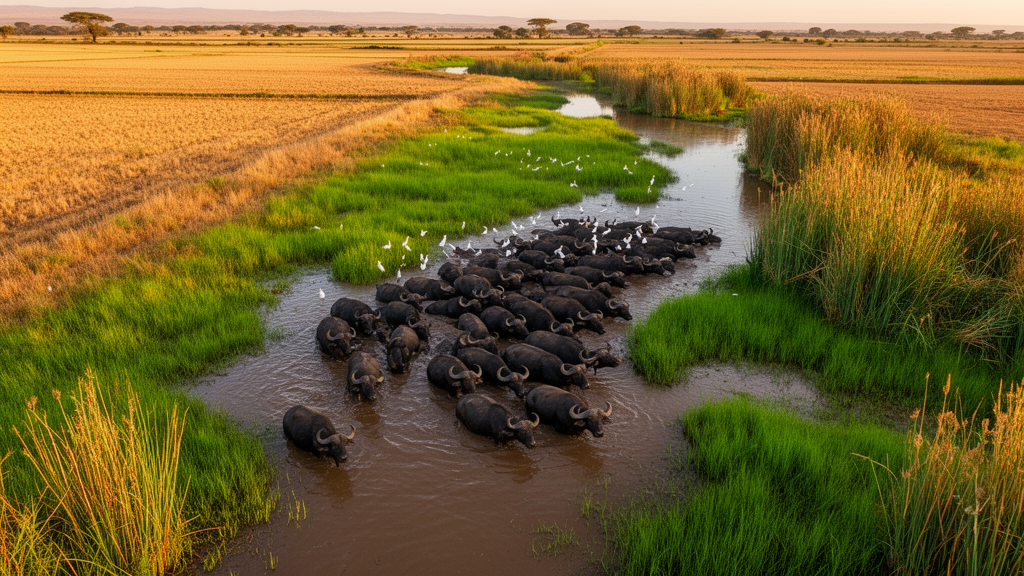
A two-year field survey of African buffalo in Ethiopia’s Gambella National Park has produced one of the most detailed ecological baselines yet for the species in the Horn of Africa, and its findings carry a double edge. Researchers estimate that roughly 4,600 buffalo roam the park, a population showing female-biased sex ratios and steady juvenile recruitment. Yet the same animals are crowding into a shrinking set of permanent wetlands and forest patches each dry season, a pattern the authors describe as a warning sign of underlying ecological vulnerability even while headline numbers appear stable.
The study, led by Bol Puoch Deng and colleagues and published in BMC Ecology and Evolution, ran across wet and dry seasons from 2022 to 2023. Field teams laid out 35 line transects stratified across four habitat types: open savanna grassland, wooded grassland, forestland, and wetland matrices. Thirty transects covered the first three strata and five crossed the interior forests. Observers walked or drove each line during early morning and late afternoon windows, when buffalo are most visible, recording herd sizes, GPS coordinates, and perpendicular distances to each group using laser rangefinders accurate to within a metre.
Over the course of the monitoring, fieldwork yielded 399 independent herd encounters. Detection probabilities ranged from 0.78 to 0.84, which the authors interpret as high and uniform efficiency across habitat strata. The population abundance estimates totalled 4,606 ± 3,335 individuals in 2022 and 4,584 ± 3,053 in 2023, while a pooled model across both years produced an estimate of 5,602 individuals, corresponding to a mean landscape density of 1.22 individuals per square kilometre. The very wide confidence intervals, which in the pooled model stretch from roughly 2,100 to 11,100 animals, reflect a well-known difficulty in distance sampling: buffalo form large, clustered herds rather than spreading evenly, so variance inflates naturally. The authors stress that raw counts captured only a fraction of the true population, which is precisely why the detection correction matters.
Within the core monitoring zones, seasonal density estimates were far more precise. A half-normal detection model fitted the Year I wet-season data best, yielding a core density of 8.1 individuals per square kilometre and about 1,010 animals; the dry-season hazard-rate model gave 7.7 per square kilometre and 960 animals. Year II figures were similar, at 8.4 and 7.9 individuals per square kilometre in wet and dry seasons respectively. Taken together, the core population fluctuated within a narrow band of roughly 960 to 1,040 individuals, which the researchers read as a remarkably stable footprint over the study period.
Demographic structure reinforced that impression of stability. The adult sex ratio stayed female-biased throughout, ranging from 0.74:1.00 to 0.98:1.00, a pattern consistent with savanna ungulate life histories in which adult males suffer higher mortality outside breeding herds. Calf-to-juvenile recruitment ratios held steady between 0.46:1.00 and 0.53:1.00 across all seasonal blocks, which the authors interpret as robust juvenile survival and steady reproductive input. Herd organisation, however, shifted dramatically with the seasons. Mean group size expanded from about 66 individuals in the wet season to 97 in the dry season, a highly significant change, as smaller sub-herds that had scattered across rejuvenated upland grazing grounds merged into large aggregations around reliable water.
That spatial contraction is where the vulnerability emerges. Seasonal shifts in habitat use were statistically significant (χ²(3) = 26.17, p < 0.001), and the direction of the shift was unambiguous. During the wet season, buffalo dispersed widely, using permanent wetlands at 29.99 percent and open savanna grasslands at 27.98 percent relative utilization. As the dry season advanced, savanna use fell by more than half to 12.59 percent, while occupancy of closed-canopy forestland rose to 26.16 percent, and permanent wetlands remained the single most heavily used zone at 31.15 percent. Logistic regression models showed that buffalo occurrence correlated positively with forest canopy cover (odds ratios of 1.036 to 1.038), declined with distance from water, and dropped near human settlements (OR = 0.78, p = 0.01). In practical terms, for every kilometre closer a plot sits to a settlement boundary, the odds of finding buffalo fall by about 22 percent, a result the authors link to the Risk-Disturbance Hypothesis, under which animals treat human presence as a predation-like threat.
Feeding ecology told a complementary story. Combining micro-histological analysis of 100 faecal samples per season with leftover-forage inspections along active grazing paths, the team identified eleven primary grass species in the diet, dominated by Urochloa mosambicensis, followed by Ischaemum fasciculatum and Panicum maximum. Crucially, diet composition showed no significant seasonal variation (χ²(10) = 4.87, p = 0.898), and the two independent dietary methods agreed with each other. Rather than switching what they eat when upland grasses lignify and lose crude protein, the buffalo change where they stand, moving into wetland zones where hydrophytic grasses such as Ischaemum fasciculatum retain moisture and nutrition long after surrounding savanna has cured. This aligns with Optimal Foraging Theory, the framework the authors use to explain how large bulk grazers adjust landscape use to maximise energy intake while limiting travel costs.
Daytime behaviour proved equally resistant to seasonal change. Using instantaneous scan sampling at 15-minute intervals from dawn to dusk, observers recorded a bimodal feeding rhythm, with grazing concentrated in the cooler early morning and late afternoon and resting and mud-wallowing peaking at midday as a thermoregulatory strategy. Feeding accounted for roughly 30 percent of the daytime budget in both seasons (30.20 percent wet, 30.87 percent dry), and the overall activity allocation did not differ significantly between seasons (χ²(8) = 6.22, p = 0.623). The authors suggest this behavioural stability is itself a product of the wetland-forest mosaic: because herds stay close to permanent water, they do not need to extend travel time during the dry season, preserving energy that animals in more degraded landscapes must spend searching for resources.
The context surrounding Gambella National Park sharpens the study’s conservation message. Gazetted in 1973 and covering roughly 4,575 square kilometres of lowland plain in southwestern Ethiopia, the park sits within a transboundary savanna complex shared with South Sudan. It faces illegal livestock incursions, with domestic cattle densities averaging around 18.4 animals per square kilometre inside core boundaries; smallholder agricultural expansion along the eastern edge, driving an estimated 1.2 percent annual loss of core savanna habitat; and human-ignited dry-season fires that affect up to 45 percent of open grasslands each year. Against this backdrop, the compression of buffalo into a handful of wetland and forest refugia each dry season concentrates risk: if those zones degrade, or if migration corridors are severed, the population’s short-term stability could erode quickly.
The authors translate their findings into four management proposals: a zoned hydrological protection framework centred on the permanent wetlands, with strict limits on cattle grazing; intelligence-led anti-poaching patrols redeployed to the wetland and riverine-forest coordinates where buffalo aggregate from November to April; a community-managed buffer corridor along the eastern periphery to constrain further agricultural conversion; and a long-term forage-quality monitoring programme tracking crude protein and fibre in dominant grasses to anticipate nutritional bottlenecks before they become demographic ones. For now, the study establishes that Gambella remains an important refuge for African buffalo in a region where empirical data on the species have long been sparse, and it demonstrates that a population can look demographically healthy on paper while its seasonal safety margin quietly narrows.
Subject of Research: Population structure, habitat use, diet, and daytime activity of African buffalo in Gambella National Park, Ethiopia
Article Title: African buffalo in focus: population structure, habitat use, and systematic behaviour in Ethiopia (Gambella National Park)
Article References: Deng, B. P., Takele, S., Rolkier, G. G., Shibru, S., & Barnabas, J. (2026). African buffalo in focus: population structure, habitat use, and systematic behaviour in Ethiopia (Gambella National Park). BMC Ecology and Evolution, 26(1), Article 82. https://doi.org/10.1186/s12862-026-02589-7
Image Credits: AI Generated
DOI: 10.1186/s12862-026-02589-7
Keywords: African buffalo, Gambella National Park, Ethiopia, distance sampling, habitat selection, wetland refugia, dry season, diet composition, activity budgets, human-wildlife conflict, conservation, Syncerus caffer
News Source: Margaret Porter. (October 30, 2026). Ethiopian buffalo census reveals stable herds squeezed into shrinking wetlands. Scienmag.



