


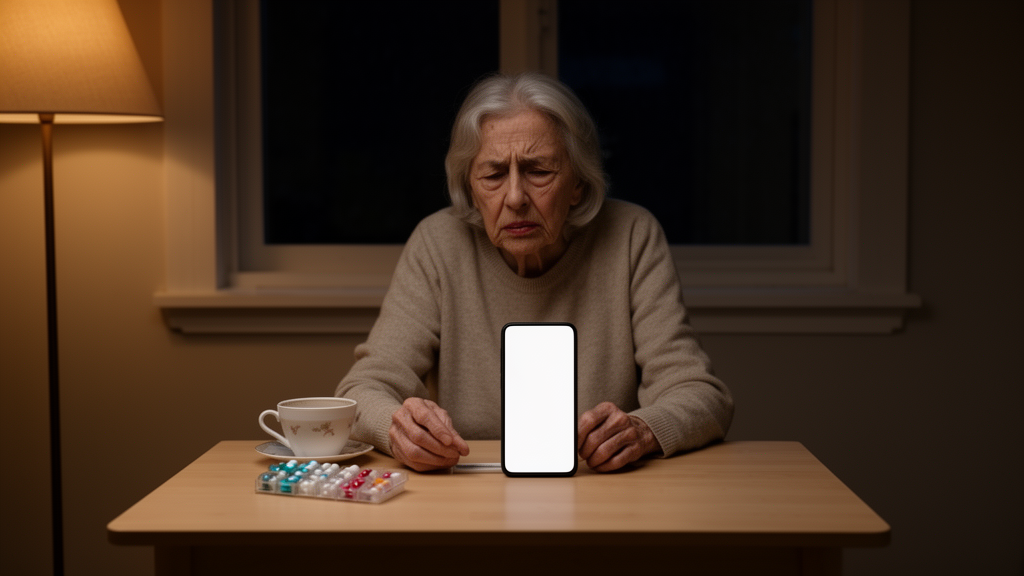
Older adults who cannot get online appear to follow a distinctly worse long-term path of mental and physical health than internet users, according to a new analysis of two large national longitudinal studies, one from China and one from the United Kingdom.
The researchers set out to map how depression and self-rated health develop together over time, and to see whether digital exclusion is associated with particular patterns of that joint development.
Methodologically, the team used parallel process latent class growth analysis, a statistical technique that models two changing outcomes simultaneously and groups people according to shared long-term trajectories. Multifactorial regression analyses were then used to test how digital exclusion related to membership of each trajectory group.
In the Chinese data, four joint trajectories emerged. A medium starting point stable group accounted for 44.7 percent of participants, a low starting point health improvement group for 16.4 percent, a high starting point growth group for 30.6 percent, and an ultra-high starting point growth group for 8.2 percent. The growth groups, as their labels indicate, describe participants whose depression and poor self-rated health worsened over the follow-up period.
Using the ultra-high starting point growth group as the reference category, the CHARLS regression analysis showed that participants who experienced digital exclusion had higher depressive symptom scores and poorer self-rated health than internet users, and were more likely to belong to the ultra-high starting point growth group. In other words, being offline was associated with the most adverse joint pattern of mental and self-rated health in the Chinese sample.
The English data produced a somewhat simpler picture, with three joint trajectories: a high starting point growth group comprising 11.4 percent of participants, a medium starting point growth group at 38.9 percent, and a low starting point stable group at 49.7 percent. With the low starting point stable group as the reference, digitally excluded participants in ELSA were more likely to be classified into both the high starting point growth group and the medium starting point growth group. The researchers note that the ELSA regression results are similar to those from CHARLS.
Taken together, the findings suggest that depression and self-rated health do not simply track one another in a single uniform way, but follow several distinct joint developmental trajectories, some of which worsen with age. The consistency of the digital exclusion association across two countries with very different social and healthcare contexts is one of the study’s notable features, although the two cohorts covered different time windows and produced different numbers of trajectory classes.
The authors are careful about what the data can and cannot show. Because the studies are observational, causal effects cannot be inferred: it is possible that poorer health or depression itself makes internet use harder, that shared underlying factors influence both connectivity and health, or that the relationship runs in both directions. The analysis also relies on self-reported measures, including self-rated health, and covers adults aged 45 and over in two specific countries, so the results may not generalise to other populations.
Nevertheless, the researchers conclude that digital inclusion may be a promising component of strategies to support mental health and self-rated health in middle-aged and older adults.
Subject of Research: Associations between digital exclusion and joint trajectories of depression and self-rated health in middle-aged and older adults in China and the United Kingdom.
Article Title: Associations of digital exclusion with joint trajectories of depression and self-rated health: evidence from two prospective longitudinal studies
Article References: Yang, X., Yang, Q., Wang, Z., Zhao, T., Liu, X., & Liu, R. (2026). Associations of digital exclusion with joint trajectories of depression and self-rated health: evidence from two prospective longitudinal studies. BMC Public Health. https://doi.org/10.1186/s12889-026-30054-z
Image Credits: AI Generated
DOI: 10.1186/s12889-026-30054-z
Keywords: digital exclusion, depression, self-rated health, CHARLS, ELSA, longitudinal study, older adults, latent class growth analysis, public health, China, United Kingdom, mental health
News Source: Glenn Wilkins. (October 29, 2026). Digital exclusion linked to worsening depression and health trajectories in older adults. Scienmag.



