


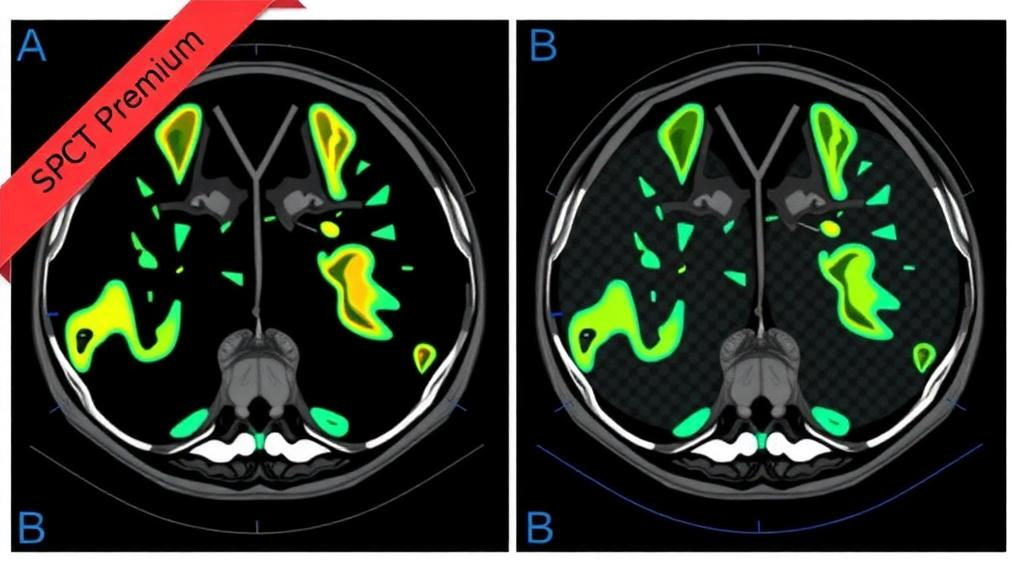
Quantitative post-therapy SPECT/CT imaging is increasingly used to derive total tumour volume (TTV) and total lesion activity (TLA), two measures that have emerged as potential early biomarkers of response to lutetium-177 PSMA-I&T, a radioligand therapy combining an imaging and therapeutic agent. A new study published in EJNMMI Physics has now examined a practical question that could shape how these biomarkers are used in the clinic: how reliably can different readers, working independently, reproduce the same longitudinal TTV and TLA measurements when they segment lesions using different methods?
The research team analysed post-therapy scans from six patients who each underwent four cycles of Lu-177 PSMA-I&T therapy. SPECT/CT images were acquired approximately 19 hours, plus or minus one hour, after each cycle on a Spectrum Dynamics Veriton 200 system, yielding 24 post-therapy scans in total. Three expert readers independently analysed every scan, allowing the investigators to quantify how much of the variability in the measurements came from the readers themselves rather than from the imaging or the disease.
Two fundamentally different segmentation strategies were compared. In the gradient-based approach, readers visually identified lesions and delineated them with the help of an edge-detection algorithm, a method that depends heavily on individual judgement about where a tumour ends. The threshold-based approach, by contrast, applied fixed standardised uptake value thresholds normalised to lean body mass, set at 2, 3, 4, 6, 8, and 10, after which readers excluded regions of physiological uptake using the LesionID tool from MIM Software. Segmentation time was recorded for every scan, and agreement was assessed with intraclass correlation coefficients using absolute agreement, alongside a longitudinal reproducibility metric called the minimal detectable change, derived from between-cycle changes in TTV and TLA.
The timing results alone reveal a striking practical difference. Gradient-based segmentation required a median of 4.8 minutes per scan, with an interquartile range spanning 2.5 to 10.6 minutes, reflecting how much the workload varied from case to case.
Reproducibility told an even sharper story. Gradient-based TTV showed only moderate interobserver agreement, with an intraclass correlation coefficient of 0.57, and a minimal detectable change of 78.3 percent. In practical terms, that means a tumour volume would have to change by more than three-quarters between cycles before readers could be confident the change was real rather than a product of measurement variability. Gradient-based TLA fared considerably better, achieving excellent agreement with an intraclass correlation coefficient of 0.92 and a minimal detectable change of 50.9 percent, though this still represents a substantial threshold for detecting smaller longitudinal changes.
The threshold-based approaches were in a different league altogether. Across all six SUV thresholds tested, interobserver agreement was near-perfect, with intraclass correlation coefficients of approximately 1.0. The minimal detectable change values collapsed to between 0.1 and 6.8 percent for TTV and between 0.1 and 4.6 percent for TLA, orders of magnitude lower than the gradient-based figures.
The study also examined how the two methods related to each other. Threshold-based TLA showed moderate correlation with gradient-based TLA at the lower thresholds of 2 through 6, and strong correlation at the higher thresholds of 8 and 10. This pattern indicates that the choice of threshold affects how closely threshold-derived measurements align with gradient-based delineations, with stronger correlation observed at the higher thresholds of 8 and 10.
The authors conclude that gradient-based TLA assessment shows higher reproducibility than gradient-based TTV for longitudinal response evaluation on post-therapy Lu-177 PSMA-I&T SPECT/CT, but that the high minimal detectable change of gradient-based TTV limits its sensitivity to smaller longitudinal changes. Threshold-based segmentation, by contrast, provided a faster and more reproducible approach with substantially lower minimal detectable change values. Importantly, the team notes that further validation is required to determine the optimal SUV threshold and to establish whether these volumetric and activity measurements translate into clinically meaningful predictions of patient outcome.
Subject of Research: Interobserver reproducibility of segmentation methods for measuring tumour volume and activity on post-therapy Lu-177 PSMA-I&T SPECT/CT
Article Title: Interobserver agreement of gradient-based and threshold-based segmentation for longitudinal TTV and TLA on post-therapy \(\mathrm {[^{177}Lu]}\) Lu-PSMA-I&T SPECT/CT
Article References: Nuttens, V., Ooms, D., Vermeulen, S., De Bondt, P., De Winter, O., & Koole, M. (2026). Interobserver agreement of gradient-based and threshold-based segmentation for longitudinal TTV and TLA on post-therapy $$\mathrm {[^{177}Lu]}$$ Lu-PSMA-I&T SPECT/CT. EJNMMI Physics. https://doi.org/10.1186/s40658-026-00936-7
Image Credits: AI Generated
DOI: 10.1186/s40658-026-00936-7
Keywords: Lu-177 PSMA-I&T, SPECT/CT, segmentation, total tumour volume, total lesion activity, interobserver agreement, quantitative imaging, SUV thresholds, reproducibility, radiomics, prostate cancer, nuclear medicine
News Source: Nathaniel Bowman. (October 29, 2026). Threshold-Based Segmentation Outperforms Gradient Methods for Tracking Tumour Volume on Lu-177 PSMA SPECT/CT. Scienmag.



